
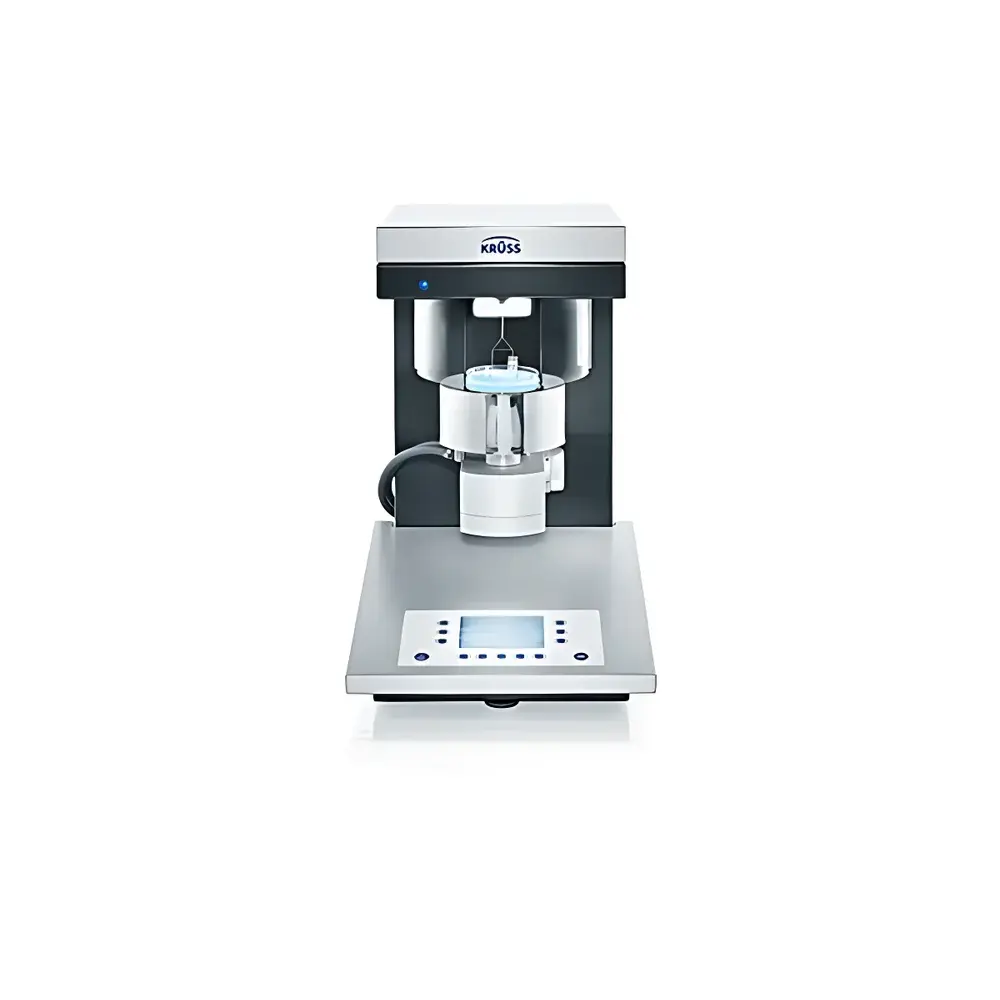
Krüss K20 Force-Based Surface Tensiometer
| Brand | Krüss |
|---|---|
| Origin | Germany |
| Model | K20 |
| Maximum Load Capacity | 50 g |
| Resolution | 100 µg |
| Measurement Frequency | 5 Hz |
| Sample Stage Travel Distance | 90 mm |
| Sample Stage Speed | 2.4–14 mm/min |
| Temperature Control Range | –10 to 130 °C (with optional jacket) |
| Surface/Interfacial Tension Range | 1–999 mN/m |
| Tension Resolution | 0.01 mN/m |
| Liquid Density Range | 1–2200 kg/m³ |
| Density Resolution | 1 kg/m³ |
| Measurement Methods | Du Noüy Ring, Wilhelmy Plate, Rod, and Ring Detachment (ASTM D971) |
Overview
The Krüss K20 Force-Based Surface Tensiometer is a precision-engineered semi-automatic instrument designed for the accurate and reproducible determination of surface tension and interfacial tension using classical force-balance principles. It operates on the fundamental physical principle that the force exerted on a solid probe—such as a platinum ring or plate—immersed in or withdrawn from a liquid interface is directly proportional to the interfacial energy per unit length (mN/m). This method conforms to internationally recognized standards including ISO 1409, ISO 6295, ASTM D971 (for transformer oil analysis), and ASTM D1331 (for interfacial tension of surfactant solutions). The K20 integrates a high-stability electromagnetic force transducer with sub-microgram resolution (100 µg), enabling robust static and dynamic measurements under controlled thermal conditions. Its modular architecture supports both routine QC workflows and method development in regulated environments, making it suitable for laboratories requiring traceable, auditable, and GLP-compliant tensiometric data.
Key Features
- High-precision electromagnetic balance with 100 µg resolution and 50 g maximum load capacity
- Semi-automatic motorized sample stage with adjustable speed (2.4–14 mm/min) and 90 mm vertical travel
- Integrated magnetic shielding and removable magnetic snap-on draft shield for vibration- and airflow-insensitive operation
- Optional temperature-controlled jacket enabling operation from –10 °C to +130 °C, compatible with internal or external Pt100 sensors
- Integrated magnetic stirrer for homogeneous dispersion of suspensions and emulsions prior to measurement
- Dual-probe support: standardized platinum ring (Du Noüy), Wilhelmy plate, and cylindrical rod for method flexibility
- Onboard memory and rechargeable long-life battery for portable or benchtop deployment
- Large transparent sample chamber with ergonomic access for rapid sample exchange and visual alignment
Sample Compatibility & Compliance
The K20 accommodates a broad range of liquid and liquid–liquid systems, including aqueous surfactant solutions, hydrocarbon–water interfaces, polymer melts, molten salts, and functional fluids such as transformer oils and hydraulic fluids. It supports density determination over 1–2200 kg/m³ with 1 kg/m³ resolution, enabling correction of buoyancy effects during interfacial tension calculations. All measurement protocols align with ASTM D971 (ring detachment for oil aging assessment), ISO 1409 (plastic film wettability), and ISO 6295 (detergent efficiency evaluation). When operated with validated calibration procedures and documented environmental controls, the system meets foundational requirements for GLP compliance and supports 21 CFR Part 11–ready software configurations via LabDesk.
Software & Data Management
Krüss LabDesk software provides full instrument control, real-time force–distance curve visualization, and automated calculation of surface/interfacial tension values based on user-selected methods (e.g., ring immersion, plate detachment, or rod withdrawal). Each measurement session logs timestamp, operator ID, ambient temperature, probe type, immersion depth, and raw force data—ensuring full audit trail capability. Reports are exportable in PDF or CSV formats and include customizable headers, statistical summaries (mean, SD, CV%), and pass/fail thresholds aligned with internal QC specifications. LabDesk supports method templates, batch processing, and electronic signature integration for regulated environments.
Applications
- Quantification of surfactant concentration below and above CMC in pharmaceutical formulations and agrochemical concentrates
- Quality control of cleaning agents and wetting agents used in semiconductor wafer rinsing and medical device manufacturing
- Emulsion stability assessment in food science (e.g., mayonnaise, dairy blends) and cosmetic emulsions
- Transformer oil degradation monitoring via ASTM D971-compliant interfacial tension testing
- Optimization of coating formulations through dynamic surface tension profiling during substrate wetting
- Liquid density verification at elevated temperatures for process fluid characterization in chemical engineering
- Validation of container cleanliness in biopharmaceutical manufacturing per USP analytical instrument qualification guidelines
FAQ
What measurement methods does the K20 support?
The K20 supports Du Noüy ring, Wilhelmy plate, rod, and ring detachment methods—each selectable via LabDesk software and compliant with ISO and ASTM standards.
Can the K20 perform temperature-controlled measurements?
Yes—when equipped with the optional thermostatic jacket and Pt100 sensor, it maintains stable temperature control from –10 °C to +130 °C.
Is the K20 suitable for GMP-regulated environments?
While the hardware itself is not certified, its design—combined with LabDesk’s audit-trail logging, electronic signatures, and calibration documentation—supports implementation within GMP/ISO 17025 quality systems.
How is density measured on the K20?
Density is determined gravimetrically using a calibrated sinker and the Archimedes principle, with results automatically corrected for temperature and air buoyancy.
Does the K20 require external PC connectivity for basic operation?
No—the instrument operates independently with onboard controls and display; PC connection is optional for advanced data management and reporting.
Related Products



