
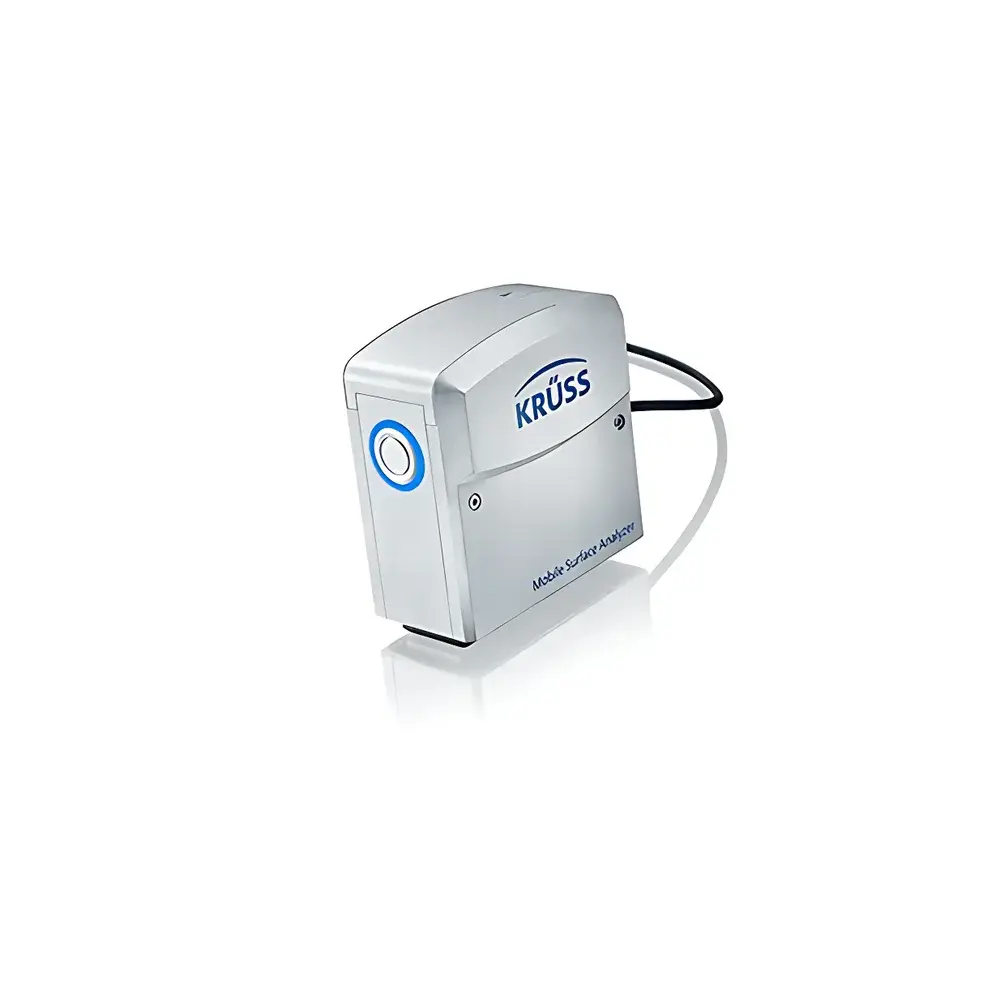
Krüss MSA Portable Drop Shape Analyzer
| Brand | Krüss |
|---|---|
| Origin | Germany |
| Model | MSA |
| Camera Interface | USB 3.0 |
| Max Frame Rate | 10 fps @ 1000 × 700 resolution |
| Illumination | Adjustable High-Power LED |
| Dispensing System | Dual- or Single-Needle Liquid Delivery |
| Dispensing Resolution | 0.1 µL |
| Contact Angle Range | 0–180° |
| Angular Resolution | 0.01° |
| Dimensions (W × D × H) | 106 mm × 59 mm × 112 mm |
| Weight | 0.85 kg |
| Surface Energy Calculation Methods | Owens-Wendt-Rabel-Kaelble, Wu, Zisman, Fowkes, van Oss & Good |
| Power Supply | USB-powered (no external adapter required) |
| Software | ADVANCE (Windows-based, GLP-compliant audit trail optional) |
Overview
The Krüss MSA Portable Drop Shape Analyzer is an engineered solution for rapid, field-deployable contact angle and surface free energy characterization of solid substrates. Based on the optical principle of drop shape analysis—capturing high-contrast silhouettes of sessile or pendant liquid droplets using a calibrated CMOS camera and precisely controlled LED illumination—the MSA quantifies interfacial interactions at the solid–liquid–vapor boundary. Unlike benchtop goniometers requiring sample fixation and environmental control, the MSA operates in situ: its compact form factor, USB-powered architecture, and non-contact dual-droplet dispensing enable direct measurement on vertical, curved, oversized, or immobile surfaces—including automotive body panels, architectural glass, roll-to-roll coated films, and assembled electronic components. The instrument implements rigorous physical models to derive surface free energy (SFE) and its polar/dispersive components, supporting process-critical decisions in surface activation, cleaning validation, coating adhesion assessment, and functional layer qualification.
Key Features
- True portable operation: self-contained, battery-free design powered exclusively via USB 3.0 from a laptop or industrial tablet—no external power supply or compressed air required.
- Dual-syringe dispensing module: synchronously deposits two independent liquid droplets (e.g., water and diiodomethane) with ±0.1 µL volumetric accuracy and minimal kinetic disturbance, eliminating sequential fluid exchange and associated surface contamination risks.
- Non-contact dispensing: needle tip maintains defined standoff distance (>1 mm) from substrate, preserving delicate or reactive surfaces (e.g., plasma-treated polymers, thin-film solar cells, biomedical coatings).
- One-click SFE workflow: automated image capture, droplet contour detection, Young–Laplace fitting, and multi-model SFE computation (Owens-Wendt-Rabel-Kaelble, Wu, Zisman, Fowkes, van Oss & Good) executed in <1 second per measurement point.
- Modular fluid handling: removable reservoir cartridges support ≥1000 dispenses per fill; optional disposable syringe kit available for viscous or residue-prone liquids (adhesives, UV-curable inks, solvent-based paints).
- Robust mechanical architecture: machined aluminum housing (IP42-rated), vibration-damped optics mount, and thermal-stable LED driver ensure repeatability across ambient temperature fluctuations (15–35 °C).
Sample Compatibility & Compliance
The MSA accommodates samples of arbitrary geometry and scale—from micro-patterned wafers to full-scale vehicle exteriors—without size or orientation constraints. Its 112 mm height and 0.85 kg mass permit handheld use on vertical walls, overhead structures, or confined production line zones. All measurements comply with ASTM D7334 (“Standard Practice for Surface Wettability of Coated Surfaces by Contact Angle Measurement”) and ISO 19403-2/3/4 (contact angle and surface energy determination). When configured with ADVANCE software’s optional audit trail and electronic signature modules, the system supports GLP and GMP environments under FDA 21 CFR Part 11 requirements for traceable, tamper-evident data generation.
Software & Data Management
ADVANCE software (v5.0+, Windows 10/11 compatible) provides intuitive, context-aware operation: real-time droplet preview, automatic baseline correction, multi-point mapping (grid or freehand), and batch export to CSV, PDF, or structured XML. Raw images, fitted contours, and SFE component breakdowns are timestamped and stored with full metadata (operator ID, location tag, ambient RH/T, fluid lot number). Custom report templates align with internal QA protocols or customer-facing documentation standards. Optional network deployment enables centralized calibration management and remote firmware updates across distributed manufacturing sites.
Applications
- Pre- and post-plasma treatment verification on polymer composites and elastomers.
- In-line quality gate for adhesive bonding readiness on aerospace structural parts.
- Quantitative validation of hydrophobic/hydrophilic coating uniformity on medical device housings.
- Root-cause analysis of delamination failures by correlating local SFE heterogeneity with peel strength maps.
- Monitoring cleaning efficacy in semiconductor wafer rework processes via dynamic contact angle hysteresis trends.
- Field assessment of anti-graffiti film degradation after outdoor exposure cycles.
FAQ
Can the MSA measure advancing and receding contact angles?
No—the MSA is optimized for static (sessile) contact angle acquisition. Dynamic angle measurement requires controlled liquid addition/removal not supported by its fixed-volume dispensing architecture.
Is calibration traceable to national standards?
Yes—Krüss supplies NIST-traceable contact angle calibration standards (θ = 30°, 60°, 90°, 120°) with certified uncertainty ≤ ±0.3°, accompanied by ISO/IEC 17025-accredited calibration certificates.
Does the software support statistical process control (SPC) charting?
Yes—ADVANCE includes embedded SPC tools (X̄-R charts, capability indices Cp/Cpk) for contact angle and surface energy parameters, exportable to Minitab or JMP.
What is the minimum measurable surface energy?
The lower limit depends on substrate homogeneity and liquid selection; typical reliable quantification range is 10–120 mJ/m², with polar component resolution down to ±0.5 mJ/m² under optimal conditions.
How is focus maintained across uneven surfaces?
The MSA uses fixed-focus optics with 4.5 mm depth-of-field; users adjust working distance manually via integrated micrometer stage (0–10 mm travel) prior to measurement—no autofocus motor or software compensation is implemented.



