
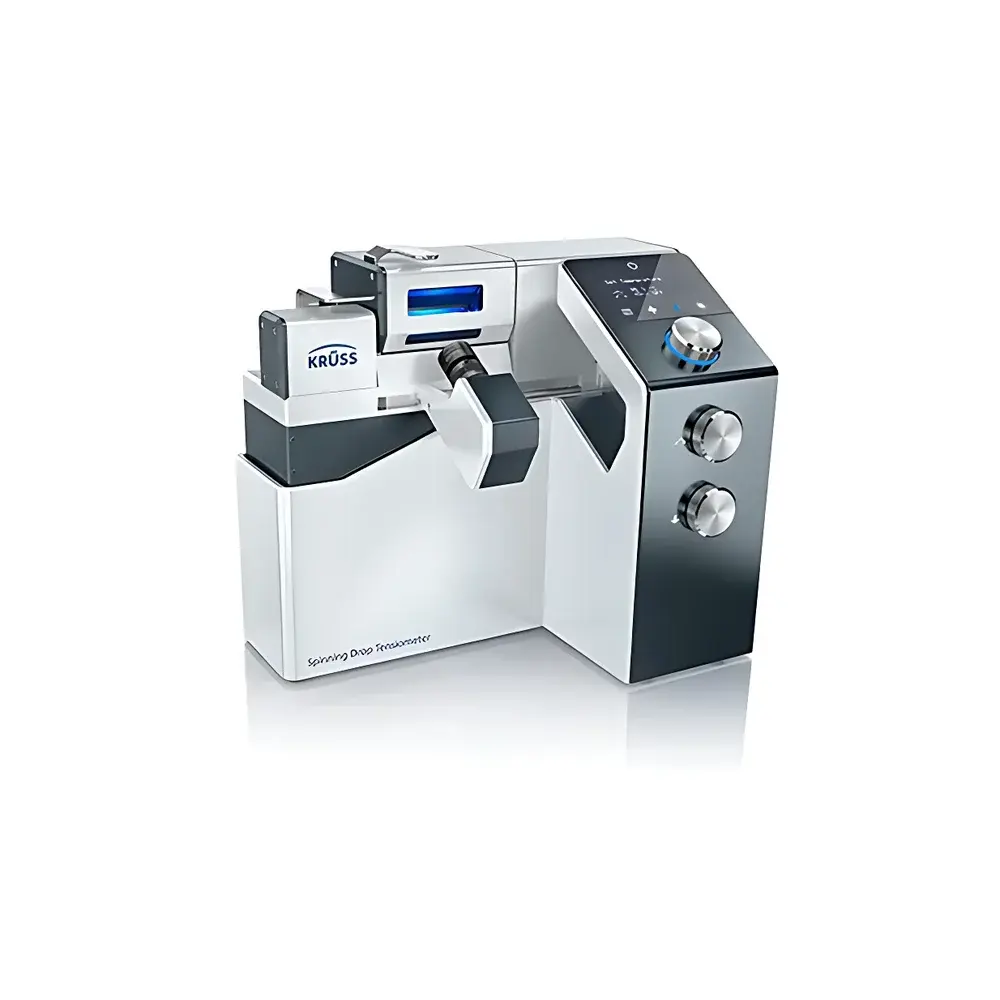
Krüss SDT Advanced Rotational Drop Interfacial Tensiometer
| Brand | Krüss |
|---|---|
| Origin | Germany |
| Model | SDT |
| Measurement Range | 10⁻⁶ – 2000 mN/m |
| Resolution | 10⁻⁶ mN/m |
| Temperature Control Range | −10 °C to +180 °C |
| Camera Frame Rate | 15 fps |
| Capillary Rotation Resolution | 0.1 rpm |
| Sample Stage Tilt | ±20° |
| Illumination | High-power monochromatic LED with stroboscopic lighting |
| Software | ADVANCE Image Analysis Suite |
Overview
The Krüss SDT Advanced Rotational Drop Interfacial Tensiometer is an engineered solution for high-precision interfacial tension measurement across extreme dynamic ranges—from ultralow values (10⁻⁶ mN/m) typical of microemulsions and enhanced oil recovery (EOR) formulations, up to 2000 mN/m encountered in polymer–solvent or molten salt systems. It operates on the rotational drop principle: a pendant droplet of the dispersed phase is suspended within a rotating cylindrical capillary filled with the continuous phase. Under centrifugal force, the droplet deforms into an ellipsoid whose shape is governed by the balance between interfacial tension and rotational inertia. By quantifying this deformation via high-speed video analysis and correlating it with angular velocity, the instrument determines interfacial tension using either the Vonnegut approximation (for low-tension, high-deformation regimes) or the full Young–Laplace equation (for higher tensions and lower rotation speeds). This dual-method capability ensures metrological traceability across heterogeneous sample classes without hardware reconfiguration.
Key Features
- Ultra-broad interfacial tension range: 10⁻⁶ – 2000 mN/m, validated per ISO 6295 and ASTM D971 standards for interfacial tension measurement.
- High-stability motorized rotation system with 0.1 rpm resolution and < ±0.02% speed deviation over 24 h—critical for reproducible droplet shape acquisition.
- USB3.0 high-resolution camera operating at 15 fps with synchronized stroboscopic LED illumination, eliminating motion blur during rapid rotation.
- Fully enclosed, ergonomically optimized housing integrating capillary holder, tilt stage (±20°), and temperature-controlled chamber—designed for GLP-compliant lab environments and operator safety.
- Patented capillary pre-filling system enabling sub-60-second sample exchange without membrane replacement or vacuum evacuation.
- Integrated Peltier-electric heating (−10 °C to +180 °C) with non-contact IR temperature sensing localized at the droplet interface—ensuring thermal accuracy within ±0.2 °C.
Sample Compatibility & Compliance
The SDT accommodates aqueous/organic, polymer/solvent, molten salt, and supercritical fluid interfaces. Its low sample volume requirement (< 5 µL dispersed phase; < 150 µL continuous phase) supports precious or hazardous material handling under containment protocols. The system complies with ISO/IEC 17025 requirements for calibration traceability and supports audit-ready documentation per FDA 21 CFR Part 11 when paired with ADVANCE software’s electronic signature and audit trail modules. All mechanical and thermal subsystems are CE-marked and conform to IEC 61010-1 for laboratory electrical safety.
Software & Data Management
ADVANCE software implements a workflow-driven interface built around modular “tiles” representing discrete experimental actions (e.g., “Initialize Rotation”, “Capture Baseline”, “Apply Young–Laplace Fit”). Each tile displays real-time feedback—including droplet centroid position, aspect ratio, and residual curvature error—without modal dialogs or nested menus. Video sequences are embedded directly into result files as compressed MP4 streams linked to metadata (temperature, rpm, timestamp, operator ID). Automated droplet tracking maintains central positioning across multi-hour dynamic measurements, minimizing drift-induced artifacts. Export formats include CSV (with full uncertainty propagation), PDF reports compliant with ISO 14644 cleanroom documentation templates, and HDF5 for integration with MATLAB or Python-based rheological modeling pipelines.
Applications
- Formulation development of pharmaceutical microemulsions and liposomal delivery systems, where interfacial stability dictates bioavailability and shelf life.
- Screening of surfactant efficiency in tertiary oil recovery, particularly for low-interfacial-tension flooding where values below 10⁻³ mN/m govern capillary number and sweep efficiency.
- Adsorption kinetics studies at liquid–liquid and liquid–molten-phase boundaries, supporting mechanistic modeling of interfacial rheology.
- Quality control of silicone oils, fluorosurfactants, and polymeric stabilizers used in coatings and agrochemical suspensions.
- Temperature-dependent interfacial thermodynamics—enabling derivation of dγ/dT and interfacial entropy for predictive formulation design.
FAQ
What interfacial tension methods does the SDT support?
The SDT implements both the Vonnegut method (based on droplet diameter vs. rotation speed) and the full Young–Laplace numerical fitting method, selectable per measurement protocol.
Can the SDT operate under inert or pressurized atmospheres?
Yes—the sealed optical chamber includes gas purge ports compatible with N₂ or Ar lines; optional pressure-rated capillaries support operation up to 10 bar.
Is ADVANCE software qualified for regulated environments?
Yes—ADVANCE v4.2+ includes 21 CFR Part 11 compliance packages with role-based access control, electronic signatures, and immutable audit logs.
How is temperature calibrated and verified?
Each instrument ships with a NIST-traceable Pt100 reference probe; users may perform in-situ verification using certified thermostatic baths or IR calibration standards.
What maintenance is required for long-term stability?
No routine optical alignment is needed; the motor and camera are maintenance-free for >10,000 hours. Capillary cleaning follows ISO 15834 guidelines using sequential solvent rinses.



