
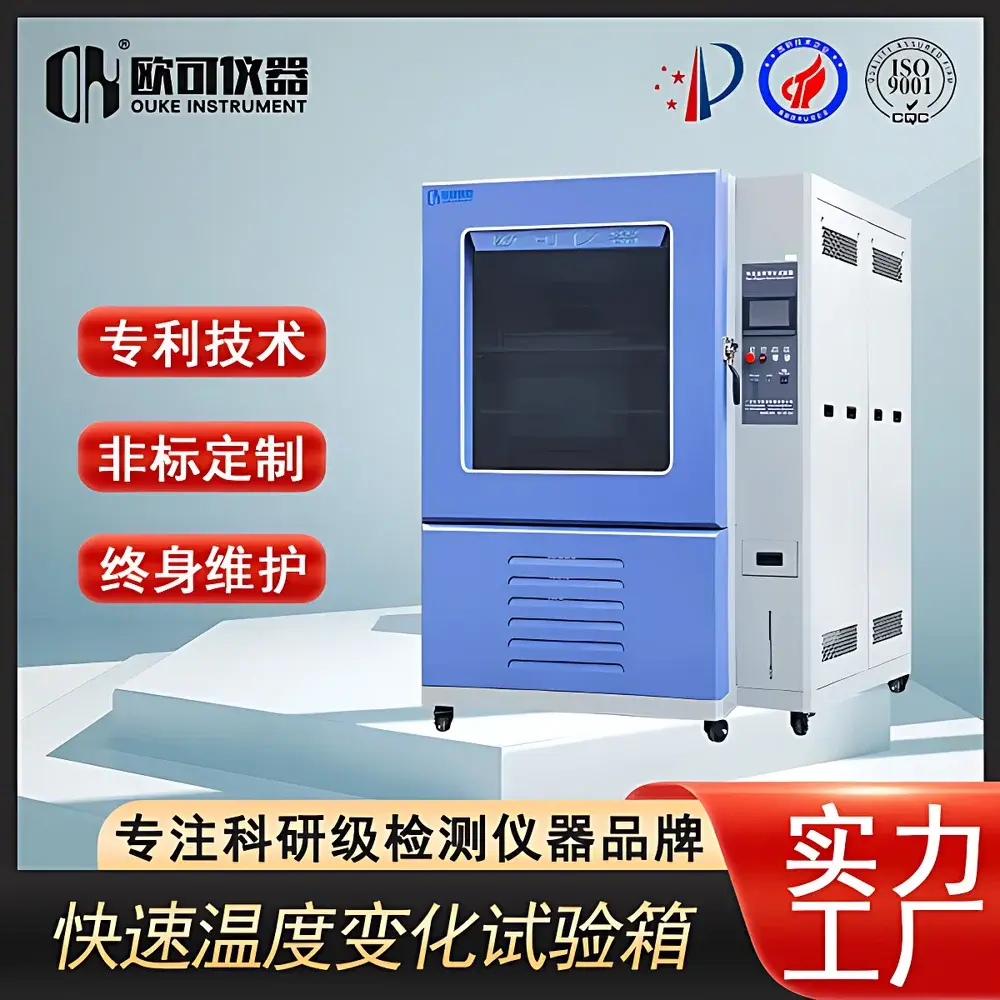
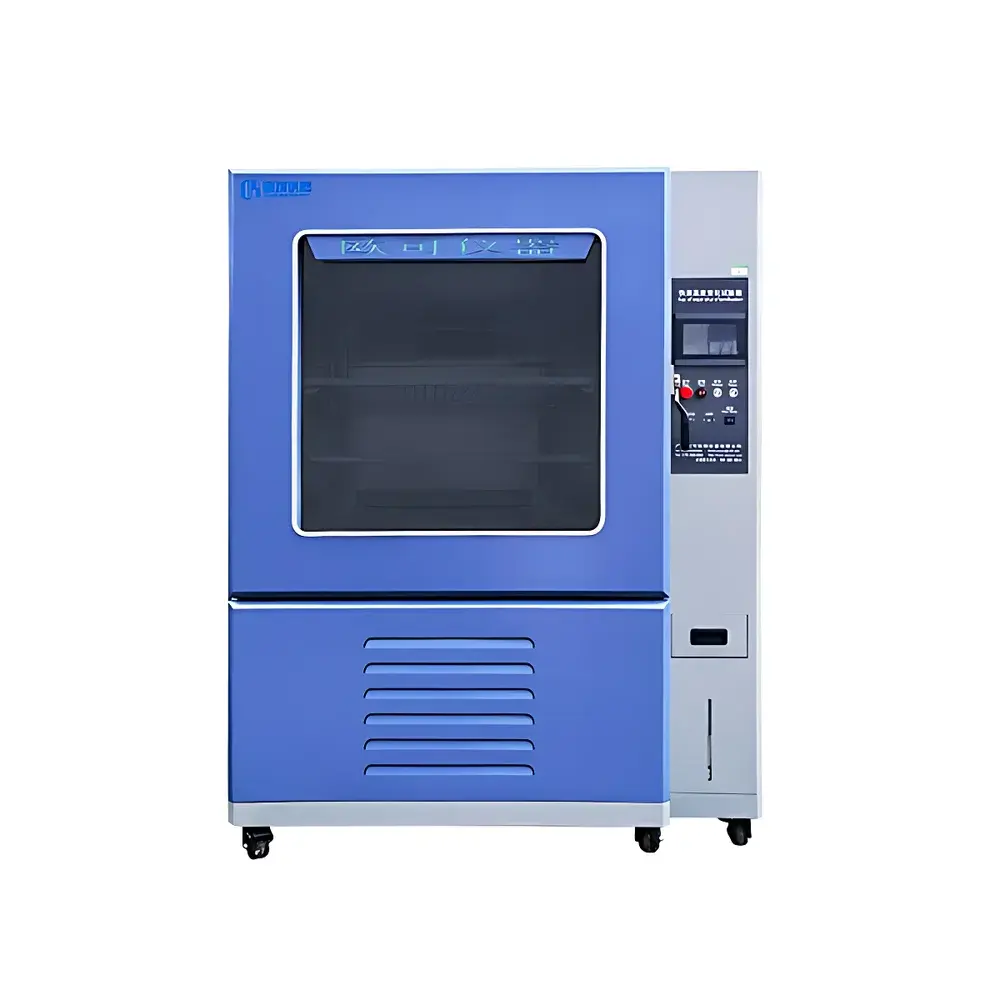
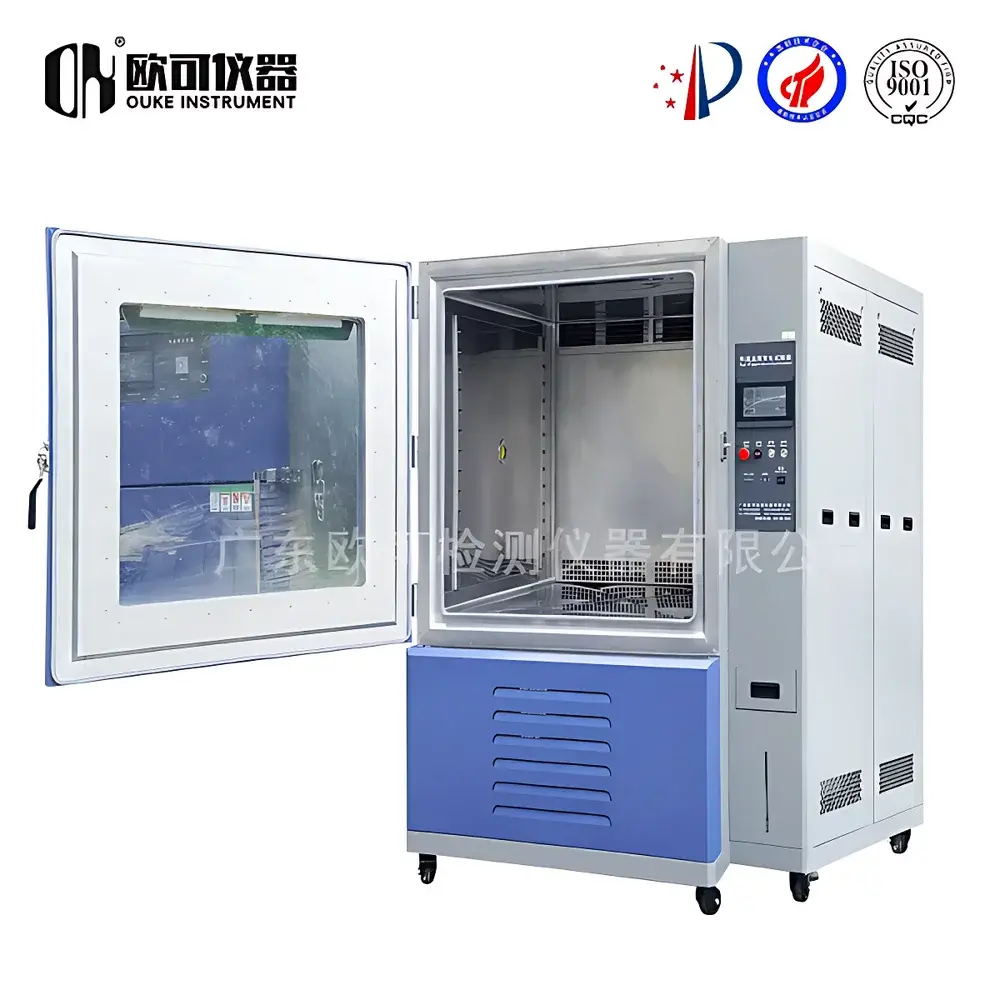
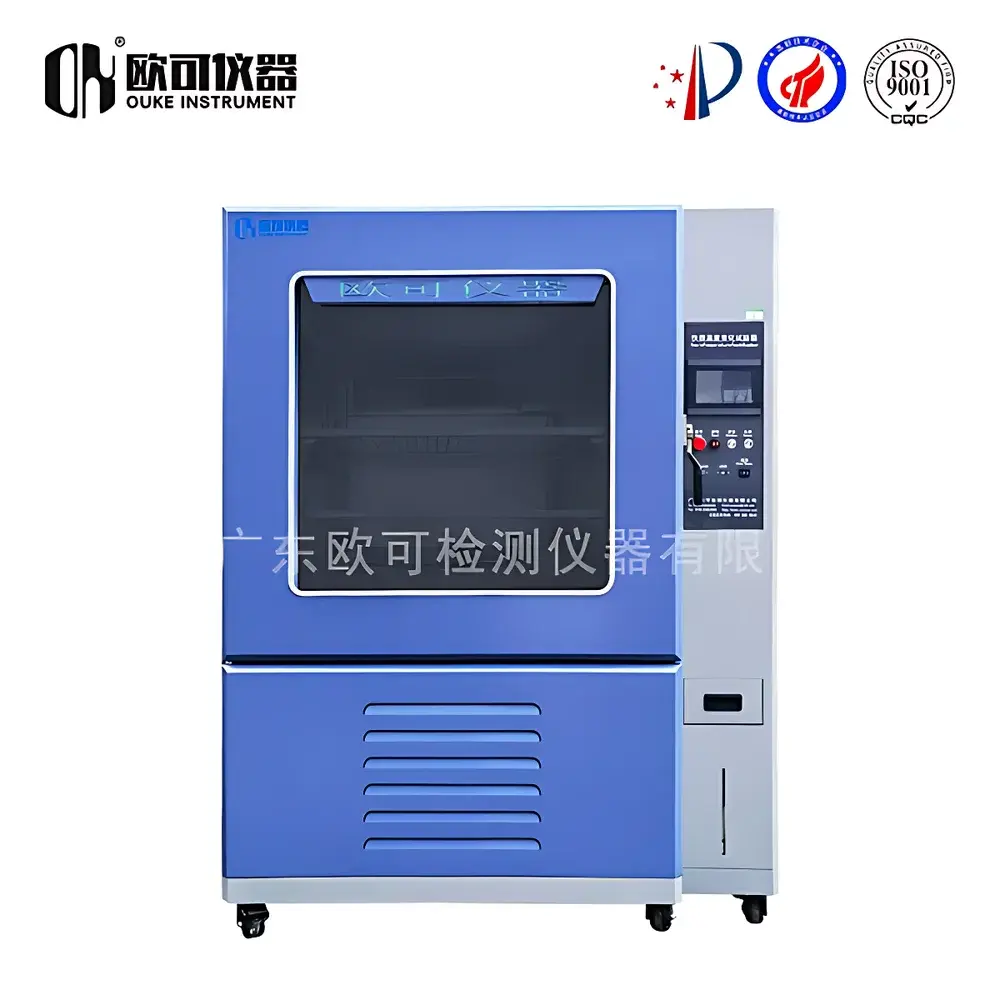
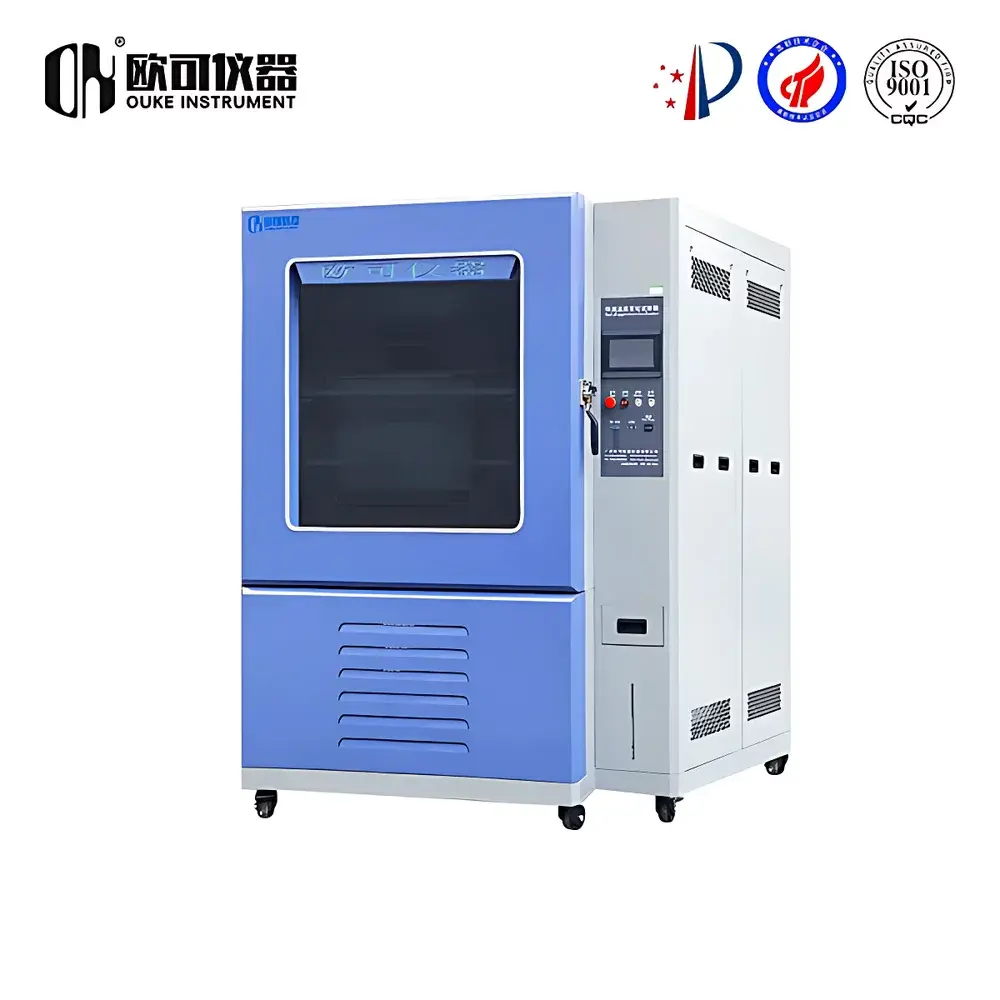
OK KS-TH-150 Advanced Rapid Thermal Cycling Chamber
| Brand | OK Instruments |
|---|---|
| Origin | Guangdong, China |
| Manufacturer Type | Direct Manufacturer |
| Country of Origin | China |
| Model | KS-TH-150 |
| Temperature Range | −70 °C to +150 °C |
| Refrigeration System | Cascade Compressor-Based with Optional Liquid Nitrogen Assist |
| Explosion-Proof Design | Standard (Non-Explosion-Proof) |
| Temperature Fluctuation | ±0.5 °C |
| Temperature Uniformity | ±2.0 °C |
| Temperature Deviation | ±2.0 °C |
| Heating Rate (Empty Load) | ≤60 min (−70 °C → +150 °C) |
| Cooling Rate (Empty Load) | ≤45 min / ≤60 min / ≤80 min (depending on target temperature transition) |
| Internal Chamber Dimensions (W×H×D) | 500 × 600 × 500 mm |
Overview
The OK KS-TH-150 Advanced Rapid Thermal Cycling Chamber is an engineered environmental stress screening (ESS) system designed to execute controlled, high-rate temperature transitions between extreme thermal boundaries. Unlike conventional environmental chambers that simulate gradual ambient conditions, this chamber implements accelerated thermal cycling based on the principles of transient heat transfer and thermo-mechanical fatigue induction. Its operational foundation lies in cascade mechanical refrigeration—typically employing dual-stage compressors—and optionally integrated liquid nitrogen (LN₂) injection for enhanced cooling capacity. Combined with high-static-pressure centrifugal airflow, optimized vertical/horizontal air distribution ducts, and predictive PID-plus feedforward control logic, the system achieves repeatable, programmable thermal profiles with minimal overshoot or dwell instability. It is explicitly intended for laboratory-based reliability qualification—not climatic simulation—and conforms to the functional intent of standards including IEC 60068-2-14 (Change of Temperature), MIL-STD-810H Method 503.6, GJB 150.5A, and JESD22-A104D.
Key Features
- High-performance cascade refrigeration system with optional LN₂ assist for rapid cooling down to −70 °C; compressor brands compliant with industrial-grade specifications (e.g., Bitzer, Doreng, Tecumseh)
- Robust heating subsystem featuring high-wattage stainless-steel sheathed heaters mounted within the air circulation duct, enabling precise ramp control up to +150 °C
- High-velocity forced convection architecture: ≥800 m³/h airflow volume, laminarized vertical/horizontal flow pattern, and low-turbulence air distribution ensuring uniform thermal exposure across the test volume
- Intelligent controller with 10.1″ color touchscreen HMI, supporting multi-segment thermal profiling (up to 999 cycles), real-time deviation monitoring, and auto-compensation for load-induced thermal inertia
- Structural integrity: Interior chamber constructed from SUS304 stainless steel; insulation layer ≥150 mm thick polyurethane foam (density ≥40 kg/m³, thermal conductivity ≤0.022 W/m·K)
- Integrated safety suite: Over-temperature cutoff, compressor high/low pressure shutdown, phase failure protection, door interlock, and leakage current detection per IEC 61000-4-5
Sample Compatibility & Compliance
The KS-TH-150 accommodates electronic assemblies, PCBs, automotive ECUs, battery modules, sensors, and aerospace avionics housings with maximum dimensions of 450 × 550 × 450 mm (allowing 50 mm clearance per side). Its internal geometry supports standardized test fixtures and thermocouple routing via two 50 mm diameter insulated port sleeves. The chamber meets mechanical and operational requirements for GLP-compliant ESS execution under ISO/IEC 17025-accredited laboratories. While not intrinsically explosion-proof, it complies with CE marking directives (2014/30/EU EMC, 2014/35/EU LVD) and supports validation documentation packages aligned with FDA 21 CFR Part 11 audit trails when paired with optional data logging software.
Software & Data Management
The included PC-based OK-TCM Suite provides full remote supervision via Ethernet or RS-485. Users can define non-linear temperature ramps (e.g., logarithmic, step-ramp, dwell-pause sequences), assign unique identifiers to test runs, and export time-stamped CSV datasets with synchronized thermocouple channel readings (up to 8 external inputs). All profile edits, start/stop events, alarm logs, and calibration interventions are timestamped and digitally signed to satisfy traceability requirements under GMP Annex 11 and ISO 9001:2015 clause 8.5.2. Data encryption (AES-256) and role-based access control ensure integrity during multi-user lab deployment.
Applications
- Environmental Stress Screening (ESS) per GJB 1032A and MIL-STD-344 for early-life defect elimination in military-grade electronics
- Thermal cycling validation of Li-ion battery packs under simulated vehicle cold-start and cabin-heating scenarios (SAE J2380, ISO 16750-4)
- Failure mode analysis of solder joints, wire bonds, and die attach interfaces using accelerated thermal fatigue protocols (JEDEC JESD22-A104D, IPC-9701)
- Material-level assessment of CTE mismatch in polymer composites, ceramic substrates, and MEMS packaging under repeated ΔT > 200 K excursions
- Pre-qualification testing of avionics units undergoing ground-to-stratosphere thermal transients (RTCA DO-160 Section 4.3)
FAQ
What is the difference between rapid thermal cycling and thermal shock testing?
Rapid thermal cycling applies continuous, controlled ramp rates (e.g., 10–25 °C/min) across a single chamber volume, inducing cumulative thermo-mechanical fatigue. Thermal shock uses discrete, near-instantaneous transfers between separate hot/cold zones (<5 min total transition), primarily assessing interfacial delamination or brittle fracture.
Does the KS-TH-150 support liquid nitrogen integration as standard?
LN₂ assist is available as an optional configuration. Base model relies solely on cascade compression; LN₂ addition requires dedicated solenoid valve manifold, vaporization coil, and consumption metering—quoted separately based on required cooling rate tier.
How is temperature uniformity verified and maintained during dynamic cycling?
Uniformity is validated per IEC 60068-3-5 using nine calibrated PT100 sensors at defined spatial coordinates. Airflow optimization, symmetric heater/refrigerant placement, and active zone compensation algorithms maintain ±2.0 °C uniformity even at maximum ramp rates.
Can the chamber be integrated into an automated test system?
Yes. Standard Ethernet (TCP/IP), RS-485 Modbus RTU, and optional IEEE-488 GPIB interfaces enable seamless integration with SCADA platforms, test sequencers, and MES systems for unattended batch processing.
Is calibration certification provided with delivery?
A factory-as-built calibration report (traceable to NIM China) is included. On-site IQ/OQ documentation, third-party UKAS/NIST-traceable verification, and annual recalibration services are available upon request.



