
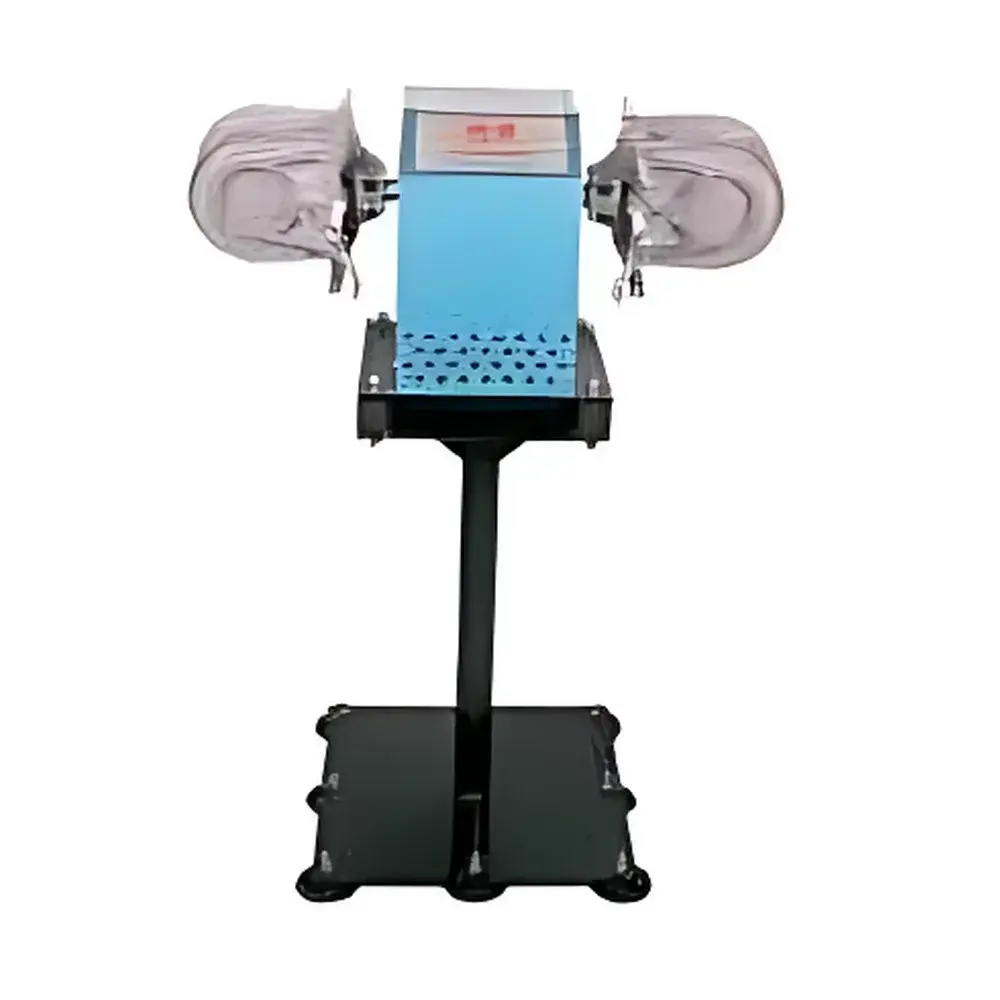
KS-370 Quick-Dispersion Tester for Coatings and Pigments
| Motor | 370 W, 220 V, 50 Hz |
|---|---|
| Crankshaft Speed | 630 rpm |
| Reciprocating Stroke | 16 mm |
| Max. Amplitude (Upper/Lower) | 8 mm |
| Arm Oscillation Angle | 30° |
| Dimensions (L×W×H) | 790 × 520 × 1090 mm |
| Weight | 63 kg |
Overview
The KS-370 Quick-Dispersion Tester is an electromechanical oscillatory dispersion instrument engineered for rapid, reproducible pigment and filler dispersion in liquid-phase coating, ink, and dye formulations. It operates on the principle of high-frequency mechanical oscillation—driven by a precisely balanced crankshaft mechanism—to generate controlled reciprocating motion and angular arm oscillation. This induces intense shear and impact forces within the sample vessel, effectively breaking down agglomerates and promoting uniform wetting and distribution of solid particles in binders or solvents. Unlike continuous-shear devices such as rotor-stator homogenizers or bead mills, the KS-370 delivers discrete, standardized energy input per cycle—making it especially suited for comparative dispersion trials where protocol consistency and inter-laboratory repeatability are critical. Its design conforms to the operational requirements of GB/T 9287–2019 (“Comparison of Pigment Dispersibility—Shaking Method”), enabling direct correlation with standardized dispersibility rankings used in quality control and formulation development.
Key Features
- High-power 370 W induction motor with stable 50 Hz frequency operation ensures consistent torque delivery across extended test cycles.
- Precisely calibrated crankshaft-driven mechanism delivers a fixed reciprocating stroke of 16 mm at 630 rpm, generating repeatable mechanical energy input per unit time.
- 30° oscillation angle of the dispersion arm enhances lateral shear component, improving particle deagglomeration efficiency compared to linear-only shakers.
- Dual-amplitude capability (±8 mm vertical displacement at upper and lower mounting points) accommodates variable vessel heights and ensures optimal energy transfer regardless of container geometry.
- Robust steel frame and vibration-damped base minimize operational noise and prevent resonance-induced measurement drift during simultaneous multi-sample testing.
- Compact footprint (790 × 520 × 1090 mm) and modular clamp system support integration into standard fume hoods or benchtop QC workstations without spatial compromise.
Sample Compatibility & Compliance
The KS-370 accepts standard laboratory containers—including glass jars (100–500 mL), stainless-steel cans, and disposable polypropylene vessels—secured via adjustable dual-clamp holders. It supports both low-viscosity dispersions (<500 mPa·s) and moderately thixotropic systems (e.g., acrylic emulsions, alkyd pastes) without requiring pre-thinning. As specified in GB/T 9287–2019, the instrument serves as the designated dispersion apparatus for evaluating relative pigment dispersibility using standardized shaking protocols. While not certified to ISO/IEC 17025 or ASTM D1210 directly, its mechanical parameters are traceable to national metrological standards, and its output is routinely accepted in GLP-compliant R&D labs for internal method validation, raw material qualification, and batch release testing. Documentation packages include calibration certificates for rotational speed and stroke amplitude verification.
Software & Data Management
The KS-370 is a standalone electromechanical instrument with no embedded microprocessor or digital interface. All operational parameters—including run duration, cycle count, and start/stop timing—are manually controlled via front-panel toggle switches and analog timer. This architecture eliminates firmware dependencies, ensuring long-term operational reliability and eliminating cybersecurity or software obsolescence risks. For regulated environments, users may integrate external data loggers (e.g., USB-connected tachometers or accelerometer-based motion sensors) to capture time-stamped speed and amplitude traces. Test records—including vessel ID, pigment type, binder ratio, dispersion duration, and post-test assessment method (e.g., Hegman grind gauge, spectrophotometric ΔE evaluation)—are maintained in paper-based or LIMS-linked electronic notebooks compliant with 21 CFR Part 11 when paired with qualified audit-trail software.
Applications
- Rapid screening of pigment dispersants and wetting agents across multiple resin systems (e.g., epoxy, polyester, waterborne acrylics).
- Comparative assessment of raw material batches for dispersibility consistency prior to full-scale production.
- Preparation of tinted dilution pastes for color strength evaluation (ASTM D280, ISO 787-24) and hue shift analysis.
- Accelerated aging studies involving pigment re-agglomeration kinetics under controlled thermal or humidity conditions post-dispersion.
- Supporting ASTM D4486 (Standard Practice for Evaluating Dispersion Quality of Pigmented Coatings) through standardized mechanical dispersion prior to particle size analysis (e.g., laser diffraction or SEM imaging).
FAQ
Is the KS-370 compliant with international dispersion standards beyond GB/T 9287?
The KS-370 meets the mechanical performance criteria required by GB/T 9287–2019. While not formally validated against ASTM D1210 or ISO 787-21, its stroke amplitude, frequency, and force profile fall within the operational envelope used in those methods; users must perform method equivalence verification per their internal SOPs.
Can the instrument be used for non-coating applications such as pharmaceutical suspensions or ceramic slurries?
Yes—provided viscosity and density remain within the mechanical tolerance range (≤1,200 mPa·s, ≤2.5 g/cm³) and particles are non-abrasive to standard stainless-steel clamps. Validation per ICH Q5C or ISO 13320 is recommended for regulated use.
What maintenance intervals are recommended for long-term accuracy?
Lubrication of crankshaft bearings every 500 operating hours and annual verification of stroke amplitude using dial indicator calibration are advised. Motor brushes require inspection after 2,000 hours of cumulative runtime.
Does the device support programmable multi-step protocols?
No—the KS-370 operates in fixed-mode only. For programmable sequences (e.g., ramped oscillation, intermittent cycling), external PLC-controlled timers or industrial-grade shaker controllers must be integrated.
Is CE or UL certification available for export to EU or North America?
The base unit complies with IEC 61000-6-2 (immunity) and IEC 61000-6-4 (emissions) when installed per manufacturer grounding instructions. CE marking requires end-user responsibility for full system integration and risk assessment under Machinery Directive 2006/42/EC.



