
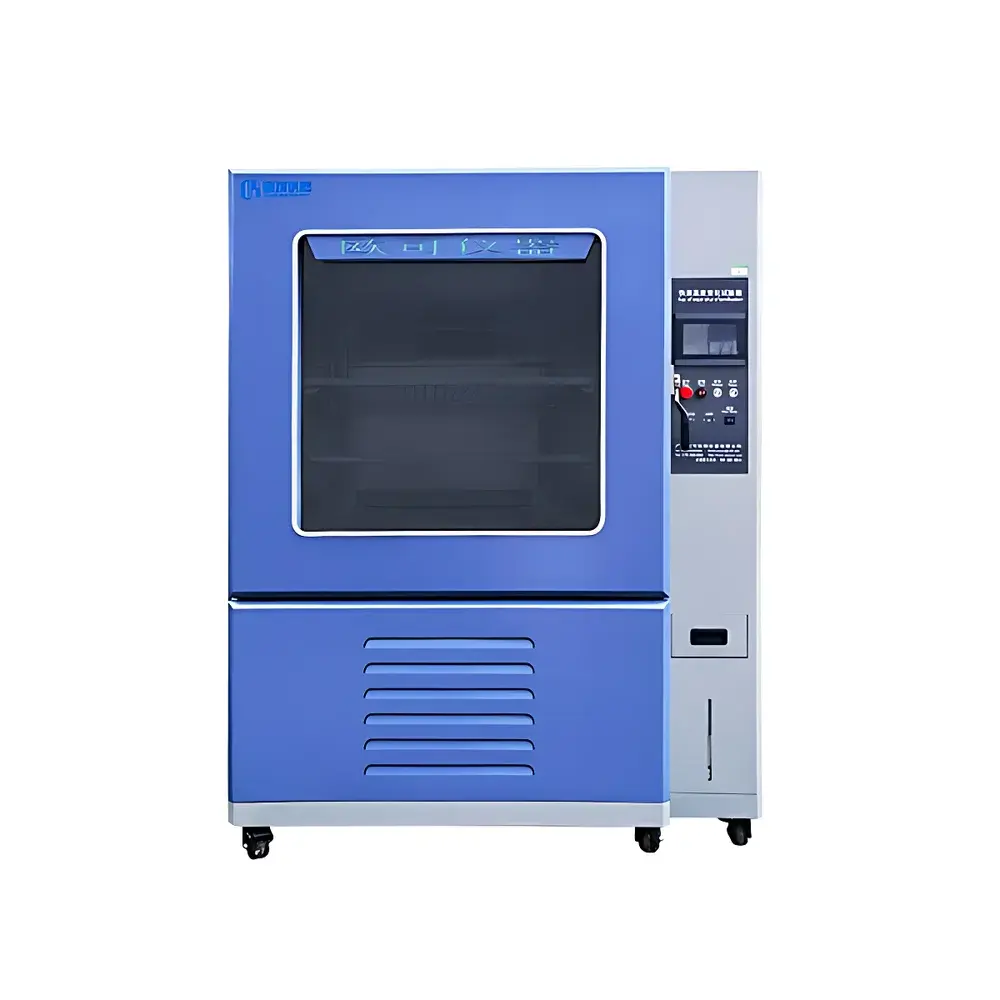
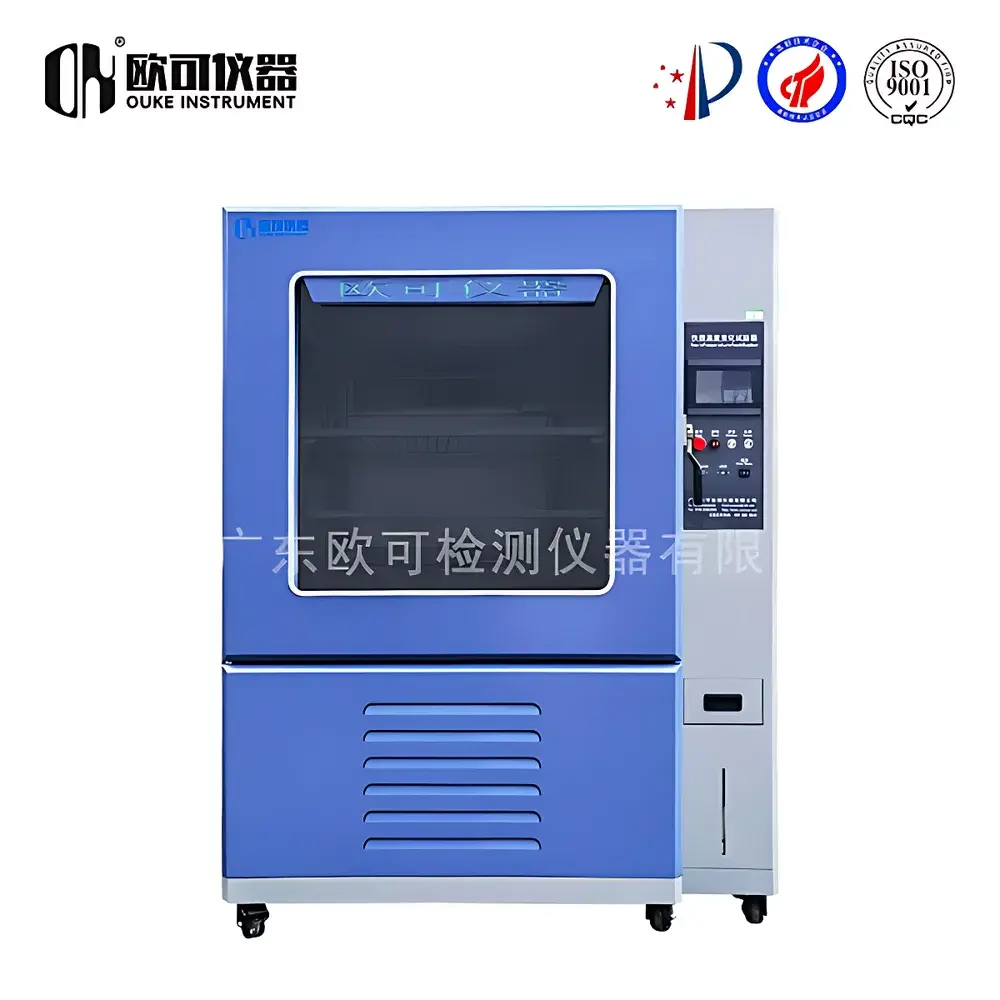
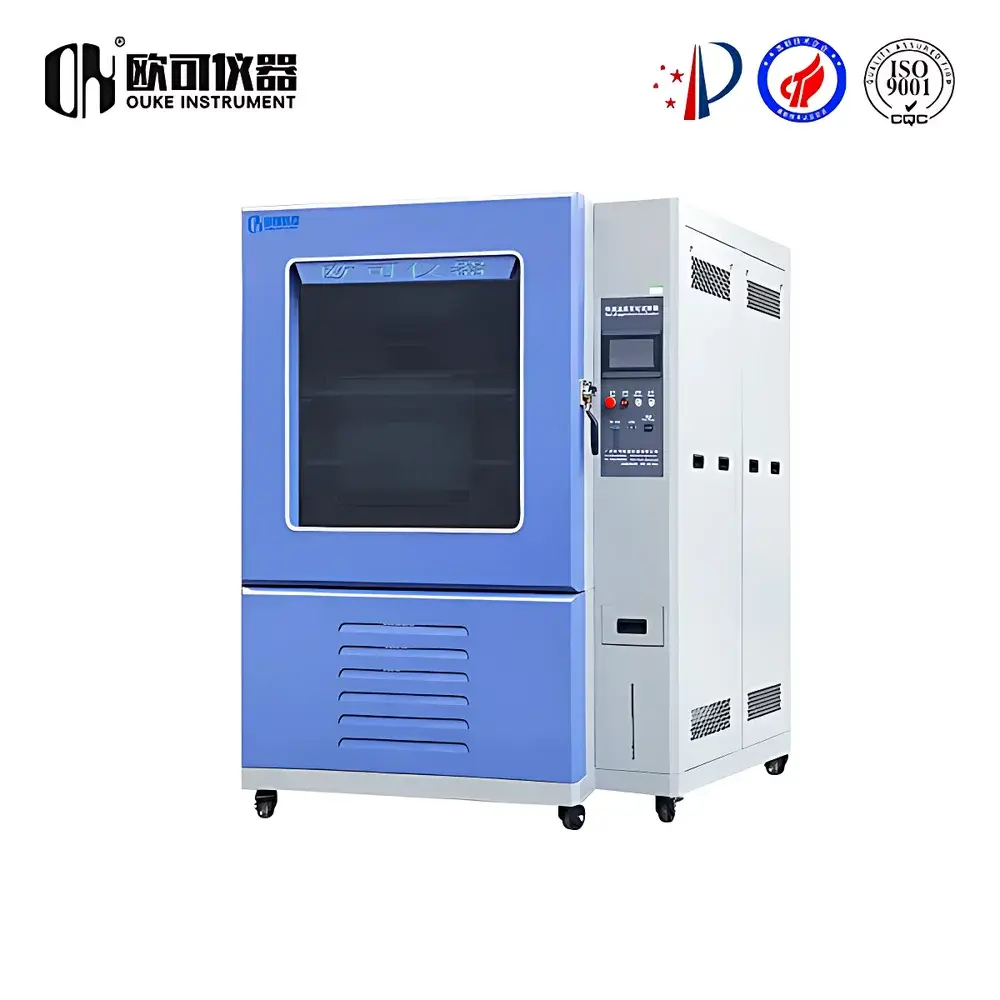
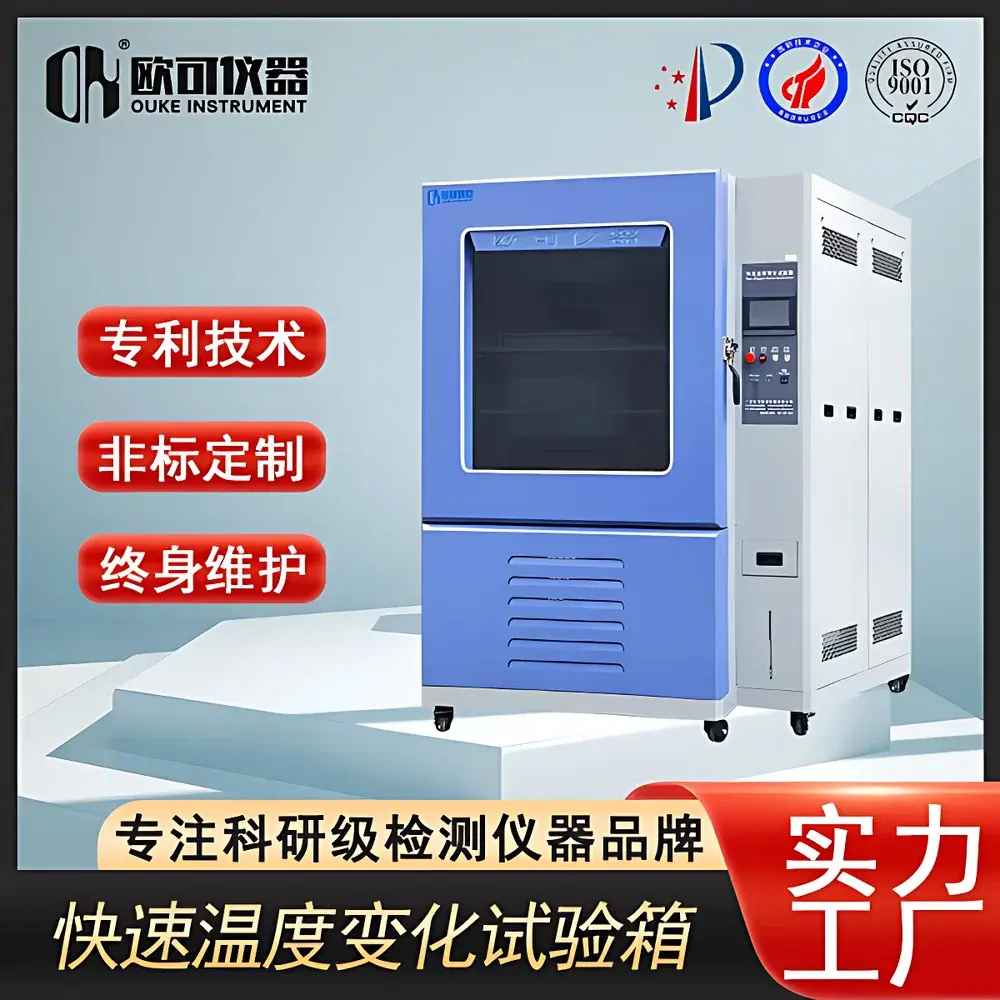
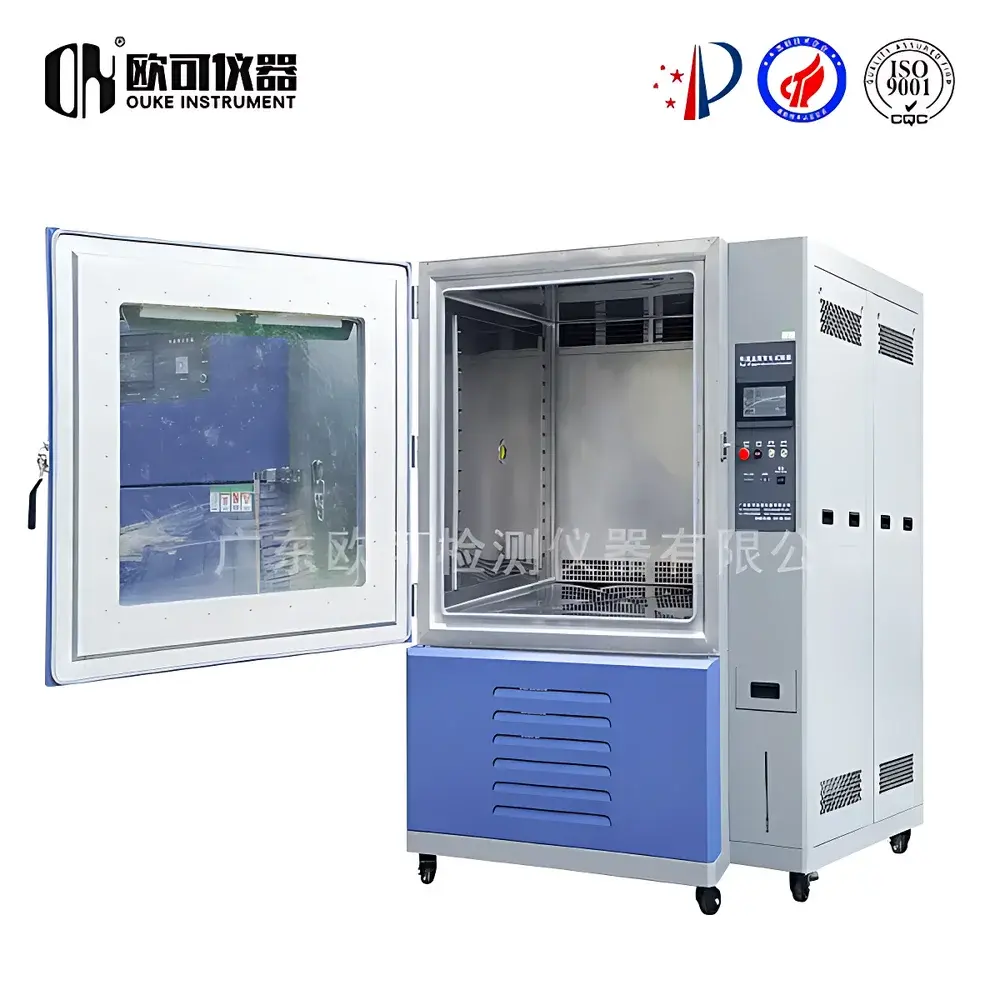
OK KS-TH-800.00 Linear Rapid Temperature Change Test Chamber
| Brand | OK |
|---|---|
| Origin | Guangdong, China |
| Manufacturer Type | Manufacturer |
| Country of Origin | China |
| Model | KS-TH-800.00 |
| Price | USD 14,200 (FOB Guangdong) |
| Internal Dimensions | 600 × 500 × 500 mm (W×H×D) |
| External Dimensions | 1500 × 2100 × 2250 mm (W×H×D) |
| Construction | SUS#304 stainless steel interior & exterior |
| Insulation | High-density glass wool + rigid polyurethane (PU) foam |
| Temperature Control System | Siemens PLC controller with color LCD touch interface |
| Temperature Setpoint Accuracy | ±0.1 °C |
| Temperature Indication Accuracy | ±0.1 °C |
| Sensor | PT100 platinum resistance thermometer |
| Heating | Independent Ni-Cr alloy electric heaters |
| Refrigeration | French Tecumseh hermetic air-cooled single-stage or cascade compressor system |
| Air Circulation | Low-noise, high-temp AC motor with multi-blade centrifugal impeller |
| Transition Mechanism | Pneumatic dual-chamber switching (two-box configuration) or motorized damper control (one-box configuration) |
| Sealing | High-tensile packing rated for −200 °C to +400 °C |
| Accessories | Two adjustable test trays, automatic high/low temperature zone switching unit, anti-sweat K-type heat pipe system |
Overview
The OK KS-TH-800.00 Linear Rapid Temperature Change Test Chamber is an engineered environmental stress screening (ESS) platform designed for accelerated thermal cycling validation in reliability engineering, aerospace component qualification, and electronics manufacturing. It operates on a dual-zone (two-box) or single-zone (one-box) architecture—both configured to deliver precise, repeatable linear temperature transitions between extremes without thermal lag or overshoot. In the two-box configuration, test specimens are physically transferred between isolated high-temperature and low-temperature chambers via pneumatic actuation; in the one-box variant, airflow routing is dynamically reconfigured using motorized dampers to expose static samples to alternating thermal streams. This design eliminates mechanical handling during cycling, preserving sample integrity and enabling real-time in-situ monitoring—critical for solder joint fatigue analysis, MEMS device characterization, and battery thermal runaway evaluation.
Key Features
- Linear temperature ramping capability: Programmable rates from 1 °C/min up to 15 °C/min (dependent on setpoint range and load), compliant with MIL-STD-810H Method 503.7 and IEC 60068-2-14 requirements for rapid thermal transition profiles.
- Siemens S7-1200 PLC-based control architecture with 7-inch full-color TFT-LCD HMI, supporting intuitive profile programming, real-time trend visualization, and password-protected parameter locking for GLP/GMP traceability.
- Dual independent thermal zones (in two-box mode): High-temperature chamber capable of +150 °C, low-temperature chamber down to −70 °C—enabling zero-crossing transitions across −65 °C to +150 °C operational envelope.
- Robust thermal insulation: 120 mm thick composite wall construction comprising vacuum-deposited glass wool and closed-cell PU foam, minimizing thermal bridging and ensuring surface condensation suppression via integrated K-type anti-sweat heat pipes.
- High-fidelity sensing and actuation: Class A PT100 sensors (IEC 60751) mounted at multiple chamber locations; electronic pressure transducers for refrigerant circuit monitoring; fail-safe interlocked door mechanisms with position feedback.
- Compliance-ready hardware: All electrical components meet CE/UL 61010-1 safety standards; refrigerant circuit conforms to EN 378-1 for flammable refrigerant containment (R404A/R23 blend).
Sample Compatibility & Compliance
The KS-TH-800.00 accommodates test articles up to 600 mm wide × 500 mm high × 500 mm deep, with optional reinforced trays supporting loads up to 50 kg per shelf. Its stainless-steel interior (SUS#304, 2B finish) resists oxidation, halogen corrosion, and cryogenic embrittlement—making it suitable for PCB assemblies, automotive ECUs, optical enclosures, and medical device housings. The chamber meets structural and operational prerequisites for ASTM E1545 (thermal shock testing), ISO 16750-4 (road vehicle environmental conditions), and JEDEC JESD22-A104F (temperature cycling). Full audit trails—including setpoint history, sensor readings, alarm logs, and user actions—are timestamped and exportable in CSV format to satisfy FDA 21 CFR Part 11 electronic record requirements when paired with OK’s optional validation package (IQ/OQ/PQ documentation set).
Software & Data Management
The embedded Siemens control firmware supports Ethernet TCP/IP communication (Modbus TCP and OPC UA server options available), enabling integration into centralized MES or SCADA environments. Optional OK-TCM v3.2 software provides extended functionality: multi-chamber synchronization, statistical process control (SPC) charting, deviation alerting via email/SMS, and automated report generation compliant with ISO/IEC 17025 clause 7.8.2. All data—including raw sensor time-series, chamber state transitions, and actuator duty cycles—is stored locally on industrial-grade SD card (16 GB) with cyclic overwrite protection. Historical datasets retain metadata such as operator ID, calibration certificate expiry, and environmental ambient conditions logged via external USB-connected温湿度 probe.
Applications
- Qualification of avionics modules under DO-160 Section 4 (temperature variation) and Section 5 (temperature shock).
- Accelerated life testing (ALT) of lithium-ion battery packs per UN 38.3 T5 thermal cycling protocol.
- Thermal mismatch evaluation of chip-scale packages (CSPs) and wafer-level CSPs using JEDEC J-STD-020D moisture sensitivity level (MSL) preconditioning.
- Validation of adhesive bond strength retention in composite aircraft structures following ASTM D1002 thermal cycling exposure.
- Stress screening of high-reliability optoelectronic transceivers used in 5G base station front-haul systems.
FAQ
What is the minimum achievable temperature transition time between −65 °C and +150 °C?
Under no-load conditions and using the two-box configuration, the chamber achieves ≤15-second zone transfer and ≤3 minutes total temperature stabilization (±2 °C tolerance band) per cycle.
Does the system support custom thermal profiles with dwell times and non-linear ramps?
Yes—the Siemens HMI allows creation of up to 99 segments per profile, including ramp, soak, and step functions, with dwell durations from 1 second to 999 hours.
Is remote monitoring and control possible via industry-standard protocols?
Standard Ethernet connectivity supports Modbus TCP for PLC-level integration; optional OPC UA server enables secure bidirectional communication with enterprise historian systems.
How is calibration maintained over long-term operation?
The chamber includes three certified PT100 reference points (−70 °C, 25 °C, +150 °C); OK provides annual NIST-traceable calibration services with uncertainty budgets per ISO/IEC 17025.
Can the unit be validated for GMP-regulated environments?
Yes—OK delivers full IQ/OQ documentation aligned with Annex 15 and EU GMP guidelines, including sensor mapping studies, alarm response verification, and cybersecurity risk assessment (IEC 62443-3-3).
Related Products



