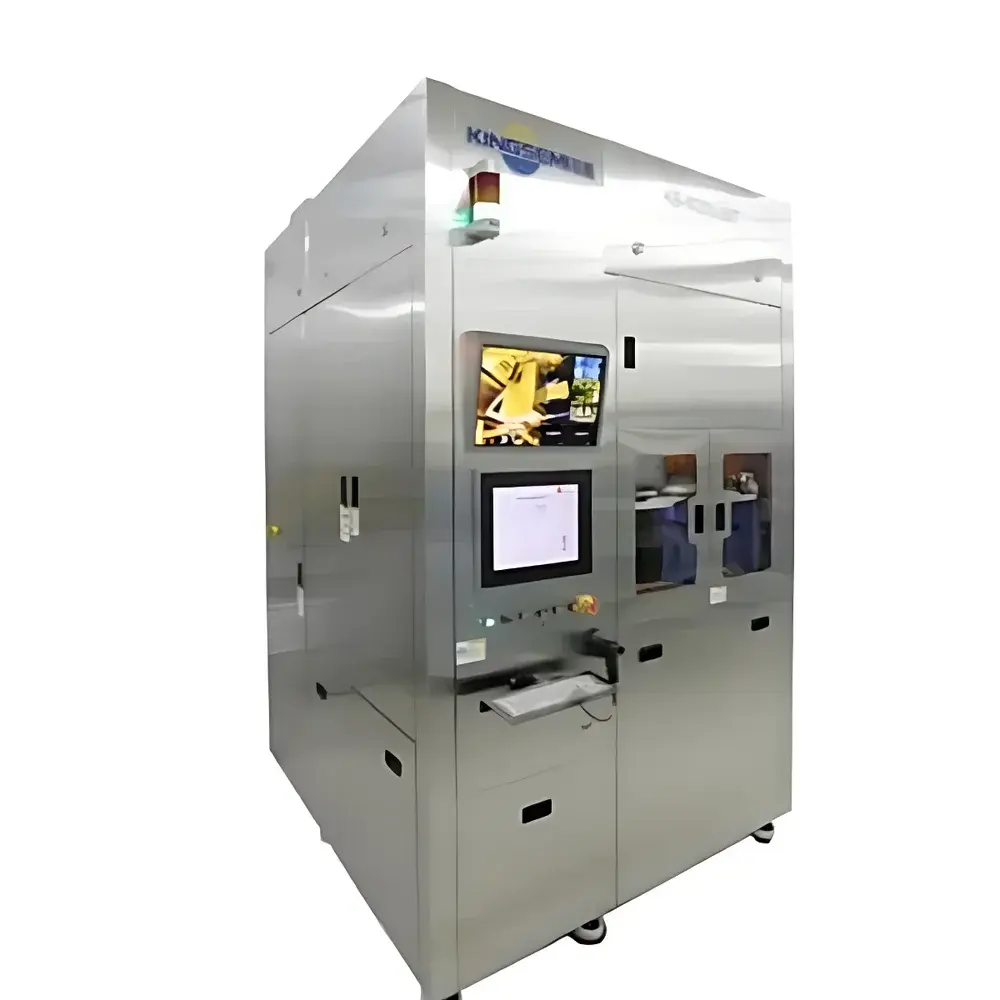
KS-S150-6ST Resist Stripper System by Kingsemi
| Brand | Kingsemi |
|---|---|
| Model | KS-S150-6ST |
| Origin | Liaoning, China |
| Equipment Type | Semiconductor Resist Stripping System |
| Configuration | 6-Station Wet Processing Platform |
| Vacuum Handling | Dual-Vacuum Dual-Clamp High-Speed Robotic Arm |
| Alignment | Automated Wafer Centering (AWC) with Vision-Based Recognition |
| Bath Compatibility | Multi-Size & Multi-Angle Immersion Modules (150 mm to 200 mm wafers) |
| Pressure Control | Closed-Loop High-Pressure Fluid Delivery (±0.2 MPa accuracy) |
| Heating System | In-Line High-Pressure Resistant Heater (PID-controlled, ≤120 °C) |
| Chuck Type | Actively Clamped, Backside-Protected Electrostatic/ Mechanical Chuck |
| Chemical Recovery | Integrated Solvent Recovery and Recirculation Loop |
| Compliance | Designed for Class 100 Cleanroom Integration |
Overview
The KS-S150-6ST Resist Stripper System is a fully automated, six-station wet processing platform engineered for high-precision photoresist removal in advanced semiconductor packaging, OLED display fabrication, and compound semiconductor manufacturing. It operates on a sequential batch-processing principle using controlled chemical immersion, rinse, and spin-dry cycles—optimized for stripping both positive and negative tone resists, lift-off metal layers, and post-etch residue after vapor deposition or sputtering. Unlike atmospheric benchtop strippers, the KS-S150-6ST integrates dual-vacuum robotic handling and active chuck clamping to eliminate mechanical contact-induced defects—including backside scratches, edge chipping, and wafer slippage—critical for thin (<100 µm), warped, or low-k dielectric wafers. Its process architecture supports standard organic strippers (e.g., NMP, DMSO, PGMEA-based formulations), sulfuric-peroxide mixtures (SPM), and engineered aqueous blends compliant with JEDEC J-STD-020 moisture sensitivity and IEC 61340-5-1 ESD control requirements.
Key Features
- Dual-vacuum, dual-clamp, four-degree-of-freedom robotic arm with proprietary motion control firmware—enabling sub-500 ms transfer time between stations and zero cross-contamination between wet and dry zones.
- Automated Wafer Centering (AWC) system utilizing high-resolution monochrome CMOS imaging and real-time centroid calculation for <±5 µm alignment repeatability across 150 mm and 200 mm substrates.
- Modular immersion bath design accommodating variable wafer diameters (150 mm, 200 mm) and non-standard orientations (e.g., notch-up, flat-down, edge-aligned)—compatible with carrier-mounted or bare-wafer handling.
- Closed-loop pressure regulation of chemical delivery lines via piezoresistive transducers and proportional solenoid valves, maintaining setpoint stability within ±0.2 MPa under dynamic flow conditions up to 12 L/min.
- In-line, pressure-rated resistive heater (stainless-steel sheathed, 316L wetted path) with PID feedback loop and thermal cut-off redundancy—achieving ±0.5 °C temperature uniformity across full bath volume at operating range 30–120 °C.
- Actively clamped electro-mechanical chuck with distributed vacuum ports and soft-touch edge seals—preventing backside marring and ensuring planar stability during high-speed spin-rinse (up to 3000 rpm).
- On-board solvent recovery module featuring multi-stage filtration (0.1 µm PTFE membrane), phase separation, and density-based reclamation—extending chemical service life by ≥40% versus open-bath systems.
Sample Compatibility & Compliance
The KS-S150-6ST accommodates silicon, SiC, GaN, glass, and flexible polymer substrates ranging from 150 mm to 200 mm in diameter and thicknesses from 50 µm to 775 µm. It supports standard SEMI F47-0212 mechanical interface specifications and integrates seamlessly into factory automation via SECS/GEM protocol over Ethernet/IP. All wetted materials—including fluid manifolds, bath liners, and chuck surfaces—comply with SEMI F57 (chemical compatibility) and ASTM F2169 (cleanliness classification). The system meets ISO 14644-1 Class 5 (ISO Class 5) cleanroom certification prerequisites when installed with HEPA-filtered exhaust and nitrogen purged enclosures. Process logs include timestamped audit trails for GLP/GMP environments, supporting 21 CFR Part 11-compliant electronic signatures when paired with validated MES integration.
Software & Data Management
The embedded control software—Kingsemi ProcessMaster v3.2—provides recipe-driven operation with hierarchical user access (Operator, Engineer, Admin), real-time parameter monitoring (temperature, pressure, flow rate, RPM), and automatic fault logging with root-cause tagging. Each process run generates an immutable .CSV log file containing >80 data channels, aligned to SEMI E142 data format standards. Optional OPC UA server enables bidirectional communication with host MES (e.g., Applied Materials EnduraLink, PDF Solutions Exensio) for SPC charting, yield correlation, and predictive maintenance modeling. All software modules undergo annual third-party validation per ASTM E2500-13 and are qualified for use in FDA-regulated R&D facilities.
Applications
- Semiconductor packaging: Post-plating resist removal in fan-out wafer-level packaging (FOWLP), redistribution layer (RDL) patterning cleanup, and bump under-bump metallization (UBM) lift-off.
- OLED manufacturing: Pixel-defining layer (PDL) strip prior to RGB evaporation, cathode metal lift-off after shadow mask alignment, and TFT array residue cleaning following photolithography.
- Compound semiconductors: GaAs HBT/HEMT resist removal after ion implantation, InP-based photonic IC etch mask stripping, and SiC power device trench passivation layer cleanup.
- MEMS & advanced sensors: Release etch residue removal in SOI-based accelerometers, piezoresistive pressure sensor cavity cleaning, and bio-MEMS surface functionalization prep.
FAQ
What wafer sizes and thicknesses does the KS-S150-6ST support?
It handles 150 mm and 200 mm wafers, with thickness ranging from 50 µm to 775 µm—including ultra-thin temporary bonded substrates.
Is the system compatible with aggressive chemistries such as SPM or piranha solutions?
Yes—fluid pathways use PFA-lined 316L stainless steel and perfluoroelastomer (FFKM) seals rated for continuous exposure to sulfuric acid/hydrogen peroxide mixtures at temperatures up to 120 °C.
Can the system be integrated into a fully automated fab environment?
Yes—it supports SECS/GEM communication, has dual Ethernet ports for factory network segregation, and provides hardware interlocks for AMHS interface handshaking.
Does the chemical recovery system require external distillation or regeneration equipment?
No—the integrated recovery loop includes inline filtration, gravity-phase separation, and conductivity-based concentration monitoring—enabling closed-loop reuse without off-site processing.
What documentation is provided for regulatory compliance in ISO 13485 or IATF 16949 environments?
Full Design Qualification (DQ), Installation Qualification (IQ), Operational Qualification (OQ), and Performance Qualification (PQ) protocols are available upon request, along with material traceability dossiers and calibration certificates per ISO/IEC 17025.