
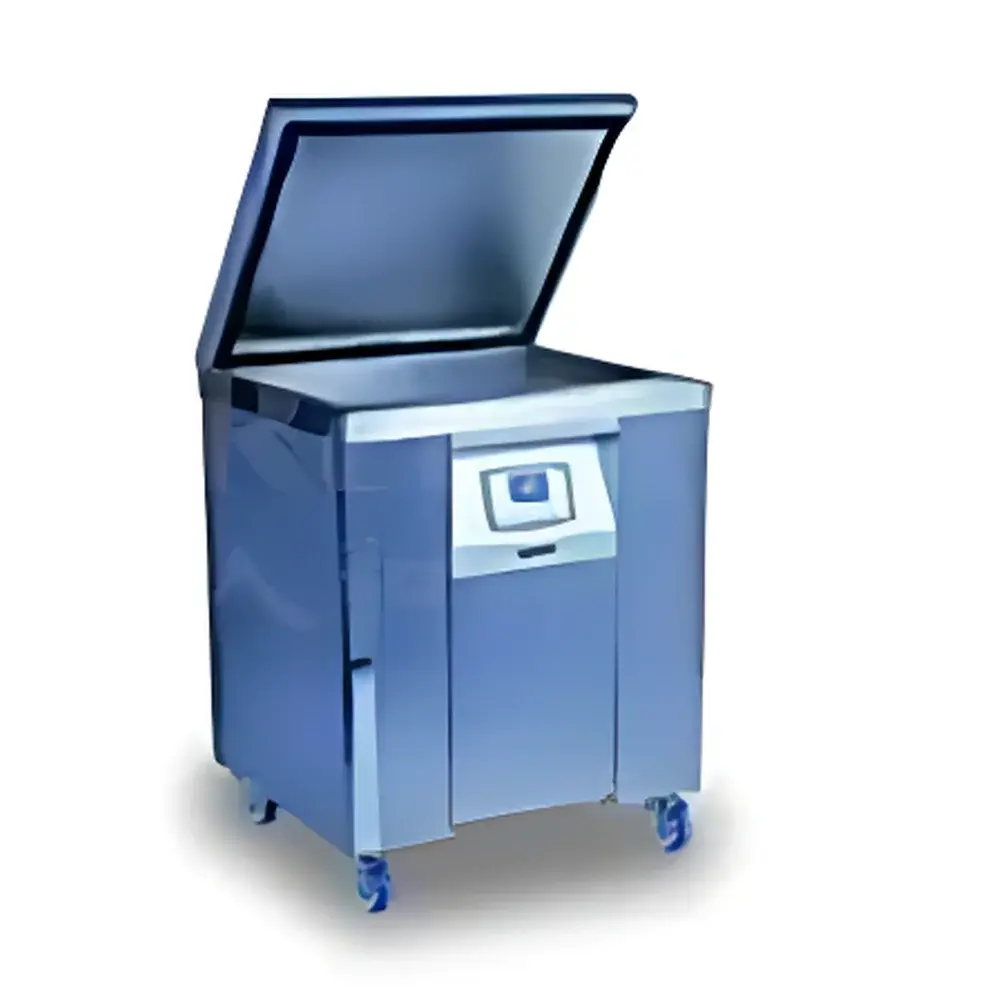
KUDOS SK-24C 90L Floor-Standing Ultrasonic Cleaner with LCD Control Panel
| Brand | KUDOS |
|---|---|
| Origin | Shanghai, China |
| Model | SK-24C |
| Tank Capacity | 90 L |
| Ultrasonic Frequency | 25 kHz |
| Total Ultrasonic Power | 1000 W |
| Power Adjustment Range | 40–100% in 1% increments |
| Temperature Control Range | 20–60 °C |
| Timer Range | 1–199 min |
| Tank Dimensions (W×D×H) | 54 × 41 × 41 cm |
| Overall Dimensions (W×D×H) | 61 × 60 × 77 cm |
| Transducer Count | 24 |
| Tank Material | 304 Stainless Steel |
| Drain Valve | Yes |
| Dry-Run Protection | Yes |
| Power Supply | 220 V / 50 Hz |
| Parameter Memory Function | Yes |
| Heating & Ultrasonic Synchronization | Yes |
Overview
The KUDOS SK-24C is a heavy-duty, floor-standing ultrasonic cleaning system engineered for high-throughput laboratory and industrial maintenance applications requiring consistent, repeatable removal of particulate, organic, and light oily contaminants from complex geometries. Operating at a fundamental frequency of 25 kHz, the unit leverages low-frequency cavitation dynamics optimized for macro-scale debris dislodgement—particularly effective on robust components such as metal tools, glassware assemblies, filtration housings, and machined parts. Its 90-liter stainless steel tank (304 grade) provides ample volume for batch processing of large or multiple items, while the integrated 24-transducer array ensures uniform energy distribution across the entire bath volume. Unlike high-frequency cleaners designed for delicate microstructures, the SK-24C prioritizes mechanical cleaning efficacy through controlled, high-intensity acoustic streaming and transient cavitation collapse—making it suitable for pre-sterilization cleaning, QC sample preparation, and routine instrument maintenance in regulated environments.
Key Features
- Intelligent LCD control panel with backlit display for intuitive parameter navigation and real-time monitoring of setpoint vs. actual temperature, elapsed time, and power output.
- Precision power regulation from 40% to 100% in 1% increments—enabling method optimization for varying soil loads and substrate sensitivities without hardware modification.
- Programmable heating function (20–60 °C) synchronized with ultrasonic activation to enhance detergent kinetics and solubilization efficiency; temperature displayed continuously on-screen.
- Dry-run detection circuitry automatically halts heating and alerts operator if liquid level falls below safe operational threshold—preventing transducer overheating and tank damage.
- Non-volatile memory retains last-used operating parameters (time, temperature, power) after power interruption, reducing setup time for repeat protocols.
- Integrated drain valve facilitates rapid, spill-free tank emptying—critical for solvent recovery, bath replenishment, or cross-contamination prevention between cleaning cycles.
- Rugged floor-standing chassis with reinforced base and ergonomic height positioning minimizes vibration transmission and improves operator ergonomics during loading/unloading.
Sample Compatibility & Compliance
The SK-24C accommodates a broad range of sample types—including glass, ceramic, stainless steel, aluminum, and certain engineering plastics—provided they are chemically compatible with aqueous or mild solvent-based cleaning media. Its 25 kHz frequency avoids excessive surface pitting on softer metals while maintaining sufficient cavitation energy for embedded particulates. The unit complies with IEC 61000-6-3 (EMC emission standards) and IEC 61000-6-2 (immunity), and its construction meets IP20 ingress protection requirements for indoor laboratory use. While not certified for ISO 13485 or FDA 21 CFR Part 11 out-of-the-box, its programmable parameters, audit-ready timer logs (via optional RS232/USB interface), and stable thermal-ultrasonic coupling support integration into GLP/GMP-aligned cleaning validation protocols when paired with documented SOPs and calibration records.
Software & Data Management
The SK-24C operates via embedded firmware with no external software dependency. All user-defined parameters—including time, temperature, and power level—are stored in EEPROM with timestamp-independent retention. Optional communication modules (RS232 or USB-to-serial adapters) enable connection to laboratory information management systems (LIMS) or custom data acquisition platforms for automated logging of cycle start/end times, temperature profiles, and fault codes. For regulatory traceability, users may implement external electronic logbooks that capture operator ID, batch number, and cleaning media lot information alongside device-generated timestamps—supporting alignment with ASTM F3127 (Standard Guide for Validation of Cleaning Processes for Reusable Medical Devices) and internal QA documentation requirements.
Applications
- Pre-sterilization cleaning of surgical instruments, dental handpieces, and reusable endoscope components prior to autoclaving or ethylene oxide treatment.
- Removal of flux residues, solder paste, and machining oils from PCB assemblies and precision mechanical parts in electronics manufacturing QA labs.
- Routine decontamination of volumetric glassware, centrifuge rotors, and chromatography column hardware in analytical chemistry and pharmaceutical R&D settings.
- Supporting ASTM D2240 (Shore A hardness) and ISO 868 sample preparation by eliminating mold-release agents or surface contaminants prior to testing.
- Batch cleaning of filter cartridges, membrane housings, and fluid-path components in bioprocessing facilities where microbial load reduction precedes integrity testing.
FAQ
What is the recommended cleaning solution for the SK-24C?
Aqueous alkaline or neutral pH detergents are preferred for general lab use; avoid chloride-containing solutions to preserve 304 stainless steel integrity. Solvent-based baths require compatibility verification with transducer encapsulation materials.
Can the SK-24C be used for degassing liquids?
Yes—its 25 kHz output effectively removes dissolved air from solvents and mobile phases; however, extended degassing (>10 min) may accelerate evaporation and requires temperature monitoring.
Is calibration required for routine operation?
While no mandatory calibration is specified by the manufacturer, periodic verification of temperature accuracy (±1 °C) and timer deviation (<±0.5%) is advised for GxP environments using NIST-traceable references.
How often should the tank water be changed?
Frequency depends on soil load and process criticality; for validated cleaning steps, change after each batch or per SOP-defined maximum exposure time—typically every 4–8 hours of cumulative operation.
Does the unit support remote start/stop or network integration?
Not natively; external relay control or PLC interfacing is possible via dry-contact terminals (optional accessory), but Ethernet or Wi-Fi connectivity is not supported.



