
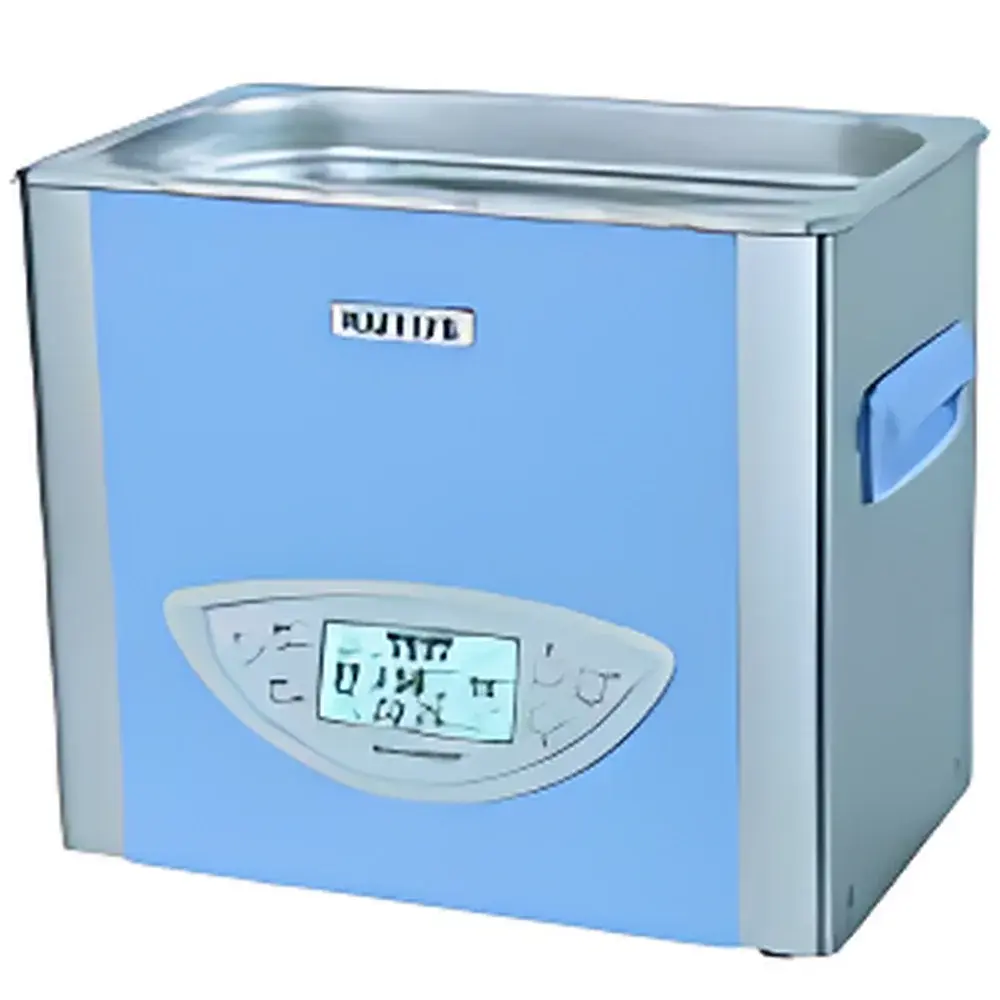
KUDOS SK2200LHC Dual-Frequency Benchtop Ultrasonic Cleaner
| Brand | KUDOS |
|---|---|
| Origin | Shanghai, China |
| Manufacturer Type | Authorized Distributor |
| Regional Classification | Domestic (China) |
| Model | SK2200LHC |
| Instrument Type | General-Purpose Ultrasonic Cleaner |
| Tank Capacity | 3 L |
| Ultrasonic Frequencies | 35 kHz / 53 kHz |
| Ultrasonic Power Output | 100 W |
| Power Adjustment Range | 40–100% of nominal power in 1% increments |
| Timer Range | 1–199 minutes |
| Display | Backlit LCD with real-time parameter interface |
| Temperature Monitoring | Built-in sensor for tank liquid temperature (non-heating unit) |
| Power Failure Memory | Yes |
| Tank Material | AISI 304 stainless steel |
| Internal Dimensions (L×W×H) | 240 × 140 × 100 mm |
| External Dimensions (L×W×H) | 270 × 160 × 240 mm |
| Carton Dimensions (L×W×H) | 367 × 267 × 334 mm |
| Net Weight | 3.7 kg |
| Gross Weight | 4.5 kg |
| Standard Accessory | Stainless steel support rack |
| Input Power Supply | 220 V AC, 50 Hz |
Overview
The KUDOS SK2200LHC is a dual-frequency benchtop ultrasonic cleaner engineered for precision cleaning of delicate laboratory components, analytical instrumentation parts, optical elements, electronic assemblies, and small-volume sample containers. It operates on the principle of acoustic cavitation—where high-frequency sound waves generate microscopic vacuum bubbles in the cleaning fluid that collapse violently upon reaching resonance, producing localized high-pressure and high-temperature micro-jets capable of dislodging sub-micron contaminants from complex geometries. The dual-frequency capability (35 kHz and 53 kHz) allows users to select optimal energy transfer characteristics: lower frequency delivers higher cavitation intensity suited for robust particulate removal from machined metal surfaces, while the higher frequency provides finer, more uniform energy distribution ideal for fragile substrates such as silicon wafers, microfluidic chips, or coated optics. Designed for ISO/IEC 17025-compliant laboratories and GLP environments, the SK2200LHC meets mechanical stability and electromagnetic compatibility requirements per IEC 61000-6-3 and IEC 61000-6-2.
Key Features
- Dual-frequency operation (35 kHz / 53 kHz) with manual selection via intuitive backlit LCD menu interface
- Precision digital timer adjustable from 1 to 199 minutes in 1-minute increments
- Continuously variable ultrasonic power control from 40% to 100% of rated 100 W output, calibrated in 1% steps for reproducible energy delivery
- Real-time display of tank liquid temperature (sensor-integrated, non-heating design), supporting thermal consistency monitoring during extended cycles
- Power-failure memory function retains last-used operational parameters (frequency, time, power level) after unexpected shutdown
- Corrosion-resistant AISI 304 stainless steel tank (240 × 140 × 100 mm internal dimensions) with rounded corners to minimize standing wave interference and ensure uniform cavitation field distribution
- Compact footprint (270 × 160 × 240 mm) optimized for fume hood integration or shared benchtop use in QC/QA labs
Sample Compatibility & Compliance
The SK2200LHC accommodates standard laboratory vessels including glass beakers (up to 500 mL), quartz cuvettes, syringe filters, HPLC vials, watch glasses, and semiconductor wafer carriers. Its non-heating architecture eliminates thermal degradation risks for temperature-sensitive polymers, adhesives, or biological residues. The unit complies with general safety standards for Class II laboratory equipment under GB 4793.1–2019 (equivalent to IEC 61010-1) and conforms to RoHS Directive 2011/65/EU for hazardous substance restriction. While not certified for sterile processing per ISO 13485, it supports cleaning validation protocols aligned with ASTM D2299 (Standard Practice for Cleaning Validation in Pharmaceutical Manufacturing) when used with documented detergent selection and rinse verification.
Software & Data Management
The SK2200LHC operates as a standalone instrument without proprietary software or PC connectivity. All operational parameters are configured and monitored locally via its embedded microcontroller-driven LCD interface. Parameter settings—including frequency mode, duration, and power percentage—are retained in non-volatile memory and recalled automatically at power-on. For regulated environments requiring audit trails, users may integrate external logging via serial or analog output (optional accessory module available upon request) compatible with LabVantage, STARLIMS, or custom SCADA systems. The device supports 21 CFR Part 11–compliant data integrity practices when paired with validated procedural documentation and user access controls.
Applications
- Cleaning of HPLC/GC autosampler vials, injection needles, and column frits prior to trace-level analysis
- Removal of polishing compounds and organic residues from optical lenses, mirrors, and laser components
- Preparation of electron microscopy specimens (e.g., TEM grids, SEM stubs) requiring particle-free surfaces
- Decontamination of reusable pipette tips, electrophoresis combs, and microtiter plates in molecular biology workflows
- Surface preparation of metal coupons for corrosion testing (ASTM G1–21) and adhesion studies
- Routine maintenance of gravimetric balance pans, weighing boats, and volumetric glassware in calibration labs
FAQ
Does the SK2200LHC include a heater?
No. This model is a non-heating ultrasonic cleaner. Temperature monitoring is provided solely for process awareness; no active heating element is installed.
Can the unit operate continuously for more than 199 minutes?
No—the maximum programmable cycle is 199 minutes. For extended cleaning, users must manually restart the timer after completion.
Is the 35/53 kHz switching automatic or user-selectable?
Frequency selection is fully manual via the front-panel interface. No auto-sensing or adaptive frequency modulation is implemented.
What cleaning solutions are compatible with the 304 stainless steel tank?
Aqueous alkaline, neutral, and mildly acidic solutions (pH 4–10) are recommended. Avoid halogenated solvents, strong oxidizers (e.g., concentrated HNO₃), and chlorinated cleaners to prevent pitting corrosion.
Is a degassing function included?
No dedicated degas mode is present. Users should manually degas cleaning solution by running the unit empty for 5–10 minutes before introducing samples.



