
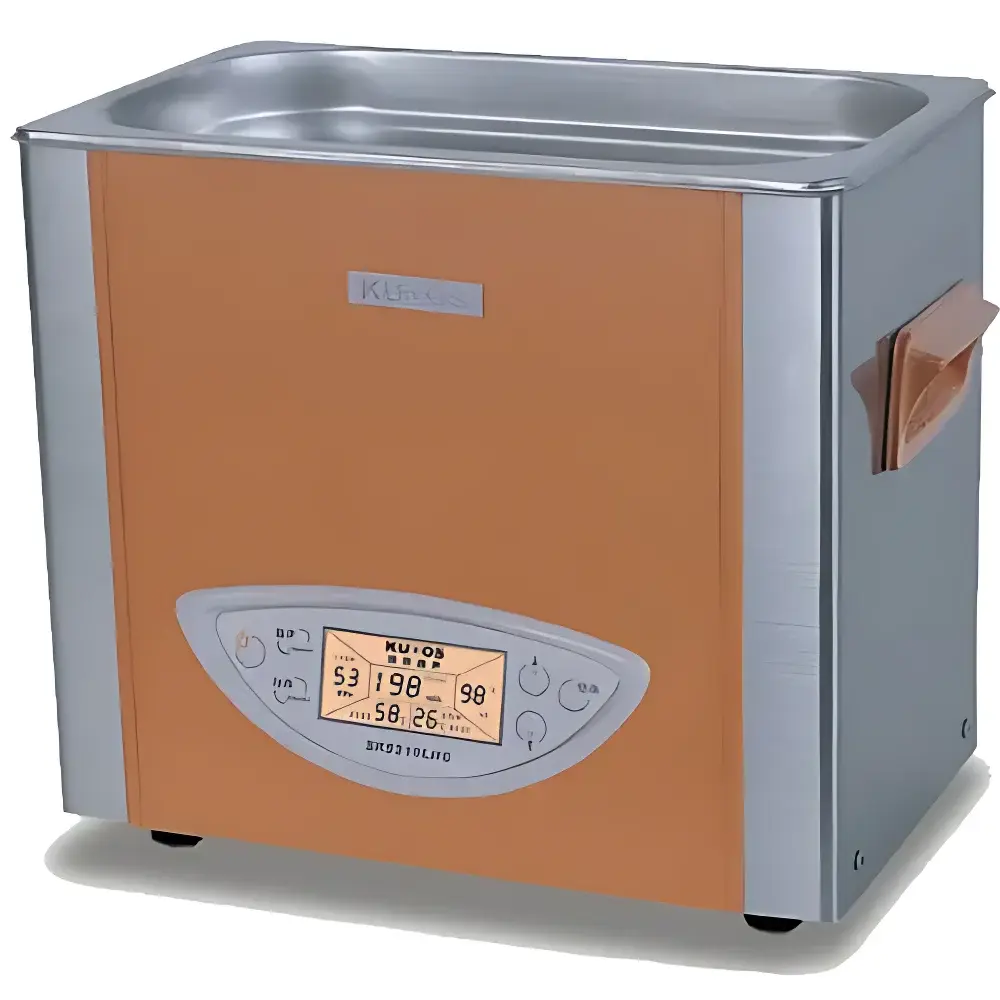
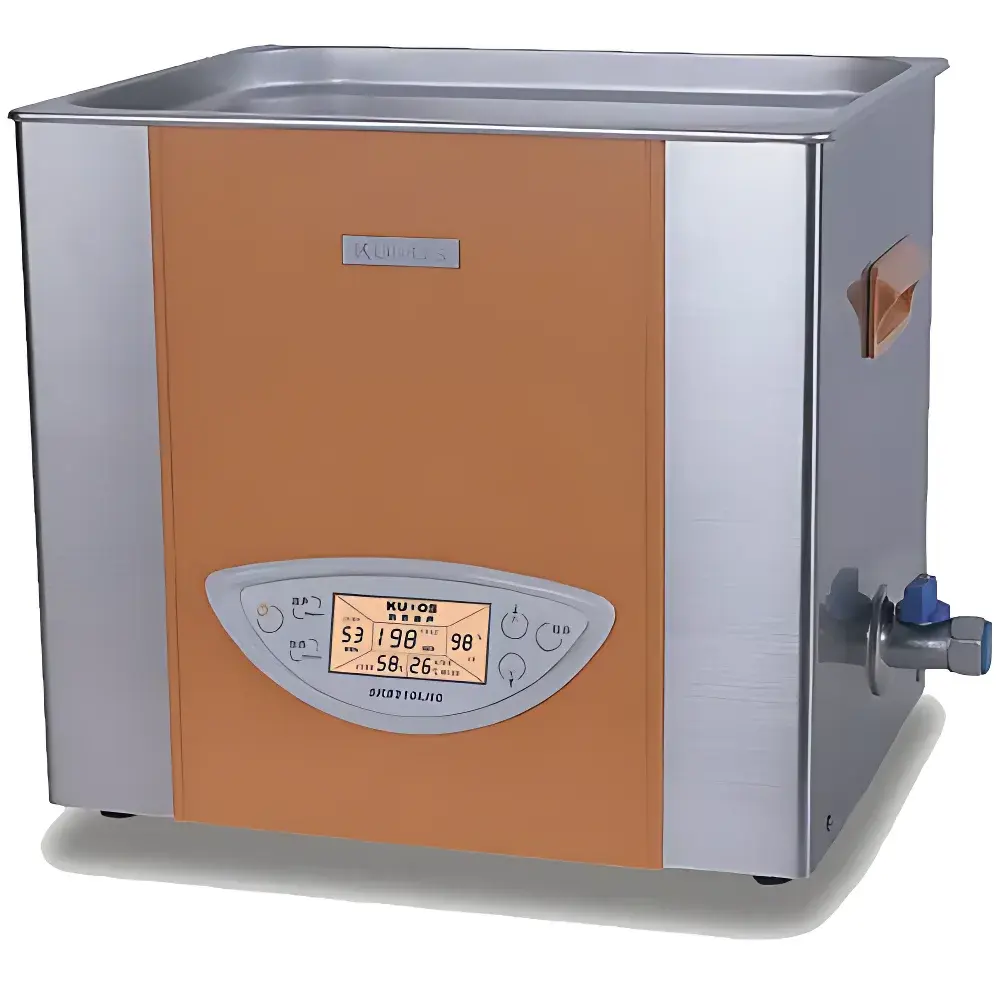
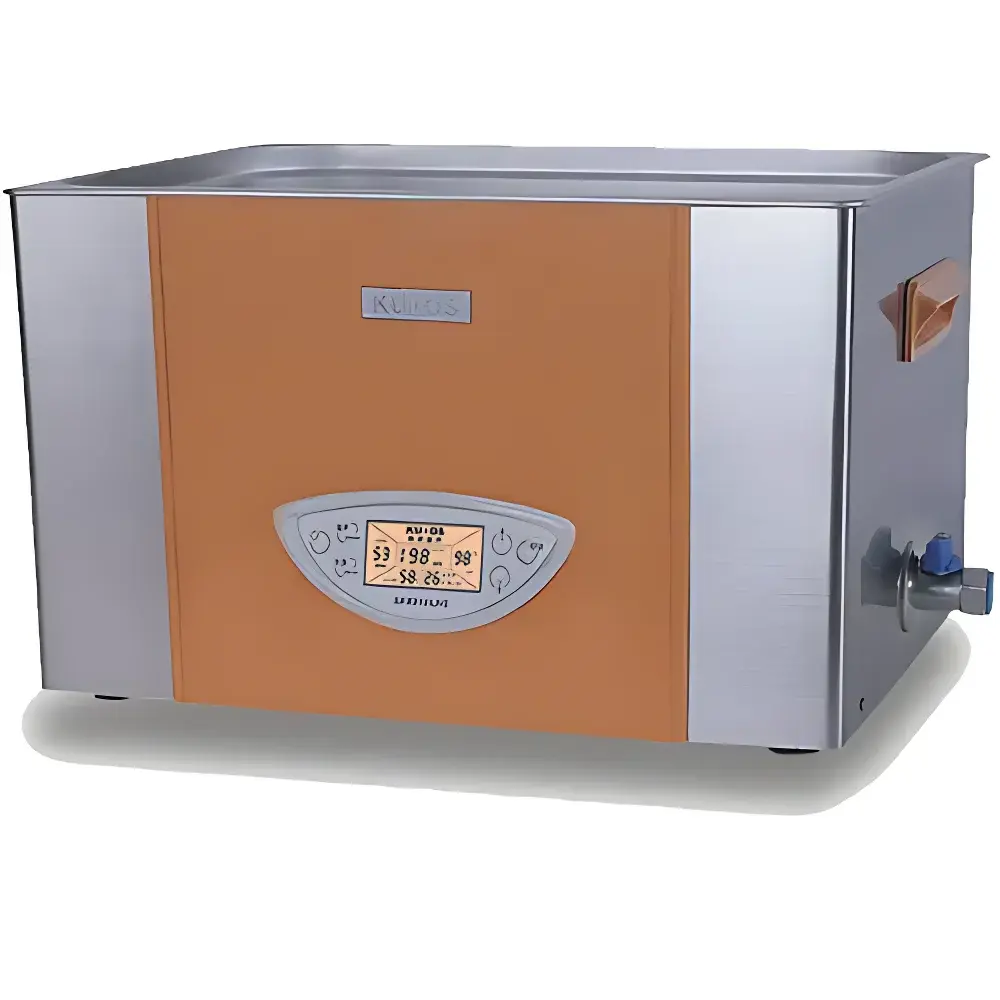
KUDOS SK2210LHC / SK3210LHC / SK3310LHC / SK5210LHC Dual-Frequency Heated Ultrasonic Cleaner
| Brand | KUDOS |
|---|---|
| Origin | Shanghai, China |
| Model Series | SK2210LHC / SK3210LHC / SK3310LHC / SK5210LHC / SK2510LHC / SK6210LHC / SK7210LHC / SK8210LHC |
| Capacity | 3–22.5 L |
| Ultrasonic Frequency | 35 kHz / 53 kHz (switchable) |
| Ultrasonic Power Output | 100–500 W |
| Power Adjustment | 40–100% in 1% increments |
| Heating Temperature Range | 20–60 °C |
| Timer Range | 1–99 min |
| Sound-Reducing Lid | Yes |
| Drain/Inlet | Manual control |
| Tank Material | 304 Stainless Steel |
| Input Power | 220 V / 50 Hz |
| Dry-Run Protection | Yes |
| Parameter Memory Function | Yes |
| Display | Backlit LCD with menu-driven interface |
Overview
The KUDOS Dual-Frequency Heated Ultrasonic Cleaner is a precision-engineered laboratory instrument designed for reproducible, residue-free cleaning of delicate and complex components—including glassware, metal parts, optical lenses, semiconductor wafers, and medical instruments. Operating on the principle of acoustic cavitation, the system generates high-intensity micro-bubbles in liquid media through piezoelectric transducers bonded to the stainless-steel tank base. The dual-frequency capability—35 kHz and 53 kHz—enables optimization across diverse sample geometries and contaminant types: lower frequency delivers higher cavitation energy for robust particulate removal from macro-scale surfaces, while higher frequency provides finer, more uniform cavitation distribution ideal for microstructures and sensitive substrates. Integrated heating (20–60 °C) accelerates solvent activity and enhances dissolution of organic residues without thermal degradation, while precise power modulation (40–100% in 1% steps) ensures process control aligned with material compatibility requirements.
Key Features
- Dual-frequency operation (35 kHz / 53 kHz), manually switchable via intuitive LCD interface
- Backlit LCD display with full menu navigation for real-time monitoring of set temperature, actual bath temperature, elapsed time, and power level
- Continuous ultrasonic power adjustment from 40% to 100% in 1% increments—enabling fine-tuned energy delivery for fragile or coated samples
- Programmable timer (1–99 minutes) with automatic shutdown and audible end-of-cycle alert
- Intelligent dry-run protection: automatic shutdown and visual/audible alarm when water level falls below safe operating threshold
- Stainless-steel tank (AISI 304) with reinforced transducer mounting for long-term mechanical stability and corrosion resistance
- Sound-dampening hinged lid reduces ambient noise and minimizes solvent evaporation during extended cycles
- Power parameter memory function retains last-used settings after power interruption—reducing setup time between sequential operations
- Manual fill-and-drain configuration compatible with standard lab utility connections and secondary containment protocols
Sample Compatibility & Compliance
This cleaner supports a broad range of sample types commonly encountered in analytical, pharmaceutical, and microfabrication laboratories—including volumetric flasks, HPLC vials, pipette tips, surgical forceps, microfluidic chips, and MEMS devices. Its non-contact cleaning mechanism avoids mechanical abrasion, preserving dimensional integrity and surface finish. The unit complies with IEC 61000-6-3 (EMC emission standards) and meets basic electrical safety requirements per IEC 61010-1 for laboratory equipment. While not certified for ISO 13485 or FDA 21 CFR Part 11 out-of-the-box, its programmable parameters, repeatable timing, and temperature logging capability (when interfaced with external data loggers) support GLP/GMP-aligned cleaning validation protocols. Users are advised to validate cycle parameters per ASTM D4163 (standard guide for ultrasonic cleaning of precision parts) and internal SOPs.
Software & Data Management
The KUDOS Dual-Frequency Cleaner operates as a standalone benchtop device with no embedded software stack or network connectivity. All operational parameters—including frequency selection, power percentage, set temperature, and timer duration—are configured directly via the front-panel LCD interface. No proprietary drivers, firmware updates, or cloud-based platforms are required. For traceability in regulated environments, users may integrate optional external USB or RS-232 data loggers to record timestamped bath temperature and cycle completion events. The absence of onboard storage or user authentication aligns with low-risk instrumentation classifications under EU MDR Annex II and USP Analytical Instrument Qualification guidelines.
Applications
- Routine decontamination of glassware and plastic labware prior to spectroscopic or chromatographic analysis
- Removal of polishing compounds and oxide layers from optical components and photomasks
- Cleaning of reusable surgical instruments in hospital central sterile supply departments (CSSD)
- Pre-bonding surface preparation of silicon wafers and ceramic substrates in R&D cleanrooms
- Extraction assistance for solid-phase microextraction (SPME) probes and filter membranes
- Disaggregation of aggregated nanoparticles in colloidal suspensions for DLS or TEM sample prep
- Supporting ASTM E1970 (standard practice for ultrasonic cleaning verification) through documented parameter consistency
FAQ
Is this unit suitable for use with flammable solvents?
No. The heater and transducer design are intended for aqueous or low-volatility aqueous-alcohol mixtures only. Flammable solvents require explosion-proof certified systems with intrinsically safe controls and vapor management—this model does not meet those specifications.
Can the timer be extended beyond 99 minutes?
No. The maximum programmable duration is 99 minutes per cycle. For longer treatments, manual restart or external timer coordination is required.
Does the unit include a degassing function?
No dedicated degas mode is provided. However, initiating operation at low power (40–50%) for 2–3 minutes before ramping up achieves effective air removal from cleaning solutions.
What maintenance is recommended for long-term reliability?
Monthly inspection of tank integrity, transducer adhesion, and lid seal condition is advised. Annual calibration of temperature sensor accuracy against NIST-traceable reference is recommended for GxP applications.



