
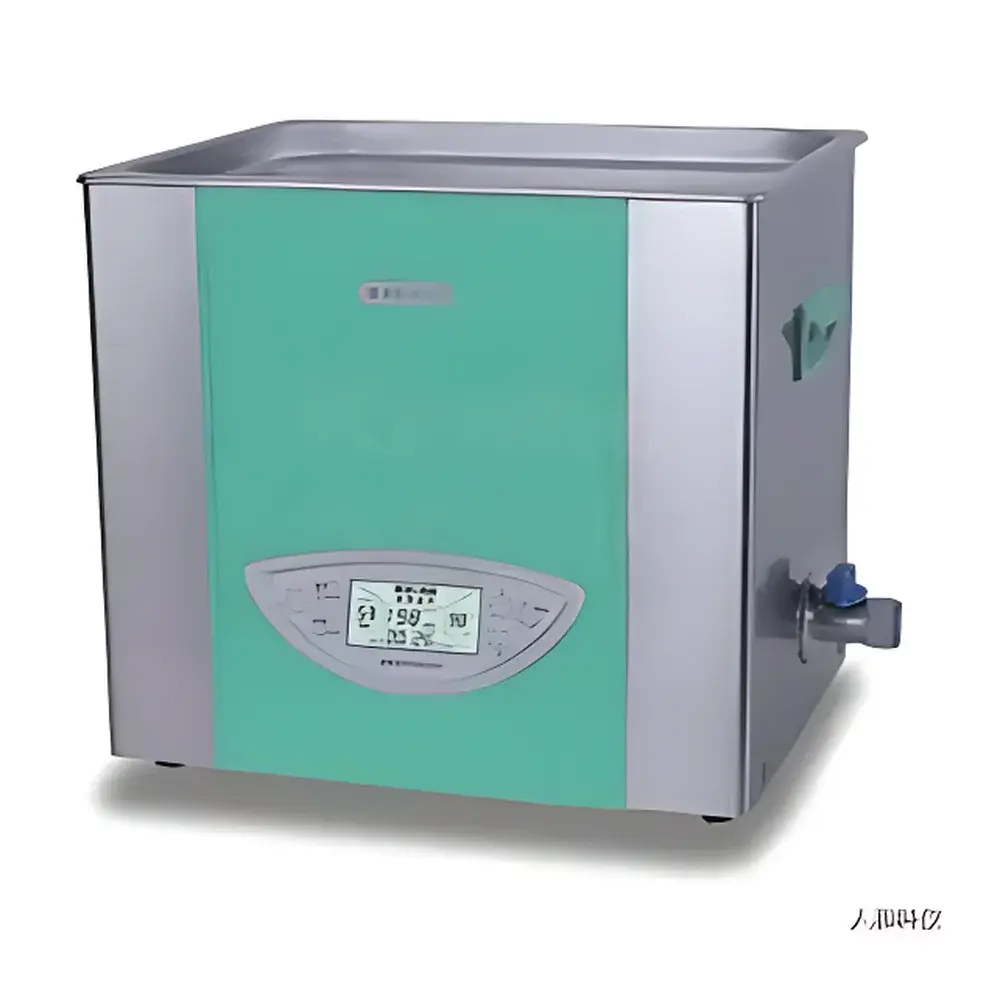
KUDOS SK250HP Adjustable-Power Benchtop Ultrasonic Cleaner
| Brand | KUDOS |
|---|---|
| Origin | Shanghai, China |
| Model | SK250HP |
| Tank Capacity | 10 L |
| Ultrasonic Frequency | 53 kHz |
| Nominal Ultrasonic Power Output | 250 W |
| Power Adjustment Range | 40–100% of full power in 1% increments |
| Timer Range | 1–199 minutes |
| Display | Backlit LCD with real-time parameter readout |
| Tank Material | 304 Stainless Steel |
| Dimensions (L×W×H) | 300 × 240 × 150 mm (tank) / 360 × 270 × 310 mm (unit) |
| Net Weight | 7.4 kg |
| Power Supply | 220 V, 50 Hz |
| Accessories | Support rack, soft drain hose, drain valve |
| Compliance | Designed for general laboratory cleaning per ISO 13485-aligned manufacturing practices and compatible with GLP documentation workflows |
Overview
The KUDOS SK250HP is a precision-engineered benchtop ultrasonic cleaner designed for consistent, repeatable removal of particulate contaminants, organic residues, and loosely adhered films from laboratory glassware, metal components, optical elements, and precision instrumentation. Operating at a fixed frequency of 53 kHz, the unit leverages high-intensity cavitation generated within a degassed aqueous medium to deliver mechanical energy at the microscale—enabling effective cleaning without surface abrasion or chemical aggression. Its 10-liter stainless-steel tank (304 grade) provides sufficient volume for standard beakers, flasks, pipette tips, filters, and small assemblies while maintaining acoustic uniformity across the bath. Unlike fixed-power units, the SK250HP integrates digitally controlled power modulation—allowing users to match energy delivery precisely to sample sensitivity and soil load, thereby minimizing erosion risk on delicate substrates such as coated optics or MEMS devices.
Key Features
- Continuous 1% incremental power adjustment from 40% to 100% of nominal 250 W output—enabling method optimization for diverse sample types and contamination profiles.
- Backlit LCD interface with intuitive menu navigation, displaying real-time timer countdown, selected power level (%), and bath temperature (sensor-enabled, non-heating mode).
- Non-volatile memory retains last-used operating parameters—including time, power setting, and timer status—ensuring procedural continuity after power interruption.
- Integrated drain valve and included soft PVC drain hose facilitate rapid, spill-free bath evacuation between cleaning cycles.
- Robust 304 stainless-steel tank construction resists corrosion from common aqueous detergents, mild alkaline solutions, and ethanol-based rinses.
- Compact footprint (360 × 270 × 310 mm) and low net weight (7.4 kg) support flexible placement on fume hood ledges, analytical workbenches, or mobile carts.
Sample Compatibility & Compliance
The SK250HP accommodates a broad range of laboratory items, including volumetric glassware (e.g., Class A flasks and burettes), stainless-steel forceps and tweezers, ceramic crucibles, anodized aluminum fixtures, and silicon wafers prior to lithography. It is not intended for use with flammable solvents, strong oxidizers (e.g., concentrated HNO₃), or materials susceptible to ultrasonic fatigue (e.g., certain polymer composites). The unit complies with IEC 61000-6-3 (EMC emission standards) and meets basic safety requirements under IEC 61010-1 for laboratory electrical equipment. While not certified for sterile processing per ISO 13485 or FDA 21 CFR Part 820, its design supports integration into GLP-compliant environments through traceable parameter logging (via external data capture) and repeatable operational protocols aligned with ASTM D4295 and ISO 11553-1 for ultrasonic cleaning validation.
Software & Data Management
The SK250HP operates via embedded firmware with no proprietary software dependency. All settings are configured directly through the front-panel interface. For laboratories requiring audit trails, the unit’s parameter retention function enables manual documentation of each run (time, power %, duration) in electronic lab notebooks (ELNs) or paper-based SOP logs. When deployed in regulated QC/QA settings, users may pair the cleaner with time-stamped video recording or integrate it into facility-wide environmental monitoring systems using optional relay outputs (not included). No USB, Ethernet, or Wi-Fi connectivity is provided—consistent with IEC 62304 Class A medical device software principles emphasizing deterministic behavior and reduced attack surface.
Applications
- Routine decontamination of HPLC vials, syringe filters, and autosampler components prior to trace-level analysis.
- Preparation of TEM grids and SEM stubs by removing carbon residue and hydrocarbon films without altering surface topography.
- Cleaning of calibration standards (e.g., NIST-traceable weights, reference mirrors) where mechanical wiping is prohibited.
- Removal of solder flux and rosin residues from PCB prototypes in electronics R&D labs.
- Supporting ISO/IEC 17025 accredited testing workflows where documented cleaning parameters are required for uncertainty budgeting.
FAQ
Does the SK250HP include a heating function?
No. This model operates in ambient-temperature ultrasonic mode only. Bath temperature is monitored and displayed but not actively controlled.
Can the unit be used with organic solvents?
It is not recommended. The 304 stainless-steel tank and internal transducers are rated for aqueous solutions only; solvent exposure may compromise gasket integrity and transducer bonding.
Is the timer programmable for delayed start?
No. The timer initiates immediately upon activation and supports only forward-counting intervals from 1 to 199 minutes.
What maintenance is required for long-term reliability?
Routine inspection of the drain valve seal, periodic descaling of the tank interior using 5% citric acid solution, and visual verification of transducer mounting integrity every 6 months.
How is acoustic uniformity ensured across the 10 L tank?
Transducer placement follows empirical nodal mapping at 53 kHz; the tank geometry (300 × 240 × 150 mm) was optimized to minimize standing-wave interference and promote even cavitation density, validated via aluminum foil erosion testing per ASTM D4295 Annex A1.



