
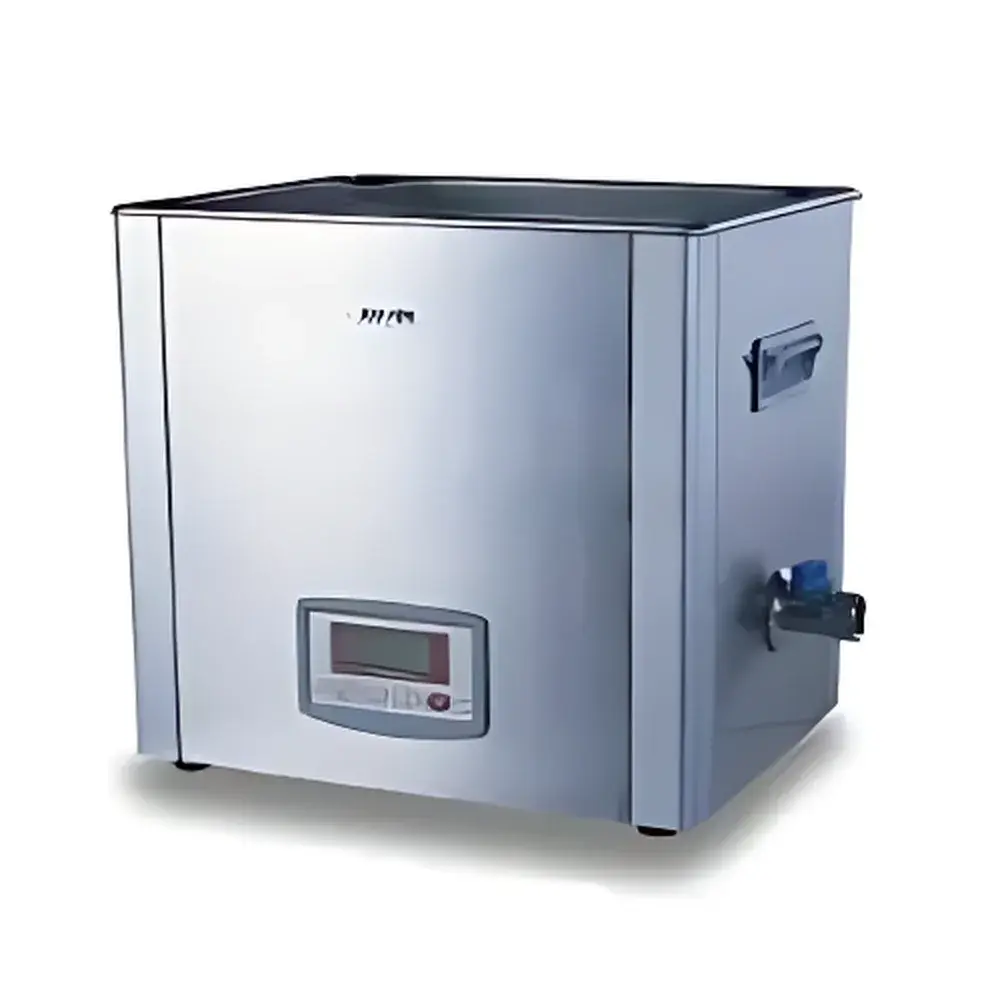
KUDOS SK5200H High-Frequency Benchtop Ultrasonic Cleaner
| Brand | KUDOS |
|---|---|
| Origin | Shanghai, China |
| Model | SK5200H |
| Tank Capacity | 10 L |
| Ultrasonic Frequency | 53 kHz |
| Ultrasonic Power | 200 W |
| Timer Range | 1–199 min |
| Tank Material | 304 Stainless Steel |
| Tank Dimensions (L×W×H) | 300 × 240 × 150 mm |
| External Dimensions (L×W×H) | 360 × 270 × 310 mm |
| Net Weight | 7 kg |
| Gross Weight | 8.3 kg |
| Drain Valve | Yes |
| Standard Accessories | Stainless steel support rack, flexible drain hose |
Overview
The KUDOS SK5200H is a high-frequency benchtop ultrasonic cleaner engineered for precision cleaning and auxiliary laboratory processes in research, quality control, and production environments. Operating at a fixed frequency of 53 kHz, it leverages cavitation physics—where rapid formation and collapse of microscopic vacuum bubbles in liquid generate localized high-pressure shockwaves and transient temperatures—to remove particulate contaminants, organic residues, and thin oxide layers from surfaces of immersed components. Unlike lower-frequency units (<40 kHz), the 53 kHz output delivers finer, more uniform cavitation distribution, making it especially suitable for delicate substrates such as optical lenses, semiconductor wafers, microfluidic devices, and precision instrumentation parts. Its 10-liter stainless-steel tank (304 grade) provides sufficient volume for batch processing of small-to-medium-sized samples while maintaining thermal and chemical stability across aqueous and mild solvent-based cleaning media.
Key Features
- Stable 53 kHz ultrasonic transducer array with optimized energy coupling into the cleaning bath, ensuring consistent cavitation intensity across the full tank volume.
- Digital timer with extended range (1–199 minutes), enabling precise process control for both short-duration degassing and extended extraction or sonication protocols.
- Robust 304 stainless-steel tank construction resistant to corrosion from water, alcohols, acetone, and common alkaline or acidic cleaning solutions.
- Integrated drain valve and included flexible drain hose facilitate safe, spill-free solution exchange—critical for multi-step cleaning workflows requiring sequential rinsing or solvent replacement.
- Adjustable support rack allows vertical or horizontal sample positioning, improving acoustic exposure uniformity and preventing direct contact between sensitive items and tank bottom.
- Front-panel backlit LCD display provides real-time visibility of operating time and power status under varied ambient lighting conditions typical in shared lab spaces.
Sample Compatibility & Compliance
The SK5200H accommodates a broad range of sample geometries and materials—including glassware, metal fixtures, ceramic substrates, plastic components (e.g., PTFE, polypropylene), and printed circuit boards—provided they are compatible with ultrasonic energy and the selected cleaning medium. It meets general safety requirements per IEC 61010-1 for electrical equipment used in laboratory settings. While not certified for medical device reprocessing per ISO 15883 or sterilization validation per ANSI/AAMI ST79, its performance aligns with standard operating procedures referenced in ASTM D2297 (adhesive surface preparation), USP (particulate matter testing), and ISO 14644-1 (cleanroom component cleaning). Users performing GxP-regulated work should validate cleaning efficacy per their internal SOPs and document parameters including temperature, solution composition, exposure duration, and post-cleaning residue analysis.
Software & Data Management
The SK5200H operates as a standalone analog-digital hybrid system with no embedded firmware, network interface, or data logging capability. All operational parameters—including elapsed time—are manually set and visually monitored via the front-panel LCD. This architecture eliminates software-related validation overhead, supporting straightforward IQ/OQ execution in regulated environments where simplicity, traceability, and deterministic behavior are prioritized over automation. For laboratories requiring electronic recordkeeping, integration with external environmental monitoring systems or time-stamped video documentation is recommended to satisfy FDA 21 CFR Part 11 audit trail expectations for critical cleaning steps.
Applications
- Routine cleaning of pipette tips, cuvettes, syringe filters, and HPLC vials prior to analytical use.
- Preparation of substrates for thin-film deposition, SEM/TEM sample mounting, and surface characterization techniques (e.g., XPS, AFM).
- Accelerated solvent extraction of plant metabolites, polymer additives, or environmental analytes from solid matrices.
- Removal of flux residues and solder paste remnants from PCB assemblies during electronics manufacturing QA.
- Deagglomeration of nanoparticle suspensions and homogenization of colloidal dispersions for formulation development.
- Microbubble-assisted degassing of viscous solvents (e.g., glycerol, silicone oils) prior to microinjection or rheological measurement.
FAQ
Is the SK5200H suitable for cleaning delicate MEMS devices?
Yes—its 53 kHz frequency minimizes macroscopic erosion while delivering effective microscale contaminant removal; however, users should verify compatibility with device packaging and adhesive integrity using representative test samples.
Can the unit be operated continuously for >120 minutes?
The timer supports up to 199 minutes per cycle; for extended operation, manual reset is required after each cycle to prevent thermal overload and ensure transducer longevity.
Does the tank have a heating function?
No—the SK5200H is a non-heated ultrasonic cleaner; bath temperature must be controlled externally if thermally assisted cleaning is required.
What cleaning solutions are compatible with the 304 stainless-steel tank?
Aqueous detergents, isopropyl alcohol, acetone, and diluted citric or phosphoric acid solutions are routinely used; avoid halogenated solvents (e.g., chloroform) and strong oxidizers (e.g., concentrated nitric acid) without confirming material compatibility.
Is calibration or annual maintenance required?
While no formal calibration certificate is provided, periodic verification of timer accuracy and visual inspection of tank integrity, transducer adhesion, and drain valve function are recommended as part of routine lab equipment maintenance per ISO/IEC 17025 Clause 6.4.



