
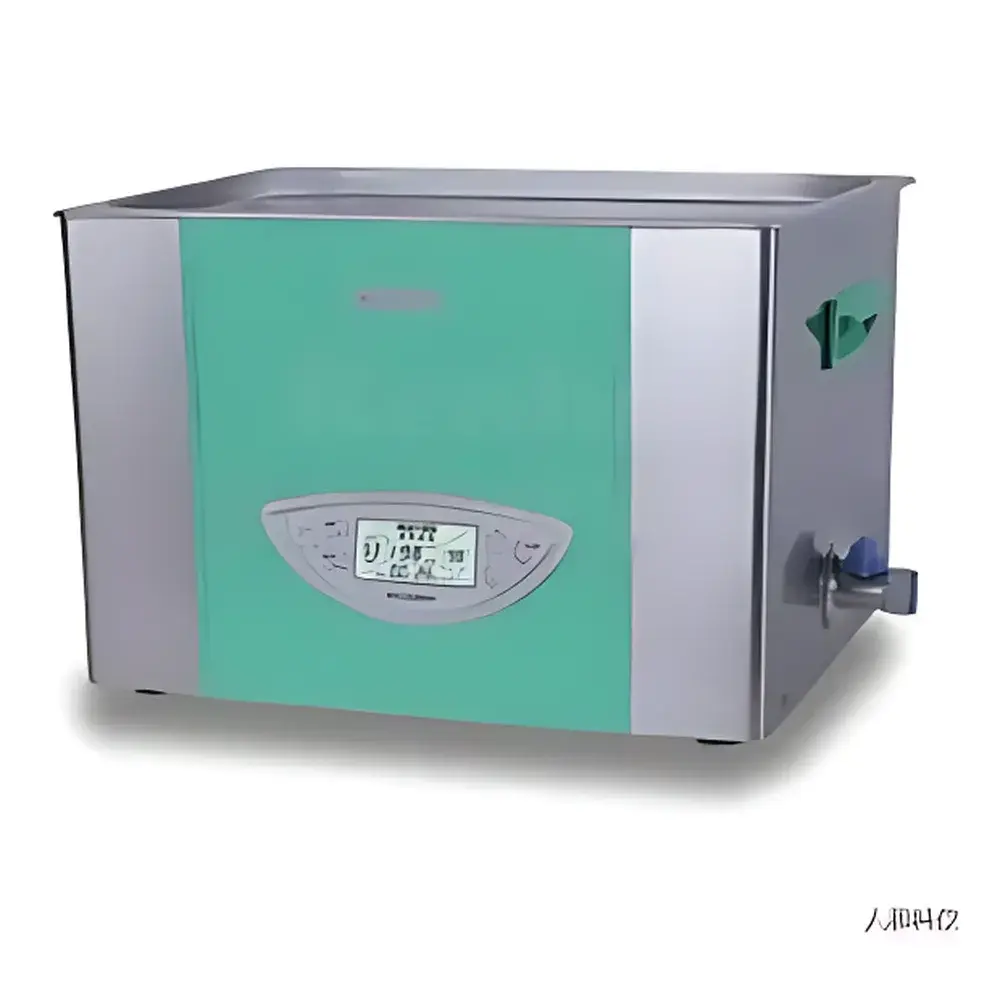
KUDOS SK8200HP Benchtop Ultrasonic Cleaner with Adjustable Power Output
| Brand | KUDOS |
|---|---|
| Origin | Shanghai, China |
| Model | SK8200HP |
| Tank Capacity | 22.5 L |
| Ultrasonic Frequency | 53 kHz |
| Nominal Ultrasonic Power Output | 500 W |
| Power Adjustment Range | 40–100% of full output in 1% incremental steps |
| Timer Range | 1–199 minutes |
| Tank Dimensions (L×W×H) | 500 × 300 × 150 mm |
| External Dimensions (L×W×H) | 570 × 330 × 330 mm |
| Net Weight | 12.2 kg |
| Power Supply | 220 V / 50 Hz |
| Tank Material | AISI 304 stainless steel |
| Display | Backlit LCD with real-time parameter readout |
| Accessories | Support rack, soft drain hose, drain valve |
| Memory Function | Yes (power setting and timer retain last-used values after power cycle) |
| Heating | Not equipped |
Overview
The KUDOS SK8200HP is a benchtop ultrasonic cleaner engineered for precision cleaning of delicate laboratory components—including glassware, metal parts, microfluidic devices, semiconductor wafers, optical lenses, and analytical sample holders—where consistent cavitation intensity and process repeatability are critical. Operating at a fixed frequency of 53 kHz, the unit generates high-intensity acoustic pressure waves in aqueous or compatible solvent media, inducing controlled transient cavitation within the cleaning bath. This physical mechanism disrupts particulate adhesion, removes organic residues, and dislodges sub-micron contaminants without mechanical abrasion or thermal degradation. Designed for integration into QC/QA workflows and GLP-compliant environments, the SK8200HP delivers stable acoustic energy distribution across its 22.5 L tank volume, supported by a robust AISI 304 stainless-steel tank and sealed transducer assembly optimized for long-term duty cycles.
Key Features
- Continuous 1% incremental power adjustment from 40% to 100% of nominal 500 W output—enabling precise optimization for sensitive substrates or low-viscosity solvents.
- Backlit LCD interface with simultaneous display of elapsed time, remaining time, set power level (%), and real-time bath temperature (sensor-integrated, non-heating mode).
- Non-volatile memory retains last-used timer duration and power setting after power interruption—reducing setup time and minimizing operator variability.
- Drain valve and included soft PVC drain hose facilitate rapid, spill-free bath emptying; support rack ensures uniform part suspension and maximizes cavitation exposure.
- Compact footprint (570 × 330 × 330 mm) with reinforced chassis and vibration-dampened feet—suitable for shared lab benches and ISO Class 5–7 cleanroom-adjacent spaces.
- No integrated heater—eliminates risk of solvent boiling, thermal decomposition, or unintended chemical reactions during cleaning of thermolabile samples.
Sample Compatibility & Compliance
The SK8200HP accommodates a wide range of sample geometries and materials, including but not limited to: borosilicate glass vials and cuvettes, stainless-steel syringe components, ceramic chromatography frits, silicon wafers, titanium surgical instruments, and polymer-based microplates. Its 53 kHz frequency balances penetration depth and cavitation density—ideal for removing sub-10 µm particles while minimizing pitting on polished surfaces. The unit complies with IEC 61000-6-3 (EMC emission standards) and IEC 61000-6-2 (immunity). While not certified to UL/CSA safety standards out-of-box, it meets general electrical safety requirements for laboratory use under EN 61010-1 when operated per manufacturer instructions. For regulated environments (e.g., pharmaceutical QC labs), the absence of heating and programmable parameters supports traceability in SOP-driven cleaning validation protocols aligned with USP and ISO 13485 Annex A.
Software & Data Management
The SK8200HP operates via embedded firmware with no external software dependency. All operational parameters—including timer value, power percentage, and elapsed runtime—are stored in non-volatile memory with timestamp-independent retention. Though it lacks USB/Ethernet connectivity or audit trail logging, its deterministic behavior (no firmware updates required, no user-accessible configuration files) ensures stability across long-term deployment. For labs requiring electronic recordkeeping, the device may be integrated into broader instrument management systems via external timers or PLC-triggered start/stop signals (dry-contact input/output optional upon request). Calibration verification is performed using standard aluminum foil erosion tests per ASTM D2603 or ISO 15051-2, with documented results retained as part of equipment qualification (IQ/OQ).
Applications
- Pre-analytical preparation of HPLC/GC vials, autosampler needles, and flow cell components.
- Cleaning of electron microscopy grids and TEM specimen holders prior to coating or imaging.
- Decontamination of reusable pipette tips and PCR plate carriers in molecular biology labs.
- Removal of polishing compounds and oxide layers from optical mirrors and laser optics assemblies.
- Routine maintenance of ultrasonic bath accessories (e.g., degassing trays, transducer mounting fixtures).
- Supporting ASTM E1292 (standard practice for ultrasonic cleaning verification) through repeatable parameter control and documentation-ready operation logs.
FAQ
Does the SK8200HP include a built-in heater?
No. The unit operates in ambient-temperature mode only. Heating is intentionally omitted to prevent solvent volatility, thermal stress on temperature-sensitive components, and uncontrolled reaction kinetics.
Can the timer be paused during operation?
No—the timer is non-interruptible once initiated. To reset, power must be cycled or the unit manually powered off and restarted.
Is the transducer array serviceable in the field?
Transducers are potted and permanently bonded to the tank base. Field replacement is not supported; units requiring transducer repair must be returned to authorized service centers.
What solvents are compatible with the 304 stainless-steel tank?
Aqueous solutions, isopropyl alcohol (IPA), ethanol, acetone, and terpene-based cleaners are routinely used. Strong oxidizers (e.g., concentrated nitric acid) or halogenated solvents (e.g., chloroform) are not recommended due to corrosion risk and potential ultrasonic attenuation.
How often should the cleaning solution be changed?
Solution replacement frequency depends on soil load and application. As a general guideline, change after every 8–10 cleaning cycles or when visible residue accumulates, turbidity increases, or cleaning efficacy declines—verified via visual inspection or particle count testing.



