
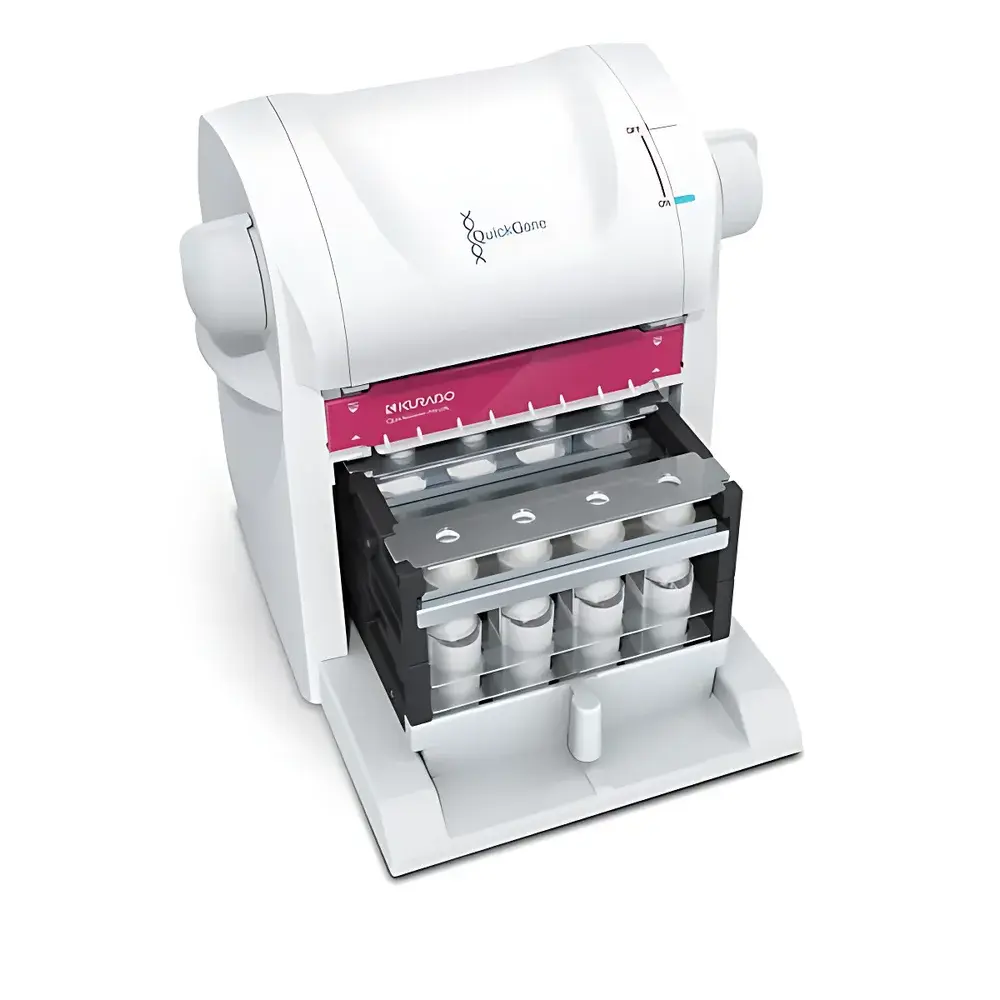
Kurabo mini8L Nucleic Acid Purification System
| Brand | Kurabo |
|---|---|
| Origin | Japan |
| Manufacturer Status | Authorized Distributor |
| Product Origin | Imported |
| Model | mini8L |
| Price Range | USD 7,000–14,000 (FOB) |
| Automation Level | Semi-Automatic Assisted |
| Sample Throughput per Run | 1–8 samples |
| Sample Volume Range | 20–200 µL |
| Processing Time per Batch | 10–45 minutes |
| Membrane Thickness | 80 µm |
| Elution Volume | Adjustable (50–200 µL) |
| Typical DNA Yield | Up to 50 µg from 2 mL whole blood |
| Purity (DNA A₂₆₀/A₂₈₀) | >1.7 |
| Extraction Principle | Pressure-Driven Vacuum Filtration via Porous Membrane |
| Compatible Sample Types | Oropharyngeal swabs, whole blood, plasma/serum, cultured cells, fresh/frozen tissue, bacteria, fungi, and microbial lysates |
| Footprint | Benchtop-Optimized (W × D × H: 280 × 320 × 260 mm) |
| Weight | 8.2 kg |
Overview
The Kurabo mini8L Nucleic Acid Purification System is a compact, benchtop-integrated vacuum-driven purification platform engineered for rapid, centrifuge-free isolation of high-quality genomic DNA and total RNA from diverse biological matrices. Unlike magnetic bead- or column-based systems requiring centrifugation or complex fluidic handling, the mini8L employs a proprietary pressure-controlled filtration architecture centered on Kurabo’s ultra-thin (80 µm), high-capacity porous membrane technology. This design enables complete nucleic acid binding, on-membrane washing, and low-volume elution within a single sealed cartridge—eliminating manual transfer steps, reducing cross-contamination risk, and ensuring reproducible recovery across variable sample viscosities and inhibitor loads. Its certified compatibility with biosafety cabinets (Class II A2/B2) makes it uniquely suited for clinical diagnostic labs, BSL-2 research environments, and decentralized testing sites where space, containment, and operational simplicity are critical constraints.
Key Features
- Benchtop footprint (280 × 320 × 260 mm) and lightweight construction (8.2 kg) enable seamless integration into laminar flow hoods, biosafety cabinets, or crowded molecular workstations.
- Pressure-regulated three-stage workflow—binding, wash, and elution—executed automatically without external centrifuges, magnets, or pumps; operator intervention limited to sample loading and protocol selection.
- Flexible batch processing: supports 1–8 samples per run with consistent yield and purity, validated across ≥12 sample types including whole blood (up to 2 mL input), buccal swabs, Gram-positive bacteria, and fibrous mammalian tissues.
- Modular cartridge system allows rapid reconfiguration: standard 8-sample format (20–200 µL input) and optional 48-well high-throughput module (200 µL input) share identical membrane chemistry and pressure calibration.
- Integrated real-time pressure monitoring and automatic cycle termination prevent membrane clogging and ensure process integrity under variable sample conditions (e.g., hemolyzed blood, viscous sputum).
Sample Compatibility & Compliance
The mini8L has been validated per ISO 20387:2018 (Biobanking) and ASTM E2923-21 (Nucleic Acid Extraction Performance Criteria) for extraction consistency across clinically relevant matrices. It complies with GLP documentation requirements through built-in audit trail logging (user ID, timestamp, protocol version, pressure curve metadata). All consumables—including Kurabo-certified DNA/RNA isolation kits for whole blood, animal tissue, and microbial pellets—are manufactured under ISO 13485 quality management systems and supplied with CoA and lot-specific QC data. The system meets IEC 61010-1 safety standards for laboratory equipment and supports FDA 21 CFR Part 11 compliance when paired with Kurabo’s optional LIMS-integrated software package (v3.2+).
Software & Data Management
Operation is controlled via an embedded 5-inch capacitive touchscreen running firmware v4.1, supporting 12 preloaded protocols (e.g., “Whole Blood DNA – Low Input”, “Bacterial RNA – High Inhibitor”) with editable parameters (vacuum pressure setpoints, dwell times, elution volume). All runs generate encrypted .csv logs containing pressure profiles, duration per stage, and pass/fail flags for each sample position. Raw data export supports CSV, PDF, and XML formats compatible with LabVantage, Thermo Fisher SampleManager, and custom ELN implementations. Optional cloud synchronization (AWS-hosted) enables remote monitoring, multi-site protocol version control, and automated backup—fully auditable per GxP data integrity principles.
Applications
- Clinical diagnostics: Rapid prep of PCR-ready DNA/RNA from residual EDTA blood tubes or nasopharyngeal swabs in infectious disease testing (e.g., SARS-CoV-2, TB, HPV).
- Translational research: Isolation of intact miRNA and lncRNA from serum exosomes using Kurabo’s RNase-inhibiting wash buffers.
- Microbiology labs: Direct lysis and purification from Gram-positive bacterial pellets without enzymatic pretreatment.
- Biosafety-constrained workflows: Fully enclosed processing inside Class II cabinets eliminates aerosol generation during lysate handling—a key advantage over spin-column systems.
- Point-of-need deployment: Battery-compatible operation (optional 12 V DC adapter) supports field use in mobile labs or resource-limited settings.
FAQ
Does the mini8L require a dedicated vacuum pump?
No—the system integrates a maintenance-free diaphragm vacuum generator with adjustable pressure range (20–80 kPa) and automatic overload protection.
Can I use third-party reagents or membranes?
Kurabo validates performance only with OEM cartridges and kits; non-certified consumables void warranty and compromise ISO 20387 traceability.
What is the maximum allowable input volume for tissue homogenates?
Up to 200 µL clarified lysate (post-bead-beating or enzymatic digestion); particulate load must be <5% w/v to prevent membrane occlusion.
Is the eluate compatible with downstream qPCR and NGS library prep?
Yes—eluates meet Qubit® and Bioanalyzer® QC thresholds (A₂₆₀/A₂₈₀ >1.7, RIN >8.5 for RNA) and show no inhibition in TaqMan® assays at 1:10 dilution.
How often does the membrane cartridge need replacement?
Each cartridge is single-use per ISO 15189:2022 requirements; reuse is not permitted due to irreversible binding site saturation and carryover risk.




