
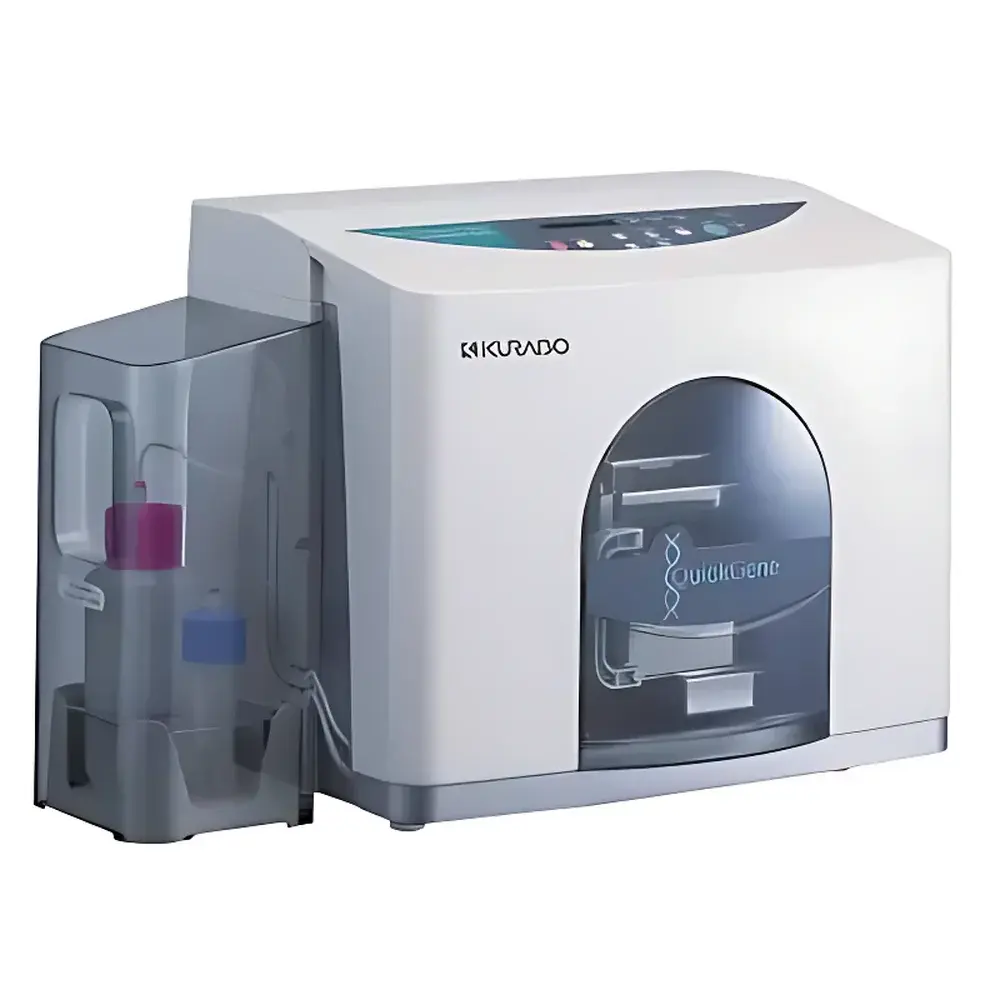
KURABO QuickGene-610L Nucleic Acid Purification System
| Brand | KURABO |
|---|---|
| Origin | Japan |
| Model | QuickGene-610L |
| Sample Throughput | 1–6 samples per run |
| Input Volume | Up to 2 mL whole blood |
| DNA Yield | >50 µg from 2 mL whole blood |
| Purity (A260/A280) | DNA >1.7, RNA >1.8 |
| Membrane Thickness | 80 µm |
| Processing Time | ~12 min for 6 whole blood samples |
| Dimensions | 448 W × 332 D × 398 H mm |
| Weight | ~24 kg |
| Operation | Pressure-driven, centrifuge-free, magnetic bead-free |
| Compatible Kit | QuickGene DNA Blood Kit |
Overview
The KURABO QuickGene-610L Nucleic Acid Purification System is an automated, pressure-driven benchtop instrument engineered for rapid, reproducible isolation of high-purity genomic DNA and total RNA from diverse biological matrices—including whole blood, cultured cells, saliva, buccal swabs, and tissue homogenates. Unlike conventional spin-column or magnetic-bead-based platforms, the QuickGene-610L employs a proprietary multi-pore membrane technology with precisely controlled 80 µm thickness, enabling selective nucleic acid binding under regulated positive air pressure. This eliminates reliance on centrifugation or magnetic separation hardware—reducing mechanical variability, operator dependency, and cross-contamination risk. The system operates on a three-step, fully enclosed protocol: binding, washing, and elution—all completed within a single disposable cartridge. Its design aligns with core principles of Good Laboratory Practice (GLP) and supports audit-ready workflows in regulated environments where traceability and process consistency are critical.
Key Features
- Pressure-driven purification architecture—no centrifuge, no magnets, no vacuum manifolds required.
- Integrated, single-use QuickGene cartridges pre-packed with Kurabo’s ultra-thin (80 µm) multi-pore membrane for consistent binding capacity and low background carryover.
- Programmable processing for 1–6 samples per run, accommodating variable input volumes up to 2 mL whole blood without manual dilution or volume adjustment.
- Complete automation: sample loading, pressure sequencing, buffer delivery, and elution are executed via embedded pneumatic control with real-time pressure monitoring.
- Compact footprint (448 × 332 × 398 mm) and lightweight design (~24 kg) enable deployment in biosafety cabinets, clean rooms, or high-density lab benches.
- Intuitive touchscreen interface with pre-installed protocols—including optimized settings for QuickGene DNA Blood Kit—and user-defined method storage with timestamped execution logs.
Sample Compatibility & Compliance
The QuickGene-610L demonstrates robust performance across clinically and research-relevant specimen types: fresh or EDTA-anticoagulated whole blood, peripheral blood mononuclear cells (PBMCs), cultured mammalian cells, and stabilized oral fluid specimens. All purification steps occur within sealed, sterile, RNase/DNase-free cartridges—minimizing aerosol generation and preserving nucleic acid integrity. The system complies with ISO 13485:2016 requirements for in vitro diagnostic (IVD) device manufacturing processes, and its operational log structure supports alignment with FDA 21 CFR Part 11 for electronic records and signatures when deployed with validated IT infrastructure. While not an IVD-certified instrument itself, it is routinely employed in CLIA-certified laboratories for pre-analytical sample preparation prior to qPCR, NGS library construction, and Sanger sequencing.
Software & Data Management
The onboard firmware provides password-protected user accounts, protocol versioning, and automatic generation of run reports—including start/end timestamps, operator ID, cartridge lot number, and pass/fail status per sample position. Exportable CSV logs contain pressure profiles, cycle durations, and error codes for root-cause analysis. No cloud connectivity or remote access is enabled by default; data remains local unless manually exported via USB interface. Audit trail functionality satisfies GLP/GMP documentation expectations for QC/QA departments managing nucleic acid extraction as a critical control point in molecular assay validation.
Applications
- Routine DNA extraction from biobank blood collections for genotyping and biobanking.
- High-integrity RNA isolation for downstream RT-qPCR and microarray profiling in translational research.
- Preparation of template nucleic acids for next-generation sequencing library construction, particularly where inhibitor removal from hemoglobin-rich samples is essential.
- Supporting clinical trial sample processing under standardized SOPs where inter-operator variability must be minimized.
- Integration into automated laboratory workflows alongside liquid handlers and PCR setup stations via timed external trigger signals (TTL-compatible I/O port available).
FAQ
Does the QuickGene-610L require external centrifugation or magnetic separation equipment?
No. The system performs all purification steps using regulated positive air pressure applied directly to the disposable cartridge.
Is the QuickGene-610L compatible with third-party reagents or custom lysis buffers?
It is validated exclusively with Kurabo-branded QuickGene kits (e.g., DNA Blood Kit, RNA Tissue Kit). Use of non-validated reagents may compromise membrane integrity, yield, or purity specifications.
What regulatory documentation is provided for installation qualification (IQ) and operational qualification (OQ)?
KURABO supplies a comprehensive IQ/OQ protocol package—including test scripts, acceptance criteria, and blank execution forms—designed for use by qualified laboratory personnel or certified service partners.
Can the system be integrated into a LIMS environment?
Yes, via manual CSV log export; however, native HL7 or ASTM E1384 interfaces are not supported. Custom middleware integration is feasible through USB-hosted file polling.
What is the expected lifetime of the pressure actuation module?
Rated for ≥10,000 cycles under standard operating conditions, with preventive maintenance recommended every 12 months or 2,000 runs—whichever occurs first.





