
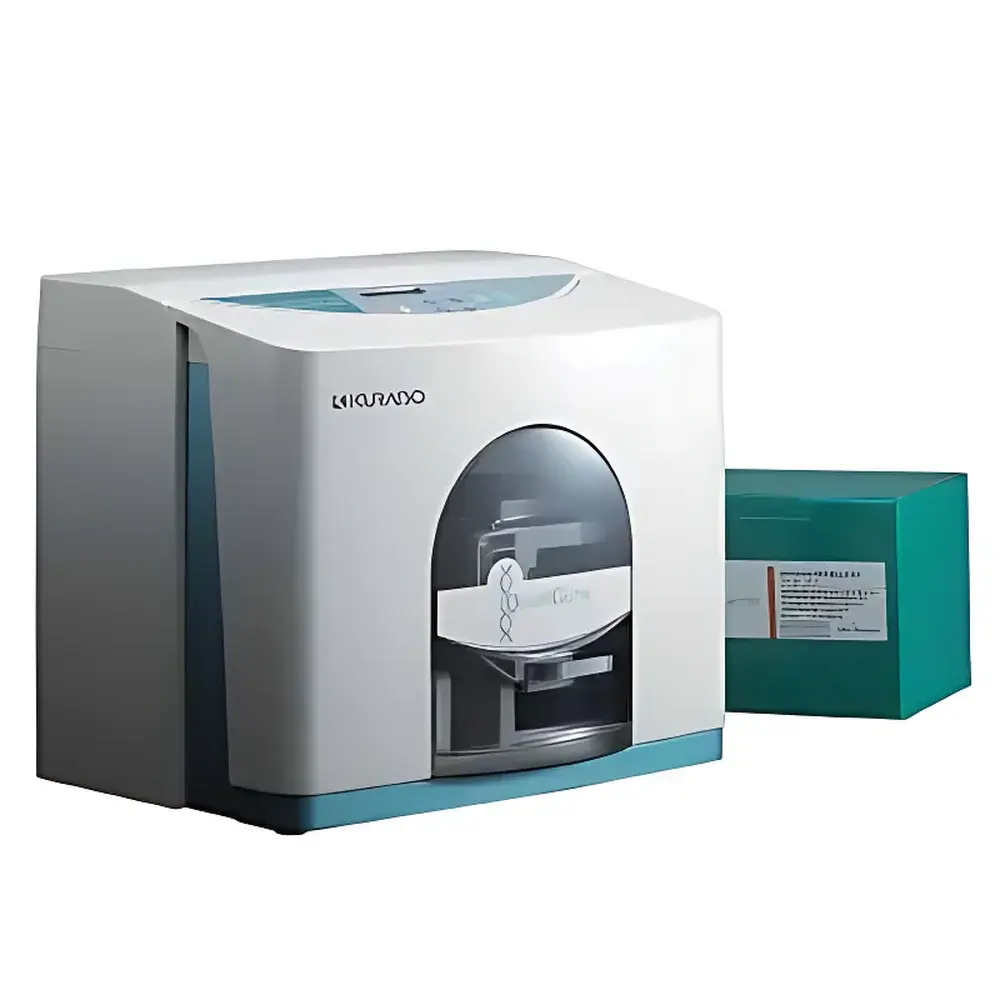
KURABO QuickGene-810 Nucleic Acid Purification System
| Brand | KURABO |
|---|---|
| Origin | Japan |
| Manufacturer Status | Authorized Distributor |
| Origin Category | Imported |
| Model | QuickGene-810 |
| Pricing | Upon Request |
| Throughput | 1–8 samples per run, up to 80 samples/hour |
| Sample Volume | 200 µL (e.g., whole blood) or 5 mg (e.g., mouse tail) |
| DNA Yield | >5 µg from 200 µL human whole blood |
| Purity | DNA A₂₆₀/A₂₈₀ > 1.7 |
| Membrane Thickness | 80 µm |
| Processing Time | 6 minutes for 8 whole blood samples |
| Dimensions | 450 × 330 × 400 mm |
| Weight | 21 kg |
Overview
The KURABO QuickGene-810 Nucleic Acid Purification System is an automated, pressure-driven benchtop platform engineered for rapid, consistent, and reagent-efficient isolation of high-integrity genomic DNA and total RNA from diverse biological matrices. Unlike centrifugation- or magnetic-bead-based workflows, the QuickGene-810 employs a proprietary multi-pore filtration architecture—featuring an ultra-thin (80 µm), chemically inert membrane—that enables selective nucleic acid binding under controlled positive pressure. This membrane-based solid-phase extraction mechanism eliminates reliance on high-speed centrifugation, ethanol precipitation, or paramagnetic particles, thereby reducing operator variability, minimizing carryover risk, and enhancing reproducibility across user skill levels. Designed for routine use in molecular diagnostics laboratories, core facilities, and translational research settings, the system supports unattended operation with minimal hands-on time and integrates seamlessly into standardized nucleic acid extraction SOPs compliant with ISO 15189 and CLIA requirements.
Key Features
- Pressure-driven, centrifuge-free purification: Three sequential pneumatic stages—binding, washing, and elution—are fully automated within the instrument housing.
- High-throughput flexibility: Processes 1–8 samples per run; achieves up to 80 samples per hour with batch scheduling.
- Optimized membrane technology: 80 µm thick Kurabo multi-pore membrane ensures high binding capacity, low nonspecific retention, and consistent flow dynamics across sample types.
- Rapid cycle time: Completes DNA extraction from 8 whole blood samples (200 µL each) in ≤6 minutes.
- Sample versatility: Compatible with whole blood, cultured cells, fresh/frozen tissue, mouse tail clips, and other solid or liquid biospecimens.
- Integrated thermal control: Maintains stable elution temperature (room temperature to 65°C) to maximize recovery of labile RNA species.
- Minimal consumables footprint: Uses pre-filled, barcode-scannable reagent cartridges to reduce pipetting errors and ensure lot-traceability.
Sample Compatibility & Compliance
The QuickGene-810 accommodates input volumes ranging from 200 µL (liquid samples such as peripheral blood, plasma, or cell suspensions) to 5 mg (solid tissues including rodent tail, liver, or muscle). Its validated protocols meet performance criteria outlined in ISO 20387:2018 (Biobanking) and support GLP-compliant nucleic acid isolation for regulated studies. All reagent kits—including DNA Whole Blood, DNA Tissue, RNA Cultured Cells, RNA Tissue, and RNA Blood Cell—are manufactured under Japanese GMP standards and supplied with CoA documentation. The system’s closed-cartridge design minimizes aerosol generation and cross-contamination, fulfilling biosafety Level 2 (BSL-2) operational guidelines. Instrument firmware supports audit trail logging and user access controls aligned with FDA 21 CFR Part 11 requirements when paired with compliant LIMS integration.
Software & Data Management
The embedded touchscreen interface provides intuitive protocol selection, real-time status monitoring, and error diagnostics without external PC dependency. Each run generates a timestamped log file containing sample ID, protocol version, pressure profiles, elapsed times per stage, and operator credentials. Exportable CSV reports include A₂₆₀/A₂₈₀ ratios and estimated yields derived from integrated calibration curves. Optional Ethernet connectivity enables remote monitoring and centralized data aggregation via laboratory informatics platforms. Software updates are delivered through secure, digitally signed packages verified against Kurabo’s public key infrastructure.
Applications
- High-volume clinical screening: Enables scalable DNA extraction for PCR-based infectious disease testing and pharmacogenomic profiling.
- Biobank processing: Supports standardized, traceable nucleic acid isolation from longitudinal cohorts under ISO 20387-accredited biorepository workflows.
- Next-generation sequencing (NGS) library prep: Delivers DNA/RNA meeting QC thresholds for Illumina, PacBio, and Oxford Nanopore input specifications.
- Regulatory submission support: Generates auditable extraction records required for IVD kit development and FDA/CE-IVD dossier preparation.
- Academic core facility deployment: Reduces training burden and increases instrument uptime through robust hardware design and fail-safe fluidics.
FAQ
Does the QuickGene-810 require centrifugation or magnetic separation equipment?
No. The system operates exclusively via programmable positive-pressure fluidics and does not interface with external centrifuges or magnet racks.
Are reagent kits supplied with lot-specific certificates of analysis?
Yes. All Kurabo-certified QuickGene kits include CoA documentation specifying purity, sterility, endotoxin levels, and functional validation data.
Can the instrument be integrated into a LIMS environment?
Yes. Through optional API-enabled Ethernet communication, the QuickGene-810 supports bidirectional data exchange with major LIMS vendors for sample tracking and electronic record archiving.
What maintenance is required for long-term reliability?
Routine maintenance is limited to quarterly fluidic path inspection and annual calibration verification using Kurabo-supplied reference cartridges—no field-service engineer visit is necessary for standard operation.
Is the system compatible with downstream applications such as qPCR or digital PCR?
Yes. Extracted nucleic acids consistently demonstrate A₂₆₀/A₂₈₀ ratios >1.7 (DNA) and >1.8 (RNA), with minimal inhibitor carryover confirmed by spike-recovery assays using commercial master mixes.





