
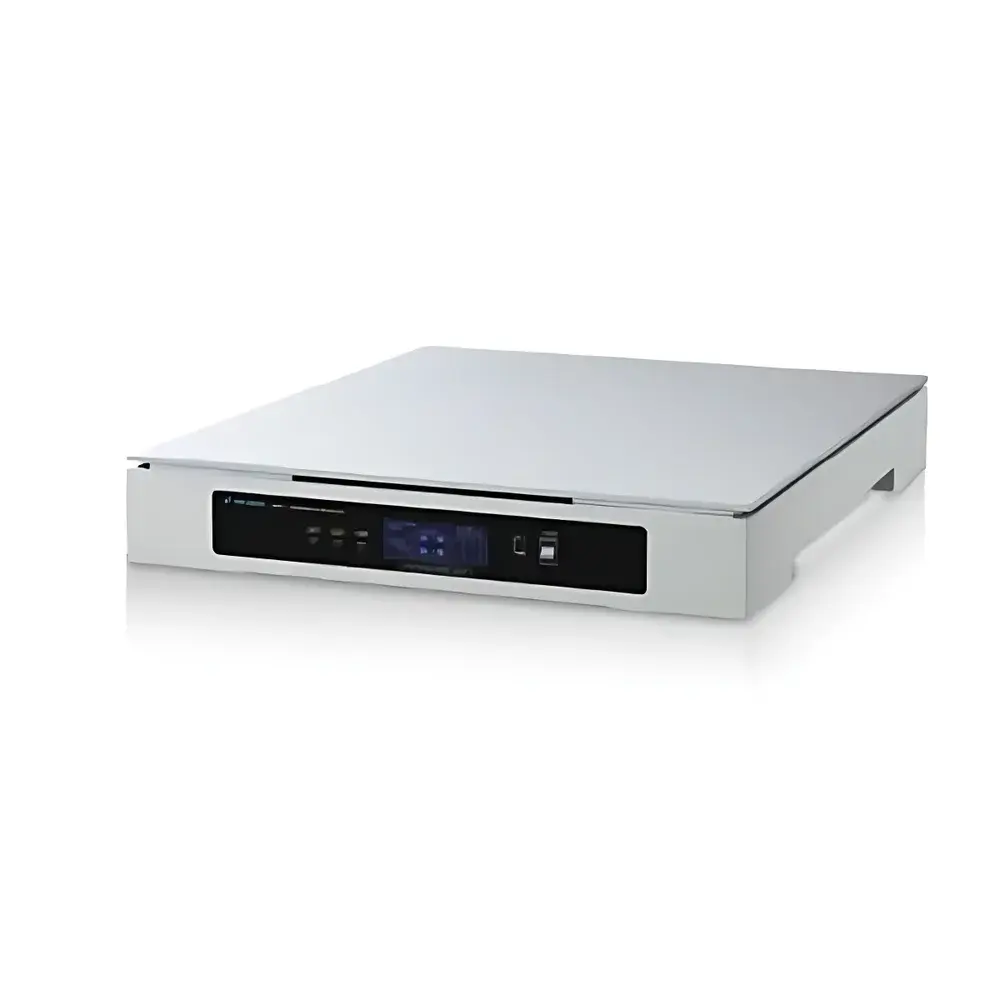
KURASHIKI EST-58-450 Active Vibration Isolation Table
| Brand | KURASHIKI |
|---|---|
| Origin | Japan |
| Model | EST-58-450 |
| Type | 6-DOF Active Vibration Isolation Platform |
| Compliance | Cleanroom-Compatible (ISO Class 5–7), No Compressed Air Required |
| Control Interface | USB 2.0 |
| Display | Integrated LCD for Real-Time Acceleration Time-Waveform & FFT Spectrum |
| Leveling Mode | Motorized Auto-Leveling with Transport Lock Toggle |
| Construction | Sealed Anodized Aluminum Enclosure & Top Plate |
Overview
The KURASHIKI EST-58-450 is a high-performance, six-degree-of-freedom (6-DOF) active vibration isolation table engineered for ultra-sensitive metrology and nanoscale imaging applications. Unlike passive isolators relying on elastomeric or pneumatic elements—whose performance degrades below 1–2 Hz and introduces mechanical resonance—the EST-58-450 employs real-time inertial feedback control across all translational (X, Y, Z) and rotational (pitch, yaw, roll) axes. This architecture delivers broadband attenuation from 0.3 Hz to over 100 Hz, eliminating low-frequency floor disturbances (e.g., building sway, HVAC-induced vibrations) while suppressing high-frequency acoustic noise and structural-borne energy without introducing secondary resonances. Designed specifically for environments where sub-nanometer stability is non-negotiable—including scanning probe microscopy (SPM), atomic force microscopy (AFM), optical profilometry, laser interferometry, and desktop SEM—the system meets stringent requirements for positional fidelity in both static and dynamic measurement conditions.
Key Features
- True 6-DOF Active Compensation: Independent electromagnetic actuators and high-bandwidth accelerometers on each axis enable closed-loop correction of ground motion in real time, achieving >30 dB attenuation at 1 Hz and >60 dB above 10 Hz.
- Integrated Real-Time Diagnostics: Built-in 4.3-inch LCD display shows simultaneous time-domain acceleration waveforms and frequency-domain FFT spectra—enabling on-site verification of isolation performance without external instrumentation.
- Cleanroom-Ready Architecture: Fully sealed anodized aluminum housing and top plate prevent particle shedding; no compressed air, oil, or exhaust vents required—validated for ISO Class 5 through Class 7 cleanrooms per ISO 14644-1.
- One-Touch Operational Modes: Single-button switching between auto-leveling mode (for operational setup) and transport lock mode (for safe relocation), with motorized leveling screws providing ±3° tilt compensation within 60 seconds.
- USB-Based Remote Monitoring: Standard USB 2.0 interface supports direct connection to host PC for waveform logging, spectral analysis, and remote configuration via KURASHIKI’s proprietary control software (Windows 10/11 compatible).
Sample Compatibility & Compliance
The EST-58-450 accommodates instruments with footprints up to 450 mm × 450 mm and payloads up to 80 kg (centered load). Its rigid, low-thermal-drift aluminum top plate ensures dimensional stability under ambient temperature fluctuations (±0.5 °C). The platform conforms to key international standards governing laboratory vibration control, including ISO 20486 (vibration criteria for nanotechnology facilities), ASTM E1776 (standard guide for vibration testing of microelectromechanical systems), and JIS B 7741 (Japanese standard for precision instrument mounting platforms). It is routinely deployed in GLP-compliant R&D labs and ISO 9001-certified manufacturing QA environments—particularly in hard disk drive (HDD) head gimbal assembly, semiconductor packaging metrology, and MEMS device characterization workflows.
Software & Data Management
KURASHIKI’s EST-Control Suite provides deterministic, low-latency communication with the isolation table via USB. The software enables real-time visualization of triaxial acceleration data, configurable alarm thresholds for excessive vibration events, and export of time-series datasets in CSV format for post-processing in MATLAB, Python (NumPy/Pandas), or LabVIEW. Audit trails—including timestamped mode changes, leveling status logs, and firmware version history—are retained locally and support FDA 21 CFR Part 11 compliance when deployed in regulated pharmaceutical or medical device development settings. Firmware updates are delivered via signed binary packages with SHA-256 verification.
Applications
- Atomic Force Microscopy (AFM): Enables stable tip-sample engagement during nanomechanical mapping and force spectroscopy.
- Laser Interferometric Surface Profilometry: Maintains phase coherence during long-integration scans of optical components and silicon wafers.
- Desktop Scanning Electron Microscopy (SEM): Reduces image blurring caused by floor-borne vibrations during high-magnification imaging (≥100,000×).
- Optical Critical Dimension (OCD) Metrology: Supports sub-0.1 nm repeatability in grating pitch and sidewall angle measurements.
- Microhardness Testing (e.g., nanoindentation): Ensures consistent indenter approach velocity and load application accuracy.
- Ultra-Precision Weighing: Eliminates drift in analytical balances and microbalances operating at ≤0.1 µg resolution.
FAQ
Does the EST-58-450 require external compressed air or vacuum sources?
No. It operates entirely on 100–240 VAC, 50/60 Hz power and uses electromagnetic actuation—making it suitable for cleanrooms and locations with limited utility infrastructure.
What is the maximum payload capacity and footprint compatibility?
The system supports payloads up to 80 kg distributed within a 450 mm × 450 mm area centered on the top plate. Off-center loads exceeding 20 kg require prior evaluation for moment arm effects.
Can vibration data be logged continuously for trend analysis?
Yes. The USB interface allows continuous streaming of raw accelerometer output at 1 kHz sampling rate, with built-in buffering for gap-free acquisition over extended durations.
Is the platform compatible with seismic retrofitting requirements in earthquake-prone regions?
While not certified as a seismic restraint device, its active stabilization architecture inherently mitigates low-frequency (<5 Hz) ground motion—common in far-field tremors—and has been successfully installed in laboratories across Japan and California with supplemental anchoring per local building codes.
How often does the system require calibration or maintenance?
No routine recalibration is required. Accelerometer and actuator health is monitored continuously; diagnostic alerts notify users of potential degradation. Recommended preventive inspection interval: every 24 months by authorized KURASHIKI service personnel.



