
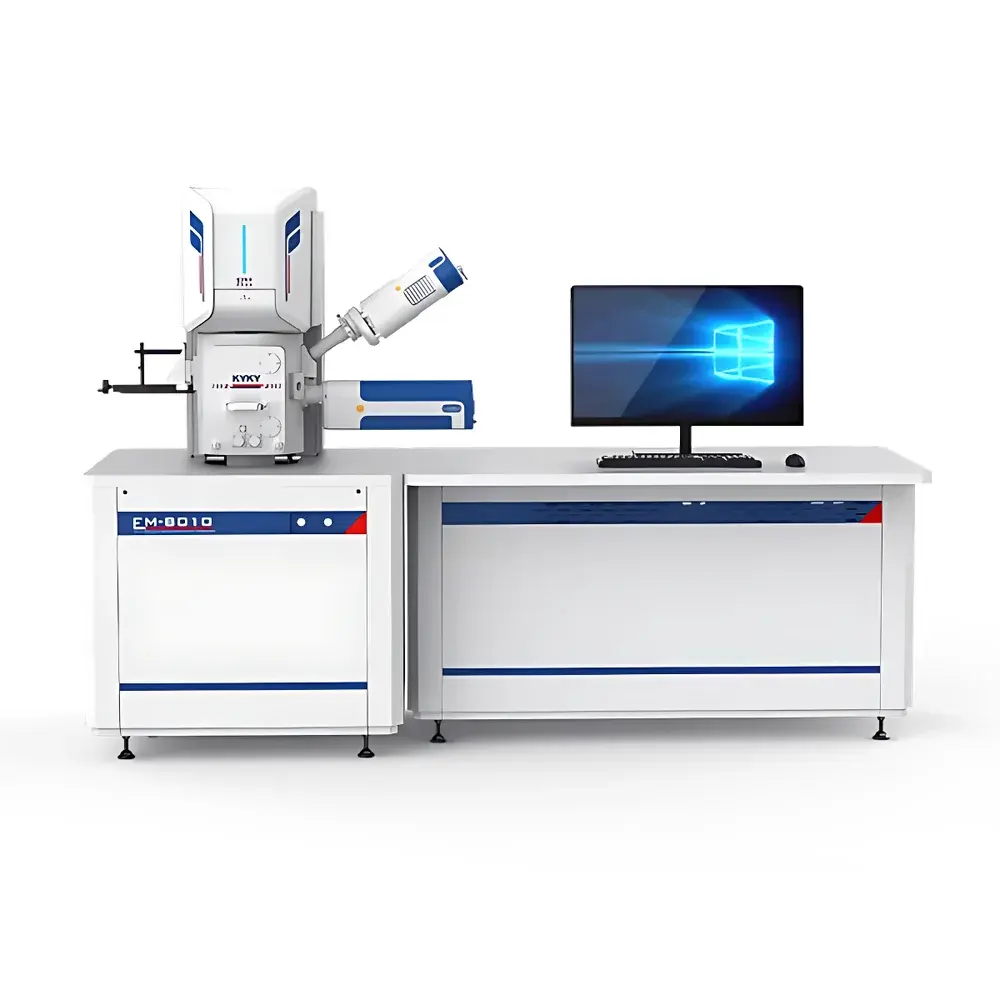
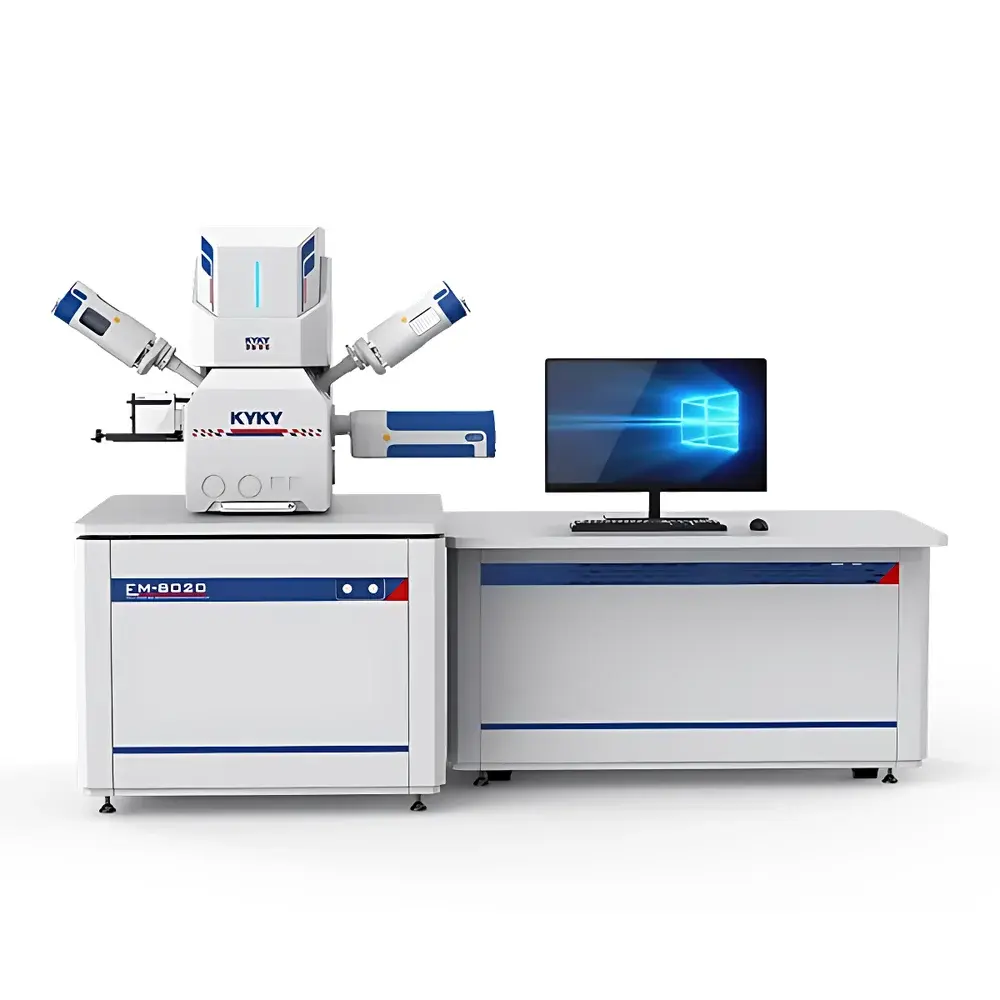
KYKY-EM80 Series Schottky Field Emission Scanning Electron Microscope
| Brand | KYKY |
|---|---|
| Origin | Beijing, China |
| Manufacturer Type | Direct Manufacturer |
| Instrument Type | Floor-standing SEM |
| Electron Gun Type | Schottky Thermal Field Emission |
| SEM Class | Entry-level Field Emission SEM |
| Secondary Electron Resolution | 1.5 nm @ 15 kV |
| Accelerating Voltage Range | 0.2–30 kV |
| Backscattered Electron Resolution | 3 nm @ 30 kV |
Overview
The KYKY-EM80 Series Schottky Field Emission Scanning Electron Microscope is an entry-level, high-stability field emission SEM engineered for precision surface imaging and compositional analysis in academic, industrial, and quality control laboratories. It employs a thermally assisted Schottky field emission electron source—delivering superior brightness, long-term beam stability, and low energy spread—enabling high-resolution imaging at both low and high accelerating voltages. Unlike conventional tungsten or cold field emission systems, the Schottky emitter operates at elevated temperatures (~1800 K), eliminating the need for frequent flashing and offering extended operational lifetime with minimal maintenance. The instrument integrates a multi-stage electromagnetic lens system optimized for chromatic and spherical aberration compensation, supporting consistent sub-2 nm secondary electron resolution at 15 kV and reliable backscattered electron contrast at 30 kV. Designed for routine and research-grade applications, the EM80 platform adheres to fundamental SEM operating principles grounded in electron-specimen interaction physics—including elastic scattering (BSE), inelastic scattering (SE), and cathodoluminescence—and supports quantitative morphological and topographic characterization across conductive and semi-conductive samples.
Key Features
- Schottky thermal field emission electron gun with >2,000-hour typical source lifetime and <0.5% beam current drift over 8 hours
- Multi-stage condenser and objective lens system enabling variable working distance (WD) operation from 4 mm to 30 mm without resolution compromise
- Dual-detector architecture: In-lens secondary electron detector (SED) for high signal-to-noise topographic imaging and solid-state backscattered electron detector (BSE) for atomic number (Z)-contrast mapping
- Modular large-chamber configuration (optional) accommodating samples up to Ø300 mm × 100 mm height, compatible with motorized 5-axis eucentric stage
- Real-time dual-channel image acquisition: Simultaneous SE/BSE display with independent gain, contrast, and dwell time control per channel
- Integrated cathodoluminescence (CL) port for spectral and spatial CL imaging (requires external monochromator or PMT assembly)
Sample Compatibility & Compliance
The KYKY-EM80 accommodates bulk solids, polished cross-sections, coated biological specimens, and conductive thin films. Standard operation requires sputter-coating (e.g., Au/Pd or Cr) for non-conductive samples; low-voltage imaging (≤1 kV) enables charge-free observation of uncoated polymers and ceramics. The system complies with IEC 61000-6-3 (EMC emissions) and IEC 61000-6-2 (immunity), and its vacuum architecture—featuring turbomolecular pumping (≤5×10⁻⁷ Pa base pressure) and differential pumping stages—meets ISO 27492 requirements for stable high-vacuum electron optical performance. Optional EBL and ultra-high vacuum (UHV) upgrades support GLP/GMP-aligned workflows where traceable beam parameter logging and audit-ready operation are required. While not pre-certified for FDA 21 CFR Part 11, the embedded software architecture permits integration with validated LIMS environments via standardized API endpoints.
Software & Data Management
Acquisition and analysis are managed through KYKY’s proprietary SEMControl Suite v4.x—a Windows-based application supporting DICOM-compliant image export, TIFF/RAW metadata embedding (including kV, WD, dwell time, magnification, and detector settings), and batch processing pipelines. The suite includes:
• Automated mosaic stitching engine capable of aligning and fusing >1,000 individual frames with real-time preview and distortion correction
• AI-accelerated particle analysis module trained on SEM-specific morphology datasets—automatically calibrates scale bars, segments particles, and computes Feret diameter, aspect ratio, circularity, convexity, and solidity per ISO 9276-2
• Dimensional metrology toolkit compliant with VDI/VDE 2634 Part 2: supports calibrated line, angle, radius, and concentricity measurements with uncertainty estimation based on pixel sampling and probe size convolution
• Export formats include CSV (statistical summaries), XML (structured metadata), and HDF5 (multi-dimensional image stacks for ML training)
Applications
The KYKY-EM80 serves as a foundational platform for materials characterization in university core facilities and R&D labs. Typical use cases include: grain size distribution analysis of sintered ceramics (per ASTM E112); morphology assessment of battery electrode coatings (NMC, SiOx, solid electrolytes); failure analysis of microelectronic interconnects; nanoparticle dispersion uniformity in polymer composites; and cellular ultrastructure imaging in resin-embedded biological sections. Its optional electron beam lithography (EBL) configuration—featuring 5 nm minimum spot size, 1 pA–20 nA programmable probe current, and vector-scan pattern generation—enables maskless nanofabrication of photonic crystals, SAW devices, and graphene FET test structures. Vacuum-integrated variants support in-situ sample transfer from deposition chambers (e.g., PVD, ALD), while laser-coupled configurations facilitate pump-probe studies of carrier dynamics in 2D materials under ultrafast excitation (pulse widths <100 fs).
FAQ
What vacuum level is maintained during standard imaging?
Base pressure is ≤5×10⁻⁷ Pa in the specimen chamber, achieved using a 70 L/s turbomolecular pump backed by a dry scroll pump.
Is the system compatible with energy-dispersive X-ray spectroscopy (EDS)?
Yes—the column includes a dedicated EDS port (standard 8° take-off angle) and mechanical/electrical interfaces for third-party silicon drift detectors (SDDs) meeting IEC 62245 compliance.
Can the software meet regulatory data integrity requirements?
SEMControl Suite supports user role-based access control, electronic signatures, and audit trail logging (system events, parameter changes, image annotations); full 21 CFR Part 11 compliance requires site-specific validation protocol execution.
What is the maximum sample height for the standard chamber?
Standard chamber accommodates samples up to 80 mm in height; extended chamber options support up to 100 mm with modified stage geometry.
Does the system support automated stage navigation using coordinate mapping?
Yes—motorized stage supports absolute positioning with ±0.5 µm repeatability and accepts user-defined coordinate lists (.csv) for multi-site automated acquisition sequences.



