
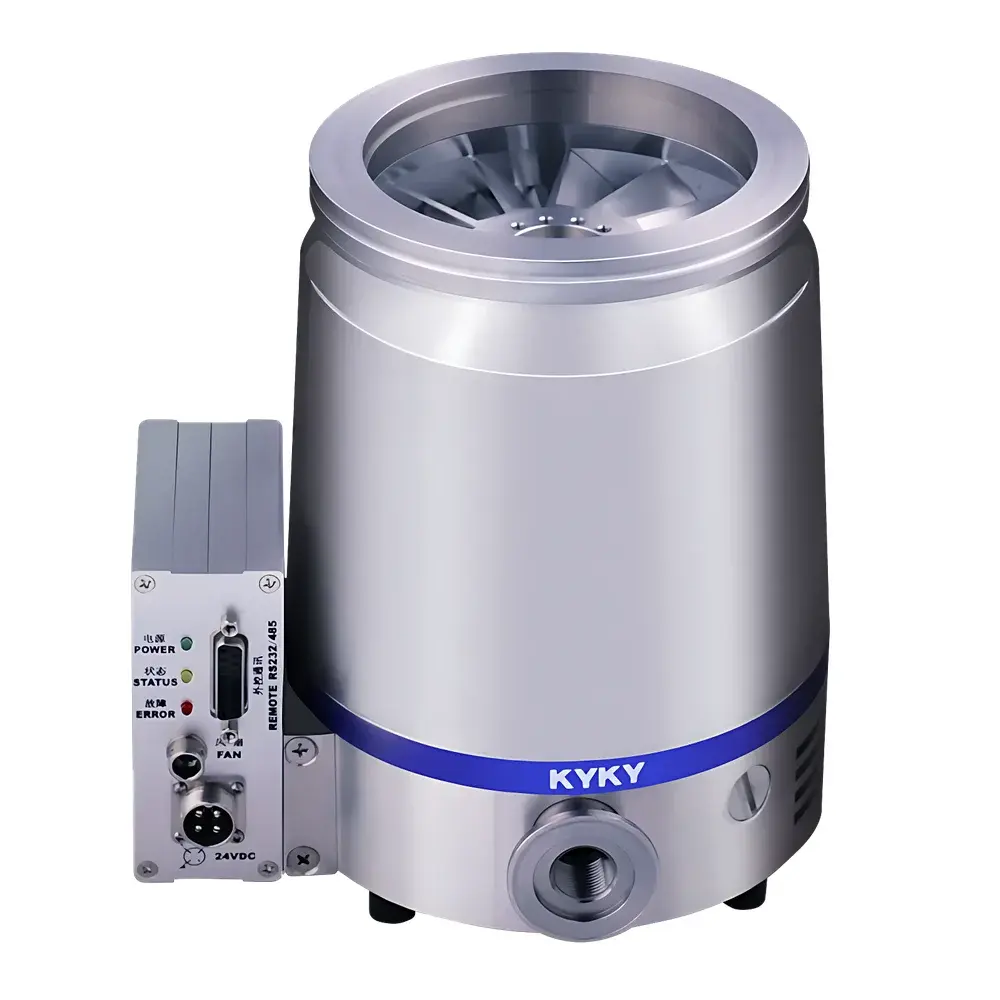
KYKY FF-100/300 Turbo-Molecular Vacuum Pump
| Brand | KYKY |
|---|---|
| Origin | Beijing, China |
| Manufacturer Type | Direct Manufacturer |
| Product Type | Oil-Free Turbo-Molecular Pump |
| Model | FF-100/300 |
| Pumping Speed (N₂) | 295 L/s |
| Ultimate Pressure (CF Flange) | 5×10⁻⁷ Pa |
| Ultimate Pressure (ISO-KF Flange) | 2.5×10⁻⁶ Pa |
| Maximum Continuous Forepressure | 500 Pa |
| Max Transient Forepressure (N₂) | 700 Pa |
| Compression Ratio (N₂) | 1×10⁹ |
| Compression Ratio (He) | 1×10⁶ |
| Compression Ratio (H₂) | 1×10⁵ |
| Compression Ratio (Ar) | 1×10⁹ |
| Gas Load Capacity (N₂) | 120 sccm |
| Gas Load Capacity (He) | 50 sccm |
| Rated Rotational Speed | 51,000 rpm |
| Startup Time | ≤4 min |
| Cooling | Air or Water (Water Flow Rate: ≥1 L/min |
| Power Supply | DC 24 V or AC 220 V |
| Max Power Consumption | 220 W |
| Inlet Flange | DN100 CF or DN100 ISO-K |
| Outlet Flange | DN25 ISO-KF |
| Weight (ISO-K Version) | 8.5 kg |
| Weight (CF Version) | 11 kg |
| Compatible Forepumps | 1–3 L/s Rotary Vane or Diaphragm Pumps |
| Recommended Controllers | TD-300, TCP-240, TC-100 |
Overview
The KYKY FF-100/300 is a compact, high-performance oil-free turbo-molecular vacuum pump engineered for integration into analytical and scientific instrumentation requiring ultra-high vacuum (UHV) conditions. Based on the principle of momentum transfer—where high-speed rotating blades impart kinetic energy to gas molecules to direct them toward the exhaust—it achieves stable, clean vacuum generation without hydrocarbon contamination. Its design prioritizes low vibration (<0.5 µm RMS), minimal electromagnetic interference, and operational flexibility across multiple mounting orientations—critical for space-constrained systems such as benchtop mass spectrometers, surface analysis chambers, and electron microscopy columns. With a rated pumping speed of 295 L/s for nitrogen and ultimate pressure down to 5×10⁻⁷ Pa (measured at the CF inlet flange), the FF-100/300 delivers reproducible UHV performance under continuous duty while maintaining compatibility with standard UHV practices including bake-out up to 120 °C.
Key Features
- Compact monoblock architecture optimized for OEM integration—footprint under 220 mm × 180 mm × 260 mm (L×W×H) for ISO-K version
- Dual-power capability: Operates natively from 24 VDC (enabling direct integration with embedded control platforms) or standard 220 VAC
- High rotor stability via active magnetic bearing compensation and precision-balanced titanium-alloy rotor assembly
- Robust forepressure tolerance: Sustains continuous operation up to 500 Pa and withstands transient surges to 700 Pa—reducing reliance on oversized backing pumps
- Low thermal load design supports air cooling in ambient environments ≤35 °C; optional water cooling enables sustained operation in high-duty-cycle applications
- Integrated safety logic: Real-time monitoring of rotor speed, bearing temperature, coolant flow, and voltage integrity with automatic shutdown on fault detection
Sample Compatibility & Compliance
The FF-100/300 is compatible with inert, reactive, and corrosive process gases—including N₂, He, H₂, Ar, O₂, and dry CO₂—provided appropriate inlet protection (e.g., cold traps or getter cartridges) is used for condensable vapors. It meets the mechanical and electrical safety requirements of GB/T 19001–2016 (equivalent to ISO 9001:2015) and conforms to CE marking directives for electromagnetic compatibility (2014/30/EU) and low-voltage equipment (2014/35/EU). While not intrinsically rated for explosive atmospheres, its oil-free operation eliminates ignition risk from hydrocarbon lubricants—supporting compliance with IEC 60079-0 for non-hazardous zone deployment. The pump is routinely validated in GLP-compliant laboratories for use in USP instrument qualification protocols, particularly in mass spectrometry systems requiring documented vacuum stability and traceability.
Software & Data Management
The FF-100/300 interfaces seamlessly with KYKY’s TD-300, TCP-240, and TC-100 controllers via RS-485 Modbus RTU or analog 0–10 V I/O. Controller firmware provides full audit trail logging—including timestamped rotor acceleration profiles, power draw history, vacuum ramp curves, and alarm event records—aligned with FDA 21 CFR Part 11 requirements for electronic records and signatures when deployed with validated software environments. Optional Ethernet gateway modules enable integration into LabVantage, Thermo Fisher SampleManager, or custom SCADA architectures using OPC UA or MQTT protocols. All controller configurations support password-protected parameter locking and user-level access control (Operator, Technician, Administrator).
Applications
- Residual gas analysis and quadrupole mass spectrometry (QMS) systems requiring stable base pressures below 1×10⁻⁶ Pa
- X-ray photoelectron spectroscopy (XPS), Auger electron spectroscopy (AES), and secondary ion mass spectrometry (SIMS) chambers
- Transmission and scanning electron microscopes (TEM/SEM) where vibration sensitivity demands sub-micron mechanical stability
- Vacuum metallurgy and additive manufacturing (e.g., electron beam powder bed fusion) process chambers
- Non-destructive testing (NDT) systems employing backscattered electron imaging or time-of-flight secondary ion detection
- Fundamental physics experiments involving atomic beam collimation, cold atom trapping, and quantum interference setups
FAQ
What is the recommended forepump pairing for the FF-100/300?
A 1–3 L/s dry scroll or diaphragm pump is optimal for most applications; rotary vane pumps may be used if equipped with a hydrocarbon trap and operated below 10% oil vapor saturation.
Can the FF-100/300 operate continuously at its maximum forepressure limit?
Yes—continuous operation up to 500 Pa is certified per KYKY’s type test report; transient excursions to 700 Pa are permitted for ≤30 seconds during system venting or gas load spikes.
Is water cooling mandatory for extended runtime?
No—air cooling suffices for average duty cycles (8 h/day operation or ambient >35 °C.
Does the pump support remote diagnostics and predictive maintenance?
Yes—controller firmware logs all operational parameters with 1-second resolution; trend analysis of rotor coast-down time and power variance enables early detection of bearing degradation.
What vacuum measurement standards apply to its ultimate pressure specification?
Ultimate pressure is measured per ISO 21360-1:2020 using calibrated Bayard–Alpert gauges, with chamber outgassing rates controlled to <1×10⁻¹⁰ Pa·m³/s and no external gas loads.



