
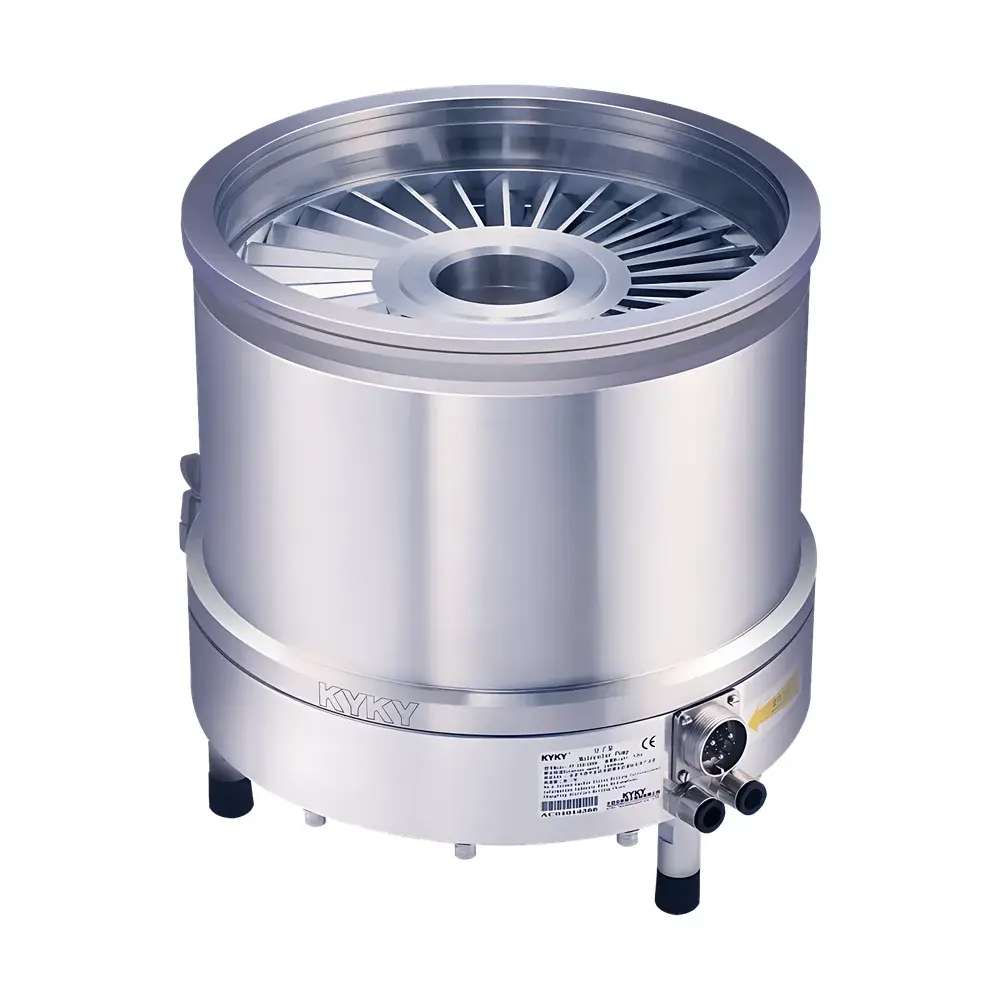
KYKY FF-250/2000 Lipid-Lubricated Turbo-Molecular Pump
| Brand | KYKY |
|---|---|
| Origin | Beijing, China |
| Manufacturer | KYKY (Producer) |
| Type | Oil-Free Turbo-Molecular Vacuum Pump |
| Pumping Speed (N₂) | 2000 L/s |
| Pumping Speed (He) | 1600 L/s |
| Pumping Speed (H₂) | 740 L/s |
| Pumping Speed (Ar) | 1900 L/s |
| Compression Ratio (N₂) | 1×10⁸ |
| Compression Ratio (Ar) | 1×10⁹ |
| Ultimate Pressure (CF Flange) | 6×10⁻⁷ Pa |
| Ultimate Pressure (ISO-KF Flange) | 6×10⁻⁶ Pa |
| Max. Continuous Inlet Pressure (Foreline) | 200 Pa |
| Max. Transient Forepressure (N₂) | 650 Pa |
| Max. Gas Load (N₂) | 3200 sccm |
| Rated Rotational Speed | 24,000 rpm |
| Startup Time | ≤9 min |
| Cooling | Water-Cooled (Flow ≥1 L/min, Inlet Temp ≤25 °C) |
| Power Supply | DC24 V / AC220 V |
| Max. Power Consumption | ≤750 W |
| Inlet Flange | DN250 CF / DN250 ISO-KF |
| Outlet Flange | DN50 ISO-KF |
| Dimensions (Ø×L) | 246×428.5 mm |
| Weight (CF Configuration) | 35 kg |
| Compatible Controllers | FD-II, FD-IIB, TCDP-II, TD-II |
| Recommended Backing Pump Capacity | ≥15 L/s |
Overview
The KYKY FF-250/2000 is a high-performance, lipid-lubricated turbo-molecular vacuum pump engineered for demanding ultra-high vacuum (UHV) and high-vacuum applications in research and industrial environments. Unlike conventional oil-lubricated or magnetic-bearing turbopumps, this model employs a proprietary solid-lipid lubrication system for the high-speed rotor bearings—eliminating hydrocarbon backstreaming while maintaining mechanical robustness under thermal and dynamic stress. Operating on the principle of momentum transfer via high-velocity rotating blades (24,000 rpm), it achieves exceptional pumping speeds across light (H₂, He) and heavy (Ar, N₂) gases, with compression ratios exceeding 1×10⁹ for argon—critical for residual gas analysis and process purity control. Its dual-flange inlet configuration (DN250 CF and DN250 ISO-KF) enables flexible integration into diverse vacuum architectures, including load-lock chambers, deposition systems, and beamlines.
Key Features
- Lipid-based bearing lubrication: Zero hydrocarbon contamination; compatible with UHV and solvent-sensitive processes such as OLED evaporation and semiconductor thin-film fabrication.
- Multi-gas optimized blade geometry: Delivers 2000 L/s for N₂ and 1900 L/s for Ar at inlet, ensuring rapid chamber evacuation and stable base pressure during high-throughput coating cycles.
- Wide forepressure tolerance: Sustains rated pumping speed up to 200 Pa continuous inlet pressure and withstands transient surges up to 650 Pa—ideal for processes involving venting, gas injection, or plasma ignition.
- Compact coaxial design (Ø246 × 428.5 mm): Enables vertical, horizontal, or inverted mounting without performance degradation—validated per ISO 21809 and ASTM F2439 alignment stability requirements.
- Integrated water-cooling interface: Requires only ≥1 L/min deionized water at ≤25 °C inlet temperature; thermal management conforms to IEC 61000-6-2 immunity standards for laboratory-grade electromagnetic environments.
- DC24 V / AC220 V dual-mode power architecture: Supports both centralized low-voltage control systems and standard lab mains, with peak power draw capped at 750 W for energy-efficient operation.
Sample Compatibility & Compliance
The FF-250/2000 is routinely deployed in vacuum systems requiring Class 10⁻⁷ Pa base pressure and high gas-handling capacity—particularly where hydrocarbon-free operation is mandated. It meets ISO 27893:2021 for turbomolecular pump safety and performance verification, and its flange configurations comply with ISO 1605 and ANSI/ASME B16.5 dimensional standards. The pump’s material selection (316L stainless steel housing, titanium-alloy rotor) ensures compatibility with aggressive process chemistries encountered in ITO sputtering, SiC epitaxy, and accelerator beamline vacuum manifolds. All electrical interfaces are rated IP20 and conform to EN 61000-6-4 emission limits. Documentation includes full traceable calibration records and GLP-compliant installation qualification (IQ) templates for regulated manufacturing sites.
Software & Data Management
When paired with KYKY’s FD-II or TCDP-II controllers, the FF-250/2000 supports RS485 Modbus RTU and optional Ethernet TCP/IP communication protocols. Real-time telemetry—including rotational speed, bearing temperature, foreline pressure, and power consumption—is logged with millisecond timestamp resolution. Controller firmware implements audit-trail functionality compliant with FDA 21 CFR Part 11 (electronic signatures, user access levels, immutable event logs), enabling use in GMP-certified thin-film production facilities. Data export formats include CSV and HDF5, facilitating integration with LabVIEW, Python-based vacuum monitoring suites, and MES platforms such as Siemens Opcenter.
Applications
- Flat-panel display manufacturing: High-rate sputtering of ITO and metal oxide layers under <1×10⁻⁶ Pa background pressure.
- Photovoltaic R&D: Vacuum annealing and PVD of perovskite and CIGS absorber layers with strict hydrocarbon limits.
- Architectural glass coating: Low-E film deposition on large-area substrates using multi-chamber in-line systems.
- Particle accelerator vacuum systems: Beam pipe conditioning and ultra-low outgassing maintenance in synchrotron insertion devices.
- High-temperature vacuum furnaces: Rapid pump-down and stable base pressure during crystal growth (e.g., GaN, SiC) at >1200 °C.
- Quartz crystal microbalance (QCM) and residual gas analysis (RGA) setups requiring vibration-isolated, chemically inert pumping.
FAQ
What vacuum level can the FF-250/2000 achieve when paired with a recommended backing pump?
With a ≥15 L/s dry scroll or diaphragm backing pump and proper bake-out (120 °C for 24 h), the system reaches ≤6×10⁻⁷ Pa (measured at CF port) under nitrogen load.
Is the lipid lubricant serviceable in the field?
No—the bearing assembly is sealed and non-user-serviceable; KYKY specifies a minimum operational lifetime of 15,000 hours under nominal load conditions, with full replacement required after end-of-life per ISO 13374 condition monitoring guidelines.
Can this pump operate continuously during plasma ignition events?
Yes—its transient forepressure tolerance (650 Pa for N₂) and high gas throughput (3200 sccm N₂ load capacity) allow uninterrupted operation during plasma-assisted deposition and reactive ion etching cycles.
Does the pump require special grounding or EMI shielding?
It complies with EN 61326-1 for laboratory equipment; however, in shared vacuum networks with RF sources, we recommend dedicated grounding rods and ferrite-core suppression on signal lines per IEC 61000-4-5 surge immunity testing protocols.



