
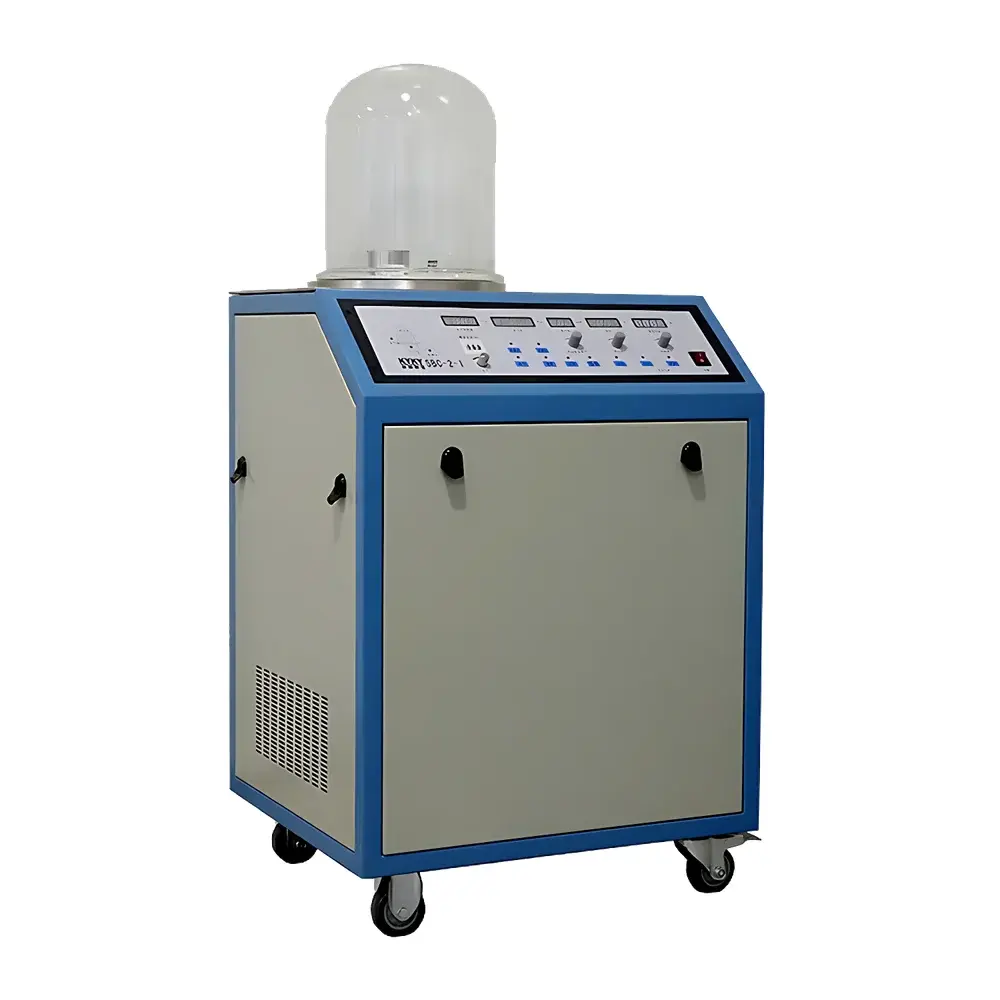
KYKY SBC-2 Multi-Function Sample Surface Coater
| Brand | KYKY |
|---|---|
| Origin | Beijing, China |
| Manufacturer Type | Direct Manufacturer |
| Country of Origin | China |
| Model | SBC-2 |
| Vacuum System | Mechanical Pump + Turbo Molecular Pump |
| Ultimate Vacuum | ≤2 × 10⁻³ Pa |
| Sputtering Voltage | 3 kV |
| Sample Stage Motion | Planar Rotation + Tilt Rotation |
| Carbon Evaporation Target Diameter | Φ38 mm |
| Sample Holder Diameter | Φ40 mm |
| Bell Jar Dimensions | Φ250 mm × H340 mm |
| Evaporation Glass Dome | Φ88 mm × H140 mm |
| Sputtering Glass Dome | Φ88 mm × H57 mm |
Overview
The KYKY SBC-2 Multi-Function Sample Surface Coater is a high-vacuum laboratory instrument engineered for precise surface preparation of non-conductive or beam-sensitive specimens prior to analysis in scanning electron microscopy (SEM), electron probe microanalysis (EPMA), and energy-dispersive X-ray spectroscopy (EDS). It integrates three complementary thin-film deposition techniques—carbon evaporation, metal sputter coating, and inert-gas ion beam treatment—within a single compact chamber architecture. The system operates on the principle of physical vapor deposition (PVD), leveraging thermal evaporation under high vacuum for carbon films and magnetron sputtering in argon plasma for conductive metal layers (e.g., Au, Pt, Cr). Ion beam treatment—conducted under high-purity argon ambient—enables controlled surface cleaning, mild etching, or amorphous layer removal without thermal damage. Its dual-pump configuration (rotary vane mechanical pump + turbo molecular pump) achieves stable base pressures ≤2 × 10⁻³ Pa, ensuring low contamination levels and high film uniformity—critical for quantitative EDS and high-resolution SEM imaging.
Key Features
- Triple-mode operation: simultaneous support for carbon evaporation, DC magnetron sputtering, and argon ion beam treatment in one vacuum chamber
- High-reproducibility sample stage with programmable planar rotation and continuous tilt rotation (±15°), enabling uniform coating thickness across irregular topographies
- Dual-stage vacuum system optimized for rapid pump-down (<15 min to operational pressure) and long-term stability; turbo molecular pump ensures minimal hydrocarbon backstreaming
- Integrated safety interlocks including overvoltage protection, vacuum-level monitoring, and automatic power cutoff during chamber breach
- Modular glass dome design: separate evaporation dome (Φ88 mm × H140 mm) and sputtering dome (Φ88 mm × H57 mm) allow technique-specific optimization of gas flow, pressure, and deposition geometry
- Carbon target holder (Φ38 mm) and sample stage (Φ40 mm) engineered for thermal symmetry and minimal shadowing effects
Sample Compatibility & Compliance
The SBC-2 accommodates standard SEM stubs (up to 25 mm diameter), TEM grids, bulk ceramic or polymer sections, and fragile biological cryo-sections. Its argon-only ion treatment mode eliminates oxidation risk for oxygen-sensitive materials (e.g., sulfides, reduced metal oxides). The system meets fundamental requirements of ISO 16700:2016 (electron microscopy specimen preparation) and supports GLP-compliant workflows through traceable process parameters (vacuum level, sputtering time, voltage). While not certified to FDA 21 CFR Part 11, its manual operation log and repeatable settings enable audit-ready documentation for regulated QC labs. All electrical components conform to IEC 61010-1 safety standards for laboratory equipment.
Software & Data Management
The SBC-2 operates via front-panel digital controls with real-time vacuum readout (Pirani + cold cathode gauge), sputtering voltage display, and timer-based process sequencing. No proprietary software is required; however, users may integrate external data loggers via analog output ports (0–10 V) for vacuum pressure and voltage monitoring. Process parameters—including dwell time, tilt angle, and rotation speed—are manually set and recorded per run. This deterministic, hardware-centric interface minimizes firmware dependencies and enhances long-term serviceability in resource-constrained environments.
Applications
- Conductive carbon coating for EDS quantification—minimizing charging artifacts while preserving X-ray generation efficiency
- Ultra-thin gold/palladium sputter layers (1–5 nm) for high-magnification SEM imaging of insulating geological or polymeric samples
- Argon ion milling of cross-sectional interfaces prior to FIB-SEM lamella lift-out
- Surface decontamination of archaeological metal fragments prior to micro-XRF mapping
- Pre-treatment of catalyst powders to remove adsorbed hydrocarbons before in situ TEM observation
- Routine preparation of failure analysis specimens in semiconductor packaging labs where residual chlorine or fluorine must be avoided
FAQ
What vacuum level is required for optimal carbon evaporation?
A base pressure ≤5 × 10⁻³ Pa is recommended; the SBC-2’s turbo-molecular pump achieves ≤2 × 10⁻³ Pa, minimizing oxide formation and ensuring stoichiometric carbon film integrity.
Can the SBC-2 deposit chromium or nickel layers?
Yes—using compatible DC-sputter targets (not included); the 3 kV power supply supports metals with moderate sputter yields under argon plasma.
Is the tilt rotation motorized and adjustable during operation?
Yes—tilt angle (±15°) and rotation speed (0–30 rpm) are independently adjustable via front-panel controls while the chamber remains under vacuum.
Does the system include a quartz crystal microbalance (QCM)?
No—the SBC-2 relies on time/voltage calibration for thickness control; QCM integration is available as a factory-installed option.
What maintenance intervals are recommended for the molecular pump?
Annual bearing inspection and rotor balancing per KYKY Technical Bulletin TB-SBC-2-MP-2023; oil changes for the mechanical pump every 500 operating hours.



