
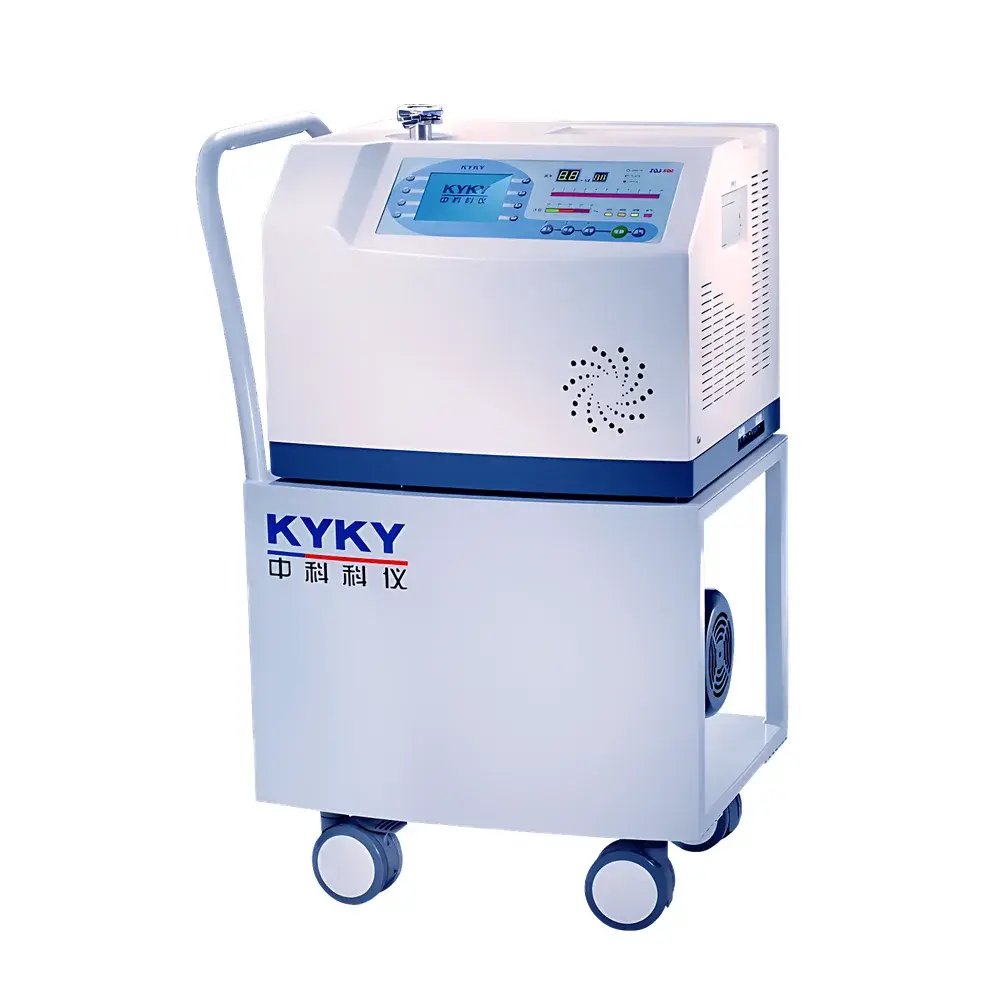
KYKY ZQJ-2000 Helium Mass Spectrometer Leak Detector
| Brand | KYKY |
|---|---|
| Origin | Beijing, China |
| Manufacturer Type | Original Equipment Manufacturer (OEM) |
| Regional Classification | Domestic (China-made) |
| Model | ZQJ-2000 |
| Price Range | USD 14,000 – 42,000 |
| Minimum Detectable Leak Rate | <2×10⁻¹¹ Pa·m³/s |
| Leak Measurement Range | 2×10⁻¹¹ – 1×10⁻⁵ Pa·m³/s |
| Maximum Inlet Pressure | 1000 Pa |
| Response Time | ≤2 s |
| Pump-down Time | <8 min |
| Power Supply | 220 V AC ±10%, 50 Hz, 16 A |
| Operating Temperature | 5–45 °C |
| Relative Humidity | ≤80% RH |
| Dimensions (L×W×H) | 645×450×950 mm |
| Weight | 80 kg |
| Communication Interfaces | RS232, External I/O, Parallel Printer Port |
Overview
The KYKY ZQJ-2000 Helium Mass Spectrometer Leak Detector is a high-sensitivity, benchtop vacuum-integrated leak detection system engineered for quantitative identification and localization of minute leaks in sealed components and vacuum systems. Based on the principle of magnetic sector mass spectrometry, the instrument selectively ionizes helium atoms introduced into the detector’s analyzer chamber and separates them by mass-to-charge ratio (m/z = 4) using a stable magnetic field. This enables highly specific detection of helium tracer gas—minimizing interference from background gases such as H₂, H₂O, or N₂—and delivering reliable, repeatable quantification of leak rates down to <2×10⁻¹¹ Pa·m³/s. Designed for integration into production QA lines, R&D laboratories, and vacuum equipment validation workflows, the ZQJ-2000 operates in both sniffer (localization) and vacuum (quantitative) modes, supporting ISO 10859-compliant leak testing protocols across regulated and non-regulated environments.
Key Features
- Proprietary dual-port turbomolecular pumping system optimized for enhanced signal-to-noise ratio and long-term baseline stability under variable load conditions.
- Dual-display interface: Integrated LCD panel with LED numeric readout ensures real-time visibility of leak rate, ion current, pressure status, and operational mode—even under ambient lighting variations.
- Intelligent vacuum control architecture: Adaptive regulation of foreline pressure and turbo pump speed minimizes thermal drift and improves measurement reproducibility across temperature gradients (5–45 °C).
- Modular I/O design: Standard RS232 serial port supports SCPI command set for automated test sequencing; isolated digital I/O enables direct interlock with chamber valves, safety cutoffs, and PLC-based manufacturing systems.
- Robust mechanical construction: Steel-reinforced chassis with vibration-damped base plate and EMI-shielded electronics enclosure ensure stable operation in industrial settings with electromagnetic noise or mechanical perturbation.
Sample Compatibility & Compliance
The ZQJ-2000 is compatible with standard helium spray probes, vacuum chambers (≤1 m³ volume), and custom-fitted test fixtures for components ranging from microelectronic hermetic packages to large-scale cryogenic vessels. It meets essential requirements of ISO 20485 (leak detection vocabulary), ASTM E493 (standard practice for helium mass spectrometer leak testing), and GB/T 17713–2019 (Chinese national standard for helium leak detectors). While not pre-certified for FDA 21 CFR Part 11, its audit-ready event logging (via RS232 timestamped output) and password-protected parameter configuration support GLP/GMP-aligned documentation practices when integrated with validated LIMS or MES platforms.
Software & Data Management
The instrument operates autonomously without external PC dependency, but supports bidirectional data exchange via ASCII-formatted serial communication. Leak rate values, timestamps, and operational states are exportable in CSV-compatible format for post-test statistical analysis (e.g., Cpk, trend charting). Optional firmware upgrades enable configurable alarm thresholds, pass/fail logic outputs, and batch ID tagging—facilitating traceability in ISO 9001-certified quality management systems. All configuration changes are logged with operator ID (if enabled) and time stamp, satisfying basic electronic record integrity expectations per ALCOA+ principles.
Applications
- Automotive: Hermeticity validation of EV battery modules, fuel rail assemblies, and HVAC evaporator cores.
- Cryogenics & Superconductivity: Integrity verification of liquid nitrogen/liquid helium dewars, magnet cold bores, and vacuum-jacketed transfer lines.
- Electronics: Screening of MEMS sensors, RF shielding enclosures, and semiconductor package seals (e.g., QFN, LGA, ceramic DIP).
- Vacuum Equipment Manufacturing: Final acceptance testing of diffusion pumps, ion implanters, and thin-film deposition chambers.
- Research Infrastructure: Leak mapping of ultra-high vacuum beamlines, particle accelerator cavities, and fusion experiment diagnostics ports.
FAQ
What calibration standards does the ZQJ-2000 support?
The instrument accepts certified helium leak standards traceable to NIM (National Institute of Metrology, China) or NIST SRM equivalents. Calibration is performed using adjustable capillary or permeation-type reference leaks spanning 1×10⁻¹⁰ to 1×10⁻⁷ Pa·m³/s.
Can the ZQJ-2000 be used in sniffer mode without a vacuum chamber?
Yes—it supports handheld probe operation with built-in helium background suppression algorithms; however, sensitivity in sniffer mode is reduced to ~1×10⁻⁸ Pa·m³/s due to atmospheric dilution effects.
Is remote monitoring possible via Ethernet or USB?
No native Ethernet or USB interface is provided; RS232 remains the sole digital communication channel. Integration with industrial networks requires an RS232-to-Ethernet converter configured in TCP server mode.
What maintenance intervals are recommended for the turbomolecular pump?
KYKY recommends annual inspection of rotor bearings and molecular pump controller firmware update; oil-free operation eliminates need for forepump oil changes, though rotary vane pump oil should be replaced every 3,000 operating hours.
Does the ZQJ-2000 comply with CE or UL safety directives?
It carries CCC (China Compulsory Certification) marking per GB 4793.1–2019. CE or UL certification is not included in standard configuration but can be arranged through third-party notified bodies upon request and additional qualification testing.





