
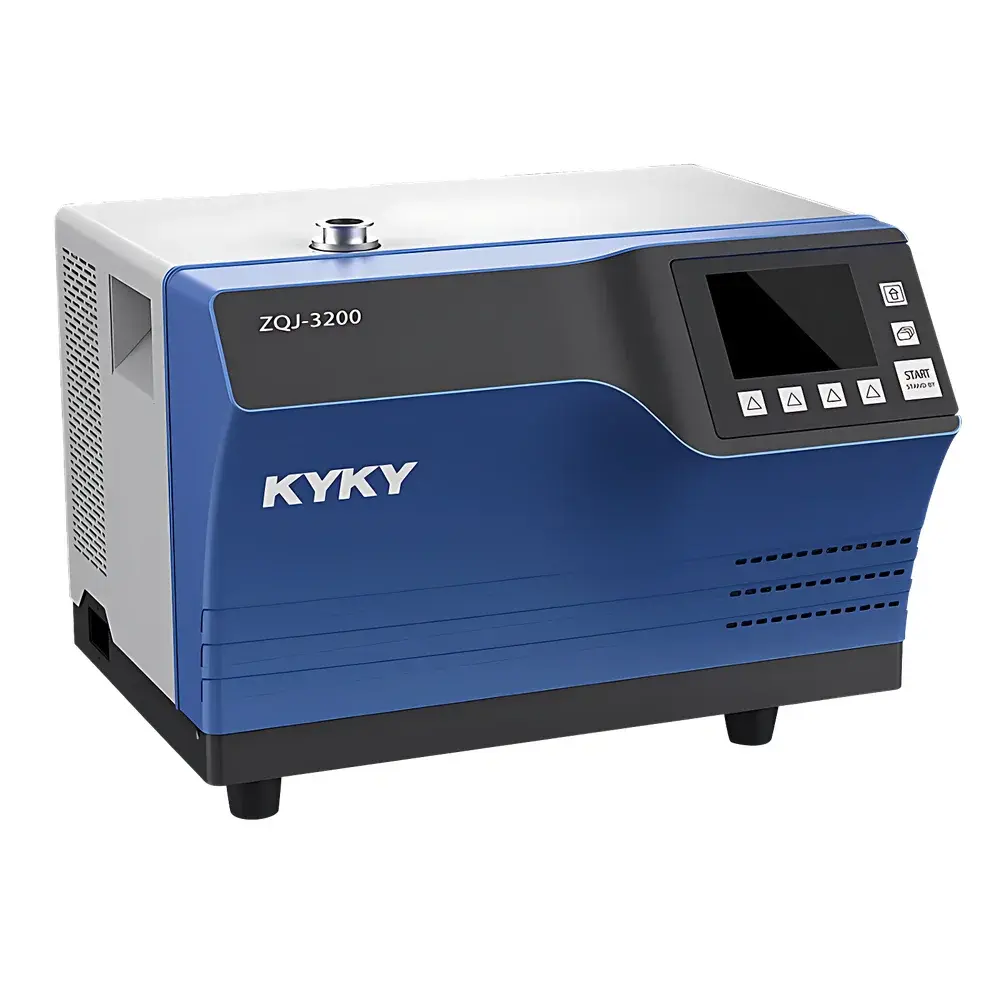
KYKY ZQJ-3200 Helium Mass Spectrometer Leak Detector
| Brand | KYKY |
|---|---|
| Origin | Beijing, China |
| Manufacturer Type | Original Equipment Manufacturer (OEM) |
| Model | ZQJ-3200 |
| Detection Sensitivity (Vacuum Mode) | 5×10⁻¹¹ Pa·m³/s |
| Measurement Range | 5×10⁻¹³ – 1×10¹ Pa·m³/s |
| Maximum Inlet Pressure (Leak Test Mode) | 2500 Pa |
| Large-Leak Mode Operating Pressure | up to 10,000 Pa |
| Helium Pumping Speed (Large-Leak Mode) | 2.5 L/s |
| Response Time | ≤1 s |
| Warm-up Time | <3 min |
| Power Supply | 220 VAC ±10%, 50 Hz, 8 A |
| Operating Environment | 5–45 °C, RH <80% |
| Dimensions (Desktop) | 541×422×379 mm |
| Dimensions (Trolley-Mounted) | 730.8×528×935 mm |
| Weight (Desktop) | 55 kg |
| Weight (Trolley-Mounted) | 108.5 kg |
| Filament | Dual Yttria-Coated Tungsten Filaments |
| Data Storage | Integrated SD Card |
| Interface Options | Digital I/O, Profibus, Ethernet |
Overview
The KYKY ZQJ-3200 Helium Mass Spectrometer Leak Detector is a high-sensitivity, dual-mode residual gas analyzer engineered for quantitative leak detection in vacuum and pressurized systems. It operates on the principle of magnetic sector mass spectrometry, selectively ionizing helium atoms (mass-to-charge ratio m/z = 4) and detecting them via a high-transmission electron multiplier. Unlike quadrupole-based alternatives, the ZQJ-3200 employs a fixed-field magnetic sector analyzer offering superior mass resolution and long-term signal stability—critical for trace-level helium quantification under variable background gas conditions. Its architecture integrates a dedicated helium ion source, optimized ion optics, and a differential pumping system that maintains optimal analyzer vacuum (<1×10⁻⁴ Pa) even during large-leak testing at inlet pressures up to 10,000 Pa. Designed for industrial robustness and laboratory-grade repeatability, the instrument meets foundational requirements for ISO 10648-2 (leak detection performance classification) and supports validation protocols aligned with ASTM E493 and ISO 13305.
Key Features
- Dual operational modes: ultra-high-sensitivity vacuum mode (detection limit 5×10⁻¹¹ Pa·m³/s) and high-throughput large-leak mode (operable at up to 10,000 Pa inlet pressure with 2.5 L/s helium pumping speed)
- Dual yttria-coated tungsten filaments—redundant emission sources enabling extended service life (>8,000 hours typical), automatic filament switching upon degradation, and uninterrupted measurement continuity
- Integrated SD card storage with timestamped, CSV-formatted leak rate logs; supports user-defined data tagging and batch export for audit-ready traceability
- 10.1-inch color capacitive touchscreen interface with customizable layout—operators may configure real-time display of leak rate, partial pressure trends, filament status, and system vacuum levels
- Industrial-grade communications suite: isolated digital I/O (for external valve control and pass/fail signaling), Profibus DP-V1 (for PLC integration in automated test cells), and 10/100BASE-T Ethernet with Modbus TCP and HTTP API support
- Thermally stabilized analyzer housing and active temperature compensation algorithms minimize drift across ambient fluctuations (5–45 °C operating range)
Sample Compatibility & Compliance
The ZQJ-3200 accommodates diverse test configurations including vacuum chamber evacuation, sniffer probe scanning, and pressurized accumulation testing. Its wide dynamic range (12 orders of magnitude: 5×10⁻¹³ to 1×10¹ Pa·m³/s) enables seamless transition from fine-leak screening of semiconductor vacuum chambers to gross-leak verification of power transformer housings. The instrument complies with electromagnetic compatibility standards IEC 61326-1 (industrial environments) and safety standard IEC 61010-1. Its firmware architecture supports configurable audit trails and electronic signatures—facilitating alignment with FDA 21 CFR Part 11 requirements when deployed in GMP-regulated manufacturing settings (e.g., nuclear component qualification or medical vacuum device production). Calibration traceability is maintained per ISO/IEC 17025 through factory-certified reference leaks (NIST-traceable).
Software & Data Management
Built-in firmware provides real-time spectral monitoring, automatic zero suppression, and adaptive background subtraction to suppress interference from hydrogen (m/z = 2) and water fragments. Leak rate calculations adhere strictly to ISO 20486 definitions—reporting normalized values in SI-compliant Pa·m³/s units. Data export includes full metadata (test ID, operator, timestamp, environmental conditions, calibration epoch). Optional PC software (KYKY LeakView Pro) adds statistical process control (SPC) charting, multi-instrument fleet monitoring, and PDF report generation compliant with EN 15038 technical documentation standards. All stored data is encrypted at rest using AES-128, and network access enforces role-based authentication (admin/operator/viewer tiers).
Applications
- Automotive: EV battery module hermeticity validation, fuel rail integrity testing, HVAC evaporator coil inspection
- Energy & Power: GIS switchgear SF₆ containment verification, steam turbine condenser tube leak mapping, nuclear coolant loop component certification
- Semiconductor & Electronics: Vacuum chamber base pressure qualification, MEMS package seal testing, lithography tool foreline integrity checks
- Cryogenics & Superconductivity: Liquid helium transfer line leak localization, MRI magnet cryostat integrity assessment
- Electrical Engineering: High-voltage bushing sealing verification, vacuum interrupter quality control, capacitor tank leak screening
- Research Infrastructure: Particle accelerator beamline vacuum segment certification, fusion reactor first-wall mock-up testing, space simulation chamber validation
FAQ
What is the recommended calibration interval for the ZQJ-3200?
Annual calibration is advised under continuous operation; biannual verification suffices for intermittent use. Factory calibration includes sensitivity verification at three points across the measurement range using certified reference leaks.
Can the ZQJ-3200 detect gases other than helium?
No. It is configured exclusively for helium (m/z = 4) detection. Its magnetic sector design rejects adjacent masses (e.g., deuterium, hydrogen, methane) with >10⁴ mass resolution, ensuring specificity without cross-gas interference.
Is remote diagnostics supported?
Yes. Via Ethernet, authorized technicians can initiate live diagnostic routines—including filament emission profiling, detector gain verification, and vacuum gauge cross-checks—while preserving local operator control.
How does the large-leak mode prevent detector saturation?
Large-leak mode engages an internal bypass valve and reduces ionizer electron emission current by 90%, limiting ion flux to the detector while maintaining linear response up to 1×10¹ Pa·m³/s.
Does the instrument support GLP-compliant data archiving?
Yes. When enabled, the system logs all critical events (calibration, filament swap, parameter changes) with immutable timestamps and operator IDs—exportable as 21 CFR Part 11–compliant audit packages.






