
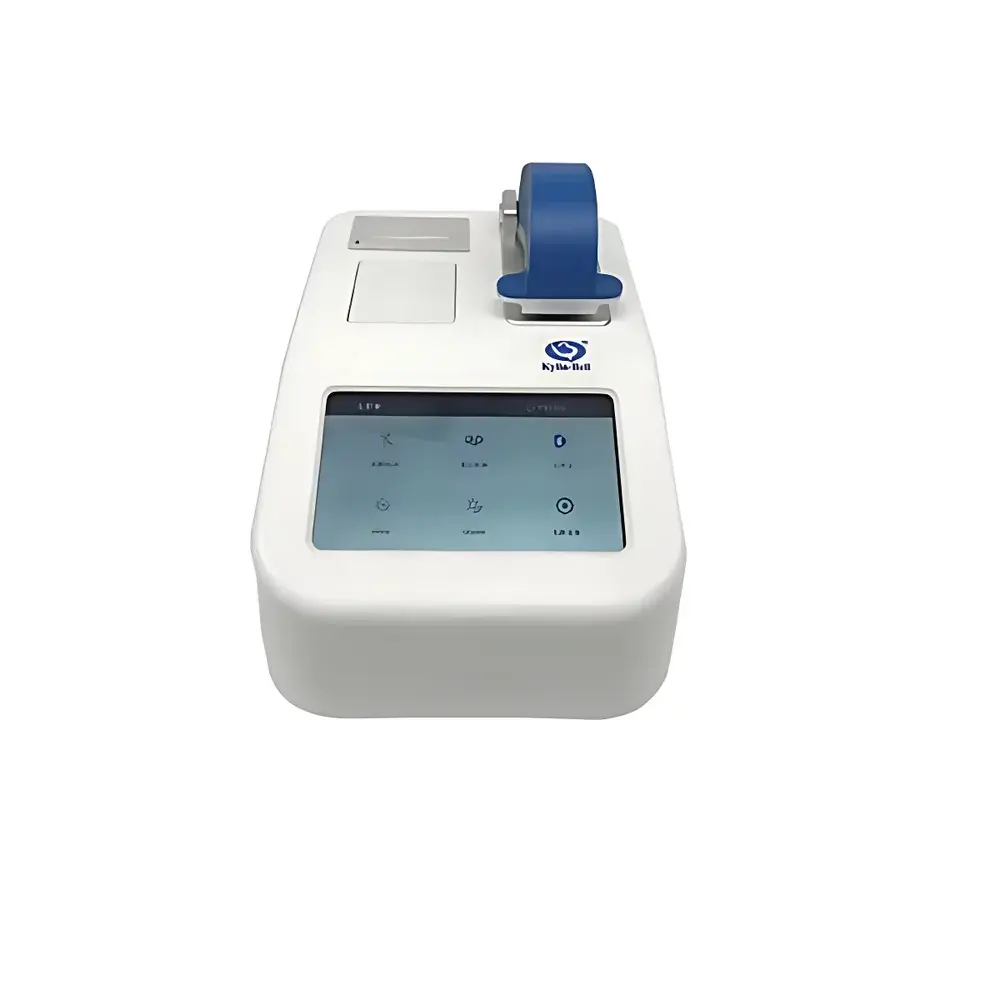
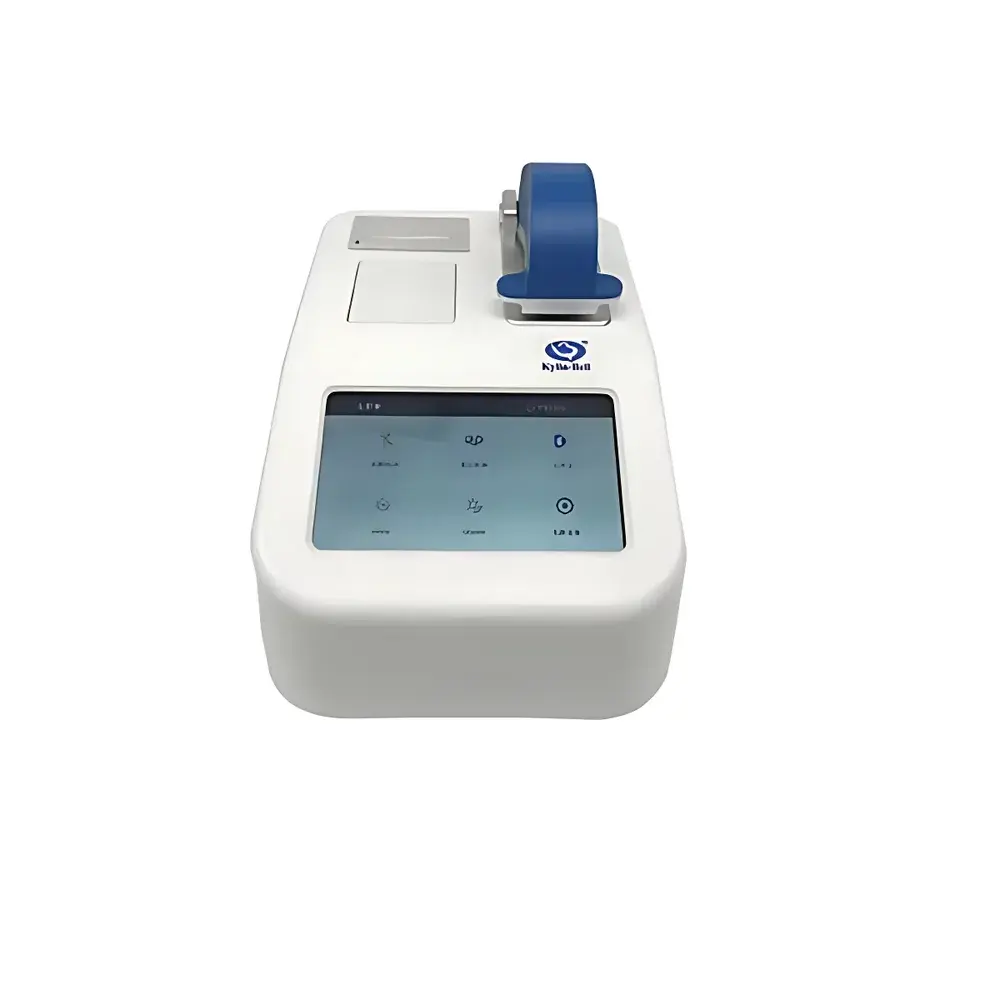
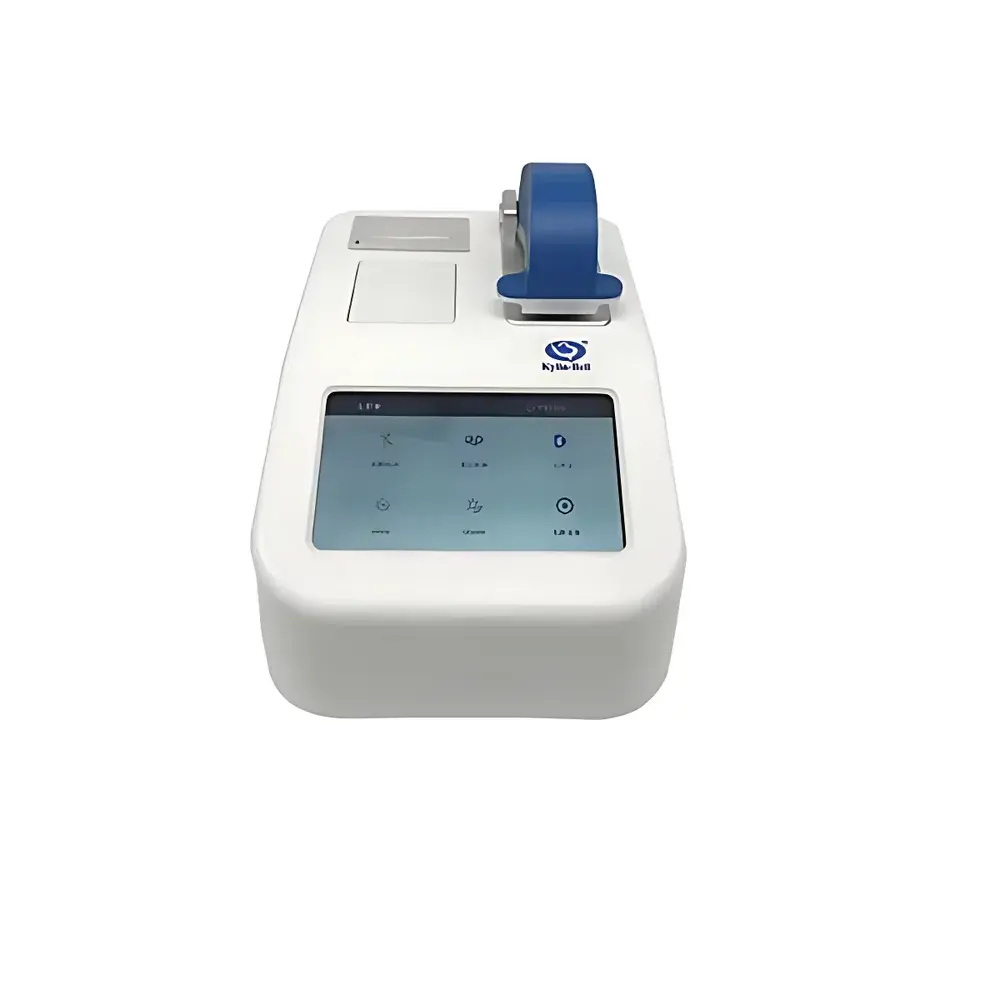
Kylin-Bell BE-9000 Ultra-Micro UV-Vis Spectrophotometer
| Brand | Kylin-Bell |
|---|---|
| Origin | Jiangsu, China |
| Model | BE-9000 |
| Spectral Range | 190–850 nm |
| Spectral Bandwidth | 190–850 nm (full-range xenon flash lamp) |
| Wavelength Accuracy | ±1 nm |
| Sample Volume | 0.5–2 µL |
| Optical Path Lengths | 0.05 mm, 0.2 mm, and 1.0 mm |
| dsDNA Quantitation Range | 2–15,000 ng/µL |
| Absorbance Accuracy | ±1% at 7.332 A (260 nm) |
| Absorbance Precision | 0.003 A (at 0.2 mm path) |
| Absorbance Linearity Range (10-mm equivalent) | 0.04–300 A |
| Measurement Time | <6 s |
| OD600 Range | 0.000–6.000 A |
| Detector | Hamamatsu UV-enhanced CMOS linear array sensor |
| Light Source | Pulsed xenon flash lamp |
| Display | 7-inch capacitive touchscreen (1024 × 600) |
| Operating System | Android-based embedded OS |
| Dimensions | 200 × 260 × 165 mm |
| Weight | 5 kg |
| Power Supply | DC 24 V adapter |
| Power Consumption | 25 W (operational), 5 W (standby) |
| Absorbance Stability & Repeatability | ≤0.5% (0–3 A), ≤2% (3–4 A) |
Overview
The Kylin-Bell BE-9000 Ultra-Micro UV-Vis Spectrophotometer is a benchtop, self-contained analytical instrument engineered for rapid, high-fidelity quantification and quality assessment of nucleic acids, proteins, and microbial suspensions without external computing hardware. It operates on the principle of ultraviolet–visible absorption spectroscopy, utilizing a pulsed xenon flash lamp as a stable, broad-spectrum light source covering 190–850 nm—enabling full-spectrum scanning and fixed-wavelength measurements in a single platform. Unlike traditional cuvette-based systems, the BE-9000 employs a precision-machined, hydrophobic sample stage with three selectable optical path lengths (0.05 mm, 0.2 mm, and 1.0 mm), eliminating the need for disposable capillaries or quartz cuvettes. This design enables direct microvolume deposition (0.5–2 µL) and immediate measurement, minimizing sample waste and cross-contamination risk while supporting both low-concentration and highly concentrated analyte analysis—e.g., dsDNA from 2 to 15,000 ng/µL (10-mm equivalent). The integrated Hamamatsu UV-enhanced CMOS linear array detector ensures high signal-to-noise ratio and photometric linearity across an extended absorbance range (0.04–300 A, 10-mm equivalent), validated per ISO 8579 and ASTM E275 guidelines for spectrophotometric performance.
Key Features
- Standalone operation with embedded Android OS and responsive 7-inch capacitive touchscreen (1024 × 600 resolution) — no PC, driver, or software installation required
- Triple-path-length capability (0.05 mm, 0.2 mm, 1.0 mm) for seamless transition between high- and low-concentration samples without dilution or recalibration
- Xenon flash lamp with >10⁹ pulse lifetime — provides consistent spectral output across 190–850 nm without warm-up delay or intensity drift
- UV-optimized CMOS linear array detector (Hamamatsu) delivering <0.003 A photometric precision at 0.2 mm path length and ±1% absorbance accuracy at 260 nm (certified against NIST-traceable standards)
- Measurement cycle completed in under 6 seconds, including auto-zeroing, spectral acquisition, and concentration calculation
- OD600 mode compliant with ISO 8199 for bacterial culture density monitoring, calibrated to standard McFarland units
- Low-power architecture: 25 W operational draw; 5 W standby consumption — suitable for shared lab environments and mobile deployment
Sample Compatibility & Compliance
The BE-9000 supports direct analysis of unpurified lysates, PCR products, purified plasmids, protein solutions (BSA, IgG), and microbial suspensions—including E. coli, S. cerevisiae, and environmental isolates. Its hydrophobic sample surface resists carryover and permits easy cleaning with ethanol or laboratory wipes. The instrument complies with core regulatory expectations for analytical instrumentation used in GLP and GMP-adjacent workflows: it maintains audit-ready measurement logs (timestamped, user-tagged), supports password-protected method storage, and generates exportable CSV reports compatible with LIMS integration. While not FDA 21 CFR Part 11–certified out-of-the-box, its data integrity framework—including immutable measurement records and configurable user roles—aligns with ALCOA+ principles for research-grade documentation.
Software & Data Management
The embedded Android interface hosts Kylin-Bell’s proprietary SpectraView™ firmware, offering preconfigured assay templates (A260/A280 ratio, Nanodrop-style nucleic acid QC, Bradford/Lowry protein assays, OD600 calibration curves), customizable wavelength selection, and real-time spectral preview. All measurements are timestamped and stored locally on internal eMMC memory (8 GB), with export via USB 2.0 to FAT32-formatted drives. No cloud connectivity or telemetry is enabled by default—ensuring full data sovereignty. Firmware updates are delivered via signed ZIP packages, verified cryptographically prior to installation.
Applications
- Molecular biology labs: Routine quantification of CRISPR gRNA, siRNA, cDNA, and next-generation sequencing libraries
- Quality control in biomanufacturing: Rapid verification of purified monoclonal antibody batches and viral vector titers
- Clinical microbiology: OD600-based growth curve generation and antibiotic susceptibility screening
- Food safety and environmental testing: Detection of microbial contamination in water, dairy, and produce extracts
- Forensic laboratories: Degraded DNA sample assessment prior to STR amplification
- Academic teaching: Hands-on UV-Vis fundamentals with minimal training overhead and zero consumable cost per measurement
FAQ
Does the BE-9000 require external calibration or annual certification?
No. The xenon flash lamp and CMOS detector are factory-aligned and thermally stabilized; routine verification using supplied quartz reference standards (included) satisfies ISO/IEC 17025 traceability requirements.
Can the instrument measure turbid or particulate samples?
Yes — the 1.0 mm path length mode and built-in scatter correction algorithm mitigate Mie scattering effects common in crude lysates and cell suspensions.
Is method transfer possible between BE-9000 units?
Yes. Assay parameters, wavelength settings, and path-length configurations are exportable as .spf files and reproducible across identical BE-9000 installations.
What maintenance is required?
None beyond periodic cleaning of the sample stage with >95% ethanol and inspection of the LED status indicators; no moving parts, lamps, or filters require replacement within 5 years of typical use.
How does the BE-9000 handle sample evaporation during measurement?
The xenon flash duration is <10 µs, and total exposure time is <100 ms — effectively freezing volatile solvent dynamics and preventing measurable evaporation artifacts in aqueous samples.
Related Products





