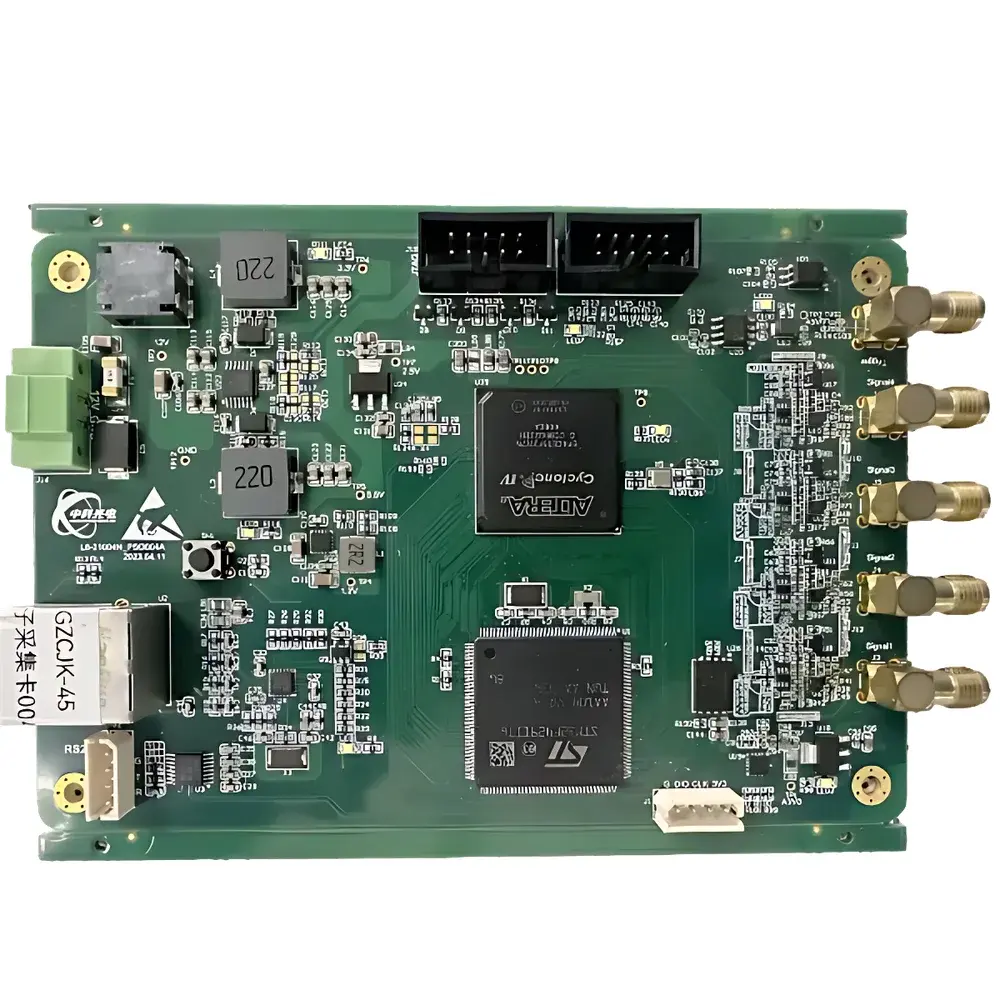
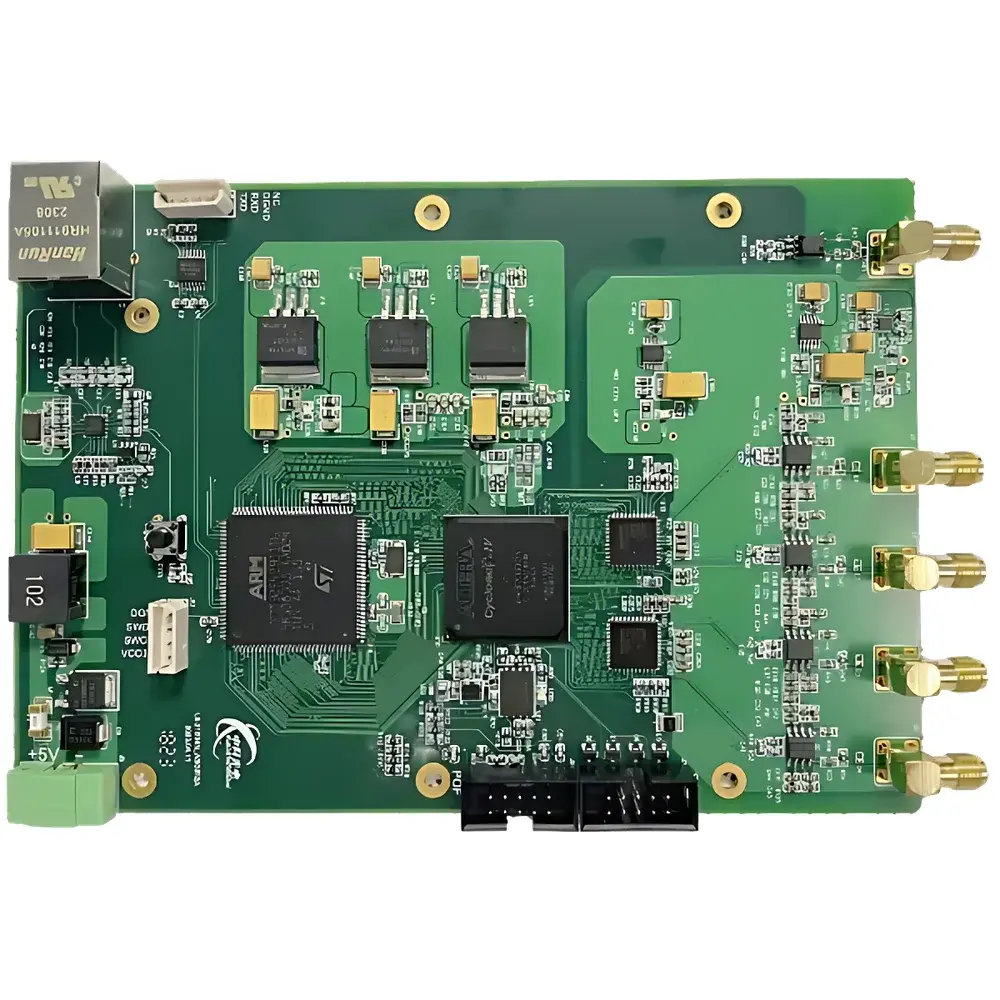
L8-21004N Series High-Speed Multichannel Data Acquisition Card
| Brand | CASP |
|---|---|
| Origin | Jiangsu, China |
| Manufacturer Type | Original Equipment Manufacturer (OEM) |
| Domestic Product Classification | China-Made |
| Model Numbers | L8-21004N_ASG003A / L8-21004N_PSG004A |
| Pricing | Upon Request |
Overview
The L8-21004N Series High-Speed Multichannel Data Acquisition Card is a precision-engineered signal digitization platform designed for time-critical, low-noise optical remote sensing applications. Built around high-fidelity analog-to-digital conversion architecture with synchronized multi-channel sampling, it enables accurate temporal capture of weak, transient photodetector outputs—particularly from pulsed laser-induced fluorescence, elastic/inelastic backscatter, and atmospheric lidar return signals. Its core functionality centers on digitizing analog voltage waveforms from photomultiplier tubes (PMTs), avalanche photodiodes (APDs), or lock-in amplifier outputs with sub-nanosecond timing resolution and minimal inter-channel skew. The card operates as a deterministic front-end interface between optical detection hardware and host-based data processing systems, supporting real-time waveform streaming and post-acquisition spectral analysis workflows essential in atmospheric physics and environmental monitoring laboratories.
Key Features
- Multi-channel synchronous acquisition with programmable sampling rates up to 1 GS/s (model-dependent), optimized for time-resolved lidar signal profiling.
- Dual-model configuration: ASG003A variant supports analog signal gating and external trigger synchronization; PSG004A variant integrates programmable signal conditioning (gain, offset, filtering) prior to digitization.
- 14-bit or 16-bit ADC resolution across all channels, ensuring high dynamic range for detecting both strong near-range and weak far-range atmospheric returns.
- Onboard FPGA-based real-time preprocessing including digital averaging, baseline subtraction, and pulse-height discrimination—reducing host CPU load and enabling embedded signal validation.
- PCIe Gen3 x8 interface providing sustained data throughput >3.5 GB/s, minimizing frame loss during continuous high-repetition-rate lidar operation (e.g., 1–20 kHz pulse trains).
- Rugged industrial-grade PCB layout with RF-shielded analog sections and ground-plane isolation to suppress EMI from high-voltage laser drivers and switching power supplies.
Sample Compatibility & Compliance
The L8-21004N Series is engineered for integration into custom-built or OEM lidar systems where signal integrity and timing fidelity are critical. It accepts bipolar or unipolar analog inputs ranging from ±1 V to ±5 V full-scale, compatible with standard PMT amplifier outputs and transimpedance stages used in Raman, Mie, and Rayleigh scattering detection chains. Input impedance is configurable (50 Ω / 1 MΩ) to match detector output characteristics. The hardware complies with CE EMC Directive 2014/30/EU and RoHS 2011/65/EU requirements. Firmware and driver software support traceable calibration procedures aligned with ISO/IEC 17025 documentation practices for metrological traceability in accredited atmospheric measurement labs.
Software & Data Management
CASP provides a comprehensive SDK (C++/Python APIs) and GUI-based acquisition software (LidarDAQ Studio) supporting cross-platform deployment on Windows and Linux (Ubuntu LTS). The software implements standardized data formats—including HDF5 v1.12 with CF-conventions metadata tagging—for interoperability with NASA’s ICARTT, ESA’s EARLINET, and NOAA’s AERONET data pipelines. All acquired waveforms are timestamped using IEEE 1588 Precision Time Protocol (PTP) when synchronized with GPS-disciplined oscillators. Audit trails, user authentication, and session-level metadata logging meet GLP-compliant record-keeping requirements. Optional FDA 21 CFR Part 11 add-on module enables electronic signatures, change control logs, and secure archive export for regulated environmental research applications.
Applications
- Atmospheric aerosol profiling via elastic (355/532 nm) and Raman (387/607 nm) lidar systems requiring simultaneous multi-wavelength photon counting and analog waveform capture.
- Temperature and humidity retrieval using rotational Raman and vibrational Raman lidar techniques, where precise spectral deconvolution depends on high-SNR, time-aligned channel data.
- Fluorescence lifetime mapping of bioaerosols (e.g., pollen, fungal spores) using UV-excited broadband emission detection with nanosecond-scale decay curve resolution.
- Calibration and validation of space-borne lidar simulators in ground-based testbeds, leveraging deterministic trigger latency (<5 ns jitter) and repeatable acquisition sequencing.
- Multi-parameter atmospheric observatories integrating lidar with ceilometers, sun photometers, and radiosondes—where centralized time-synchronization and unified data ingestion are essential.
FAQ
What is the maximum sustained acquisition duration per buffer at 500 MS/s with 4 active channels?
Buffer depth is configurable up to 256 MB per channel; at 500 MS/s and 16-bit resolution, this supports ~1.3 seconds of continuous acquisition before host transfer is required.
Does the card support external clock synchronization for distributed lidar arrays?
Yes—it features SMA-input reference clock input (10 MHz) and PPS input, compatible with GPS-disciplined OCXOs and White Rabbit timing networks.
Is Linux driver support available for real-time kernel environments (e.g., PREEMPT_RT)?
CASP provides verified real-time DMA drivers for Ubuntu 22.04 LTS with RT kernel patches, achieving <10 µs interrupt latency under load.
Can I perform on-FPGA FFT or correlation processing without host intervention?
The onboard Xilinx Kintex-7 FPGA includes configurable IP blocks for streaming FFT (up to 65,536 points), cross-correlation, and moving-average filters—deployable via bitstream update.
How is calibration traceability documented for ISO/IEC 17025 compliance?
Each unit ships with a factory calibration certificate referencing NIM (National Institute of Metrology, China) standards, including gain/offset linearity, channel-to-channel skew, and effective number of bits (ENOB) measurements.