
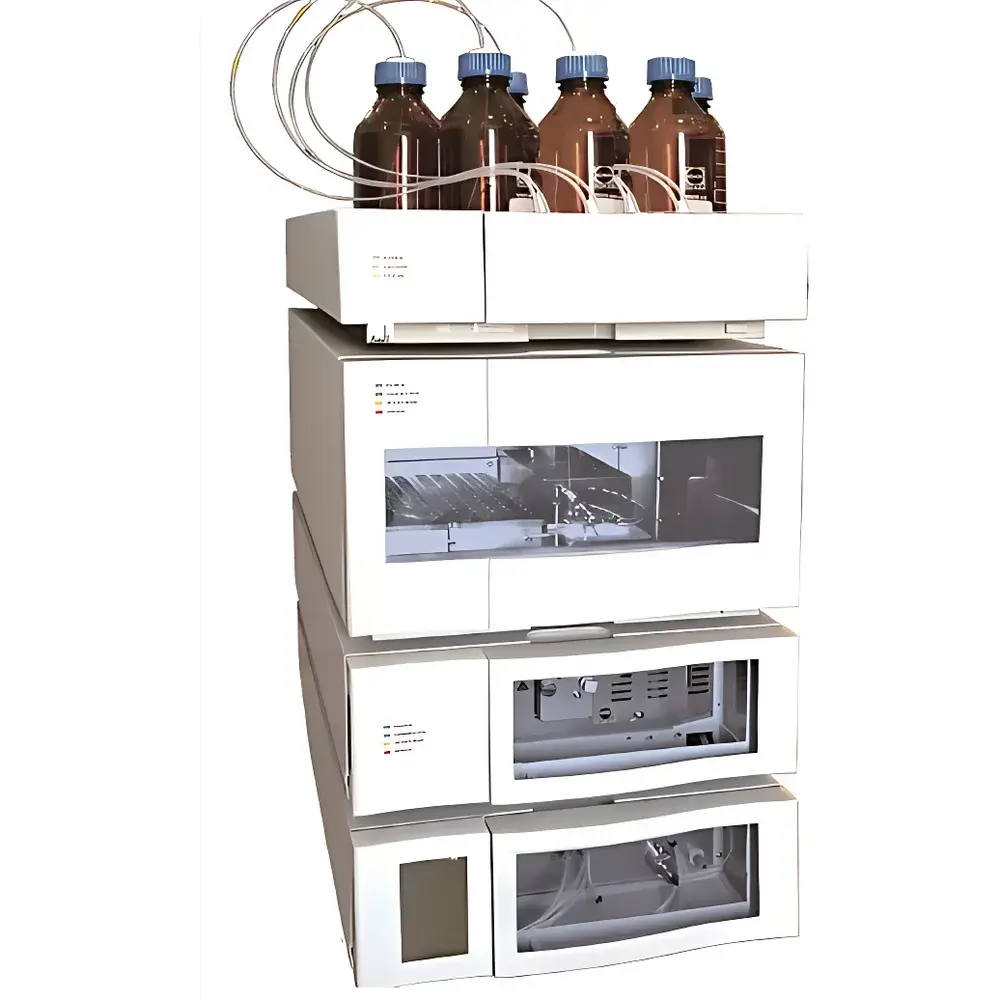
Lab-Antech AA9800 Amino Acid Analyzer
| Brand | Lab-Antech (formerly LABA Tianjin) |
|---|---|
| Origin | USA |
| Manufacturer Type | Authorized Distributor |
| Instrument Type | Post-Column Derivatization System |
| Pump Flow Rate | 0.001–10.000 mL/min |
| Maximum Pump Pressure | 6000 psi |
| Autosampler Injection Volume | 0.1–500 µL |
| Autosampler Temperature Control | 4–40 °C |
| Post-Column Reactor Temperature Range | Ambient to 200 °C |
| Detection Wavelengths | 440 nm and 570 nm |
| Flow Cell Volume | 10 µL |
Overview
The Lab-Antech AA9800 Amino Acid Analyzer is a dedicated high-performance liquid chromatography (HPLC) system engineered for the precise separation, derivatization, and quantification of free and hydrolyzed amino acids in complex biological, pharmaceutical, food, and clinical matrices. It implements the classical post-column ninhydrin derivatization method—standardized in ISO 13903, AOAC 994.12, and USP —where amino acids are resolved on a cation-exchange resin under precisely controlled pH and ionic strength gradients, followed by thermal reaction with ninhydrin at elevated temperature to yield chromophores detectable at 440 nm (for proline and hydroxyproline) and 570 nm (for primary α-amino acids). The system’s modular architecture integrates gradient-elution separation, programmable temperature-controlled reaction kinetics, dual-wavelength photometric detection, and fully automated operation—enabling reproducible retention time alignment, sub-picomole sensitivity, and robust inter-day precision required for regulatory-compliant workflows.
Key Features
- Integrated post-column derivatization platform with independent temperature control for both analytical column (ambient–120 °C) and reaction coil (ambient–200 °C), supporting programmable temperature ramping and gradient stabilization
- High-pressure binary solvent delivery system with flow accuracy ±0.1% RSD and pressure stability ≤0.1% RSD at 6000 psi maximum output
- Autosampler with 0.1–500 µL variable injection volume, refrigerated sample compartment (4–40 °C), and needle wash station with inert gas purging
- Dual-wavelength UV-Vis detector featuring 10 µL low-dead-volume flow cell, wavelength switching within 100 ms, and simultaneous dual-channel data acquisition
- Chemically inert fluidic path constructed entirely from PEEK and titanium components; compatible with aggressive ninhydrin reagents and acidic/basic buffers
- Onboard vacuum degasser, programmable auto-purge cycles, and sealed reaction coil with multi-directional flow design for homogeneous mixing and minimized band broadening
- Comprehensive self-diagnostic suite monitoring pump performance, valve actuation, detector lamp energy, temperature sensor integrity, and pressure transducer calibration status
Sample Compatibility & Compliance
The AA9800 accommodates diverse sample types including protein hydrolysates (6M HCl, 110 °C, 24 h), plasma/serum (deproteinized with sulfosalicylic acid or acetonitrile), tissue extracts, fermentation broths, and nutritional formulations. Its operational parameters conform to critical regulatory frameworks: method repeatability meets ICH Q2(R2) guidelines for analytical procedure validation; data integrity adheres to FDA 21 CFR Part 11 requirements via audit-trail-enabled software; and hardware design supports GLP/GMP laboratory environments through traceable calibration logs, user-access controls, and electronic signature capability. All buffer and reagent lines feature continuous inert gas (N₂ or Ar) sparging to prevent oxidation of sensitive analytes such as cysteine and tryptophan.
Software & Data Management
Control and analysis are performed using Lab-Antech AminoSoft™ v5.x—a validated Windows-based application compliant with 21 CFR Part 11 Annex 11. The software provides real-time system monitoring, method editor with multi-step gradient programming, peak integration using tangent skim and valley-to-valley algorithms, library-assisted peak identification (built-in database of >45 amino acid standards), and customizable report generation (PDF/CSV/XLSX). Raw data files include embedded metadata (instrument ID, operator, timestamp, method version, calibration history), and all processing steps are logged with immutable timestamps. Optional LIMS integration is supported via ASTM E1384-compliant HL7 and XML interfaces.
Applications
- Quantitative profiling of essential and non-essential amino acids in infant formula, dietary supplements, and sports nutrition products per AOAC 994.12 and EU Regulation No. 1169/2011
- Stability-indicating assays for therapeutic peptides and recombinant proteins during forced degradation studies (acid/base/oxidative stress)
- Clinical diagnostics of inborn errors of metabolism (e.g., phenylketonuria, maple syrup urine disease) using plasma or dried blood spot samples
- Quality control of fermentation-derived amino acids (L-glutamic acid, L-lysine, L-threonine) in industrial bioprocessing
- Validation of hydrolysis completeness in collagen and gelatin characterization per ISO 17276
FAQ
What derivatization chemistry does the AA9800 employ?
It uses ninhydrin-based post-column derivatization under controlled temperature and residence time, optimized for stoichiometric conversion of α-amino groups into Ruhemann’s purple (570 nm) and imino acid adducts (440 nm).
Is the system compatible with ortho-phthalaldehyde (OPA) pre-column derivatization?
No—the AA9800 is purpose-built for ninhydrin chemistry; OPA workflows require alternative instrumentation with pre-column reaction modules and different detector configurations.
Can the autosampler handle viscous or particulate-containing samples?
Yes—equipped with high-torque syringe drive and optional 0.2 µm inline filtration; however, centrifugation or membrane filtration prior to injection is recommended for samples exceeding 5 cP viscosity or containing suspended solids.
How is system suitability verified before sample analysis?
Via built-in system suitability tests including resolution between lysine/arginine peaks, tailing factor for glycine, %RSD of replicate injections (n=6), and signal-to-noise ratio (>100:1 at 10 pmol injection).
Does the instrument support remote monitoring and troubleshooting?
Yes—via secure HTTPS-enabled web interface with real-time pressure/temperature plots, alarm notifications, and diagnostic log export for Level 2 technical support escalation.



