
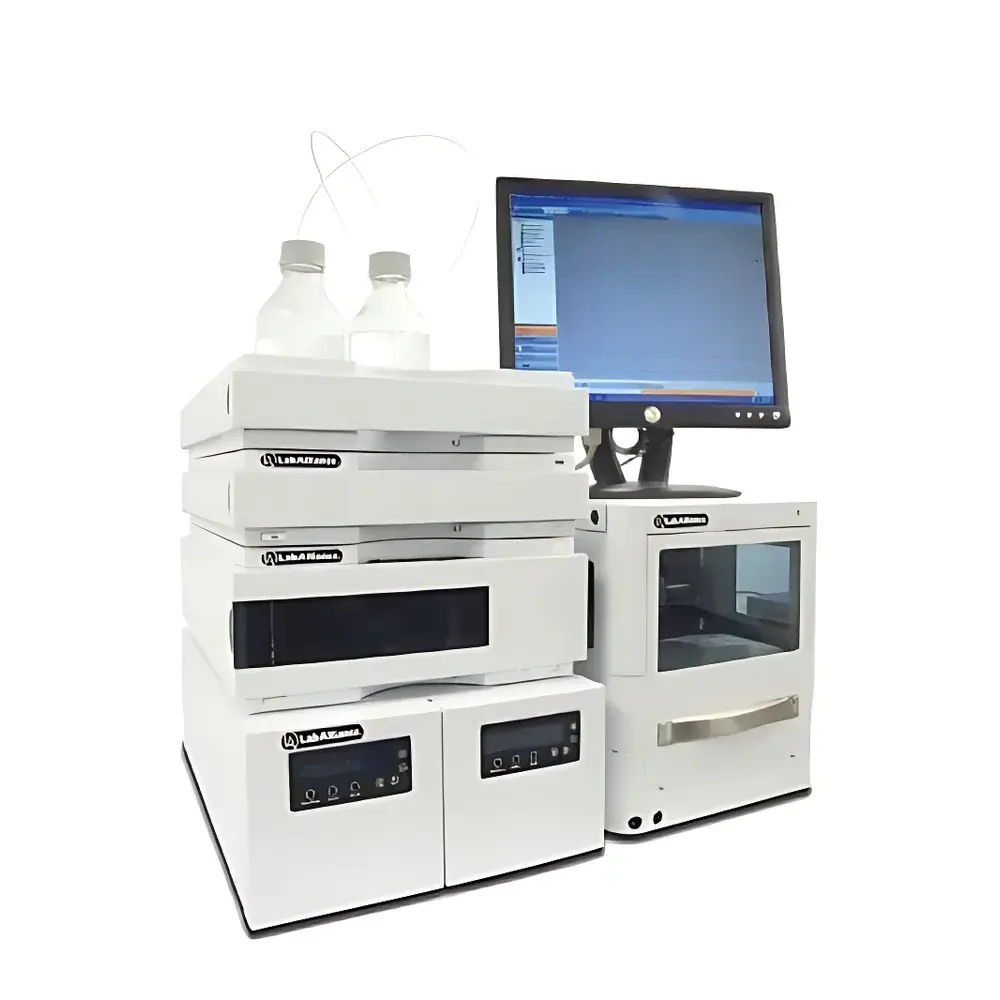
LAB LC UP2000 Ultra-High-Pressure Liquid Chromatograph
| Origin | USA |
|---|---|
| Manufacturer Type | Authorized Distributor |
| Origin Category | Imported Instrument |
| Model | UP2000 |
| Price Range | USD 28,000 – 70,000 |
| Instrument Type | Ultra-High-Performance Liquid Chromatograph (UHPLC) with Online Solid-Phase Extraction (SPE) |
| Flow Rate Range | 0.001–20 mL/min |
| Maximum System Pressure | 25,000 psi |
| Autosampler Tray Capacity | 120 positions |
| Injection Volume Range | 1–100 µL |
| Column Oven Temperature Range | Ambient +10 °C to 150 °C |
| UV-Vis Wavelength Range | 190–800 nm |
| Data Acquisition Rate | 100 Hz |
Overview
The LAB LC UP2000 is an ultra-high-pressure liquid chromatograph engineered for precision, robustness, and method scalability in modern analytical laboratories. Based on the fundamental principles of high-efficiency reversed-phase chromatography under elevated pressure regimes, the UP2000 delivers sub-2 µm particle column performance at sustained pressures up to 25,000 psi—enabling rapid, high-resolution separations of complex mixtures including biomolecules, natural product extracts, and synthetic pharmaceutical intermediates. Its architecture conforms to the physical constraints of modern UHPLC methodology: minimized dwell volume, low dispersion flow paths, and thermally stabilized fluidic components ensure retention time reproducibility ≤0.15% RSD and peak area precision <0.5% RSD (n=6) under GLP-compliant operation. Unlike legacy HPLC platforms, the UP2000 supports both conventional 4.6 × 150 mm columns and extended-length 3.0 × 100+ mm columns packed with hybrid silica-based sub-2 µm particles—facilitating method transfer from research to regulated QC environments without revalidation.
Key Features
- 25,000 psi binary or quaternary solvent delivery system with active pulse damping and real-time pressure monitoring
- High-precision autosampler with 120-position refrigerated tray (4–10 °C), needle wash station, and low-dead-volume injection valve (≤100 nL internal volume)
- Column oven with dual-zone temperature control (ambient +10 °C to 150 °C) and independent pre-heater for inlet line stabilization
- Full-spectrum UV-Vis detector featuring a 1024-element diode array, 190–800 nm wavelength range, and 100 Hz acquisition rate for high-speed peak tracking
- Integrated online SPE interface supporting 96-well plate-compatible cartridges and automated column-switching protocols
- Modular design compliant with ISO/IEC 17025 laboratory infrastructure requirements and compatible with third-party column switching valves and mass spectrometer interfaces
Sample Compatibility & Compliance
The UP2000 accommodates diverse sample matrices—including aqueous biological fluids (plasma, urine), organic plant extracts, polymer leachables, and small-molecule APIs—without hardware modification. Its fluidic path employs chemically resistant materials (e.g., PEEK, sapphire, and titanium alloys) suitable for aggressive mobile phases (e.g., 0.1% TFA in acetonitrile/water). The system meets critical regulatory prerequisites: it supports audit-trail-enabled data capture per FDA 21 CFR Part 11 when operated with validated EZChrom Control software; complies with ICH Q2(R2) guidelines for method robustness testing; and facilitates validation per ASTM E2629 (Standard Guide for Validation of Chromatographic Methods) and USP Chromatography. All firmware and control logic are traceable to version-controlled release notes, enabling full GxP audit readiness.
Software & Data Management
EZChrom Control serves as the native acquisition and processing platform, offering sequence-driven method execution, real-time chromatogram overlay, peak purity assessment via spectral deconvolution, and customizable report templates aligned with ISO/IEC 17025 reporting clauses. Raw data files adhere to ANDI/MSD format standards and support direct import into third-party tools including OpenLab CDS, Chromeleon, and MassHunter. Audit trail functionality logs all user actions—including method edits, integration parameter changes, and calibration events—with immutable timestamps and operator ID binding. Data integrity safeguards include automatic backup to network-attached storage (NAS), write-once-read-many (WORM) archive options, and role-based access control (RBAC) configurable to meet internal SOPs and external inspection criteria.
Applications
- Routine quantification of monoclonal antibody charge variants using shallow pH gradients on BEH C4 columns
- High-throughput screening of natural product libraries via online SPE–UHPLC–DAD workflows with <5 min cycle time
- Stability-indicating assay development for peptide therapeutics under forced degradation conditions (acid/base/oxidative stress)
- Residual solvent analysis in polymer excipients per ICH Q3C guidelines using gradient elution and headspace-compatible injection protocols
- Metabolite profiling in rodent plasma following oral dosing, leveraging 100 Hz spectral acquisition for co-eluting isobaric species differentiation
FAQ
What column dimensions and particle sizes are supported at maximum pressure?
The UP2000 is validated for columns ranging from 2.1 × 30 mm to 4.6 × 150 mm with particle diameters of 1.7–2.6 µm, including hybrid silica (e.g., BEH, Kinetex), core-shell, and wide-pore (>300 Å) phases.
Is the system compatible with mass spectrometry interfaces?
Yes—standard ESI and APCI source connections are supported via optional heated capillary kits and flow-splitting modules; system backpressure remains stable under split-flow conditions down to 10 µL/min.
How is temperature stability maintained across the entire flow path?
Column oven, detector flow cell, and autosampler needle seat are independently thermoregulated; all zones maintain ±0.3 °C stability over 24 h at setpoints between 30–80 °C.
Can the online SPE module be bypassed for conventional UHPLC operation?
Yes—the SPE interface uses a motorized 6-port/2-position valve; manual or software-initiated bypass mode enables direct injection without hardware reconfiguration.
What documentation is provided for IQ/OQ/PQ validation?
A complete validation package—including installation qualification (IQ) checklists, operational qualification (OQ) test protocols with acceptance criteria, and PQ-ready templates—is supplied with each instrument shipment and updated annually per ISO/IEC 17025 revision cycles.
Related Products




