
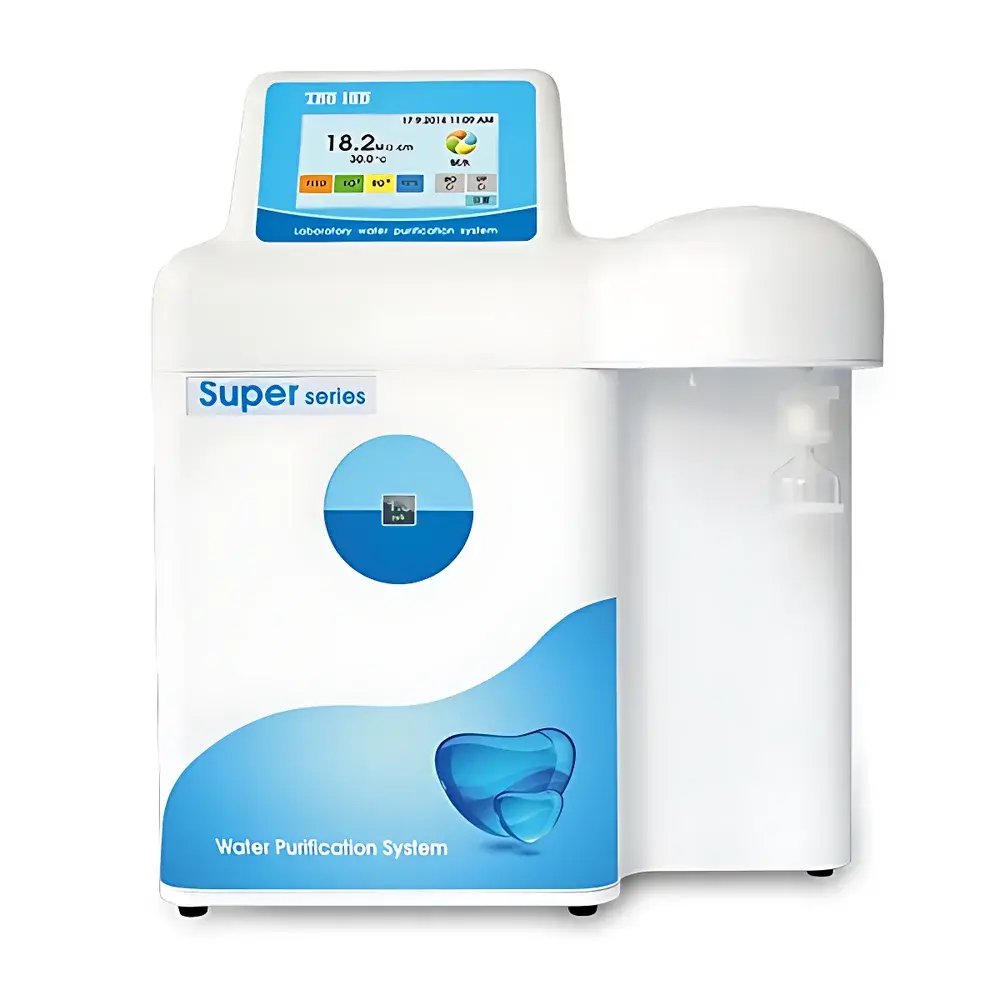
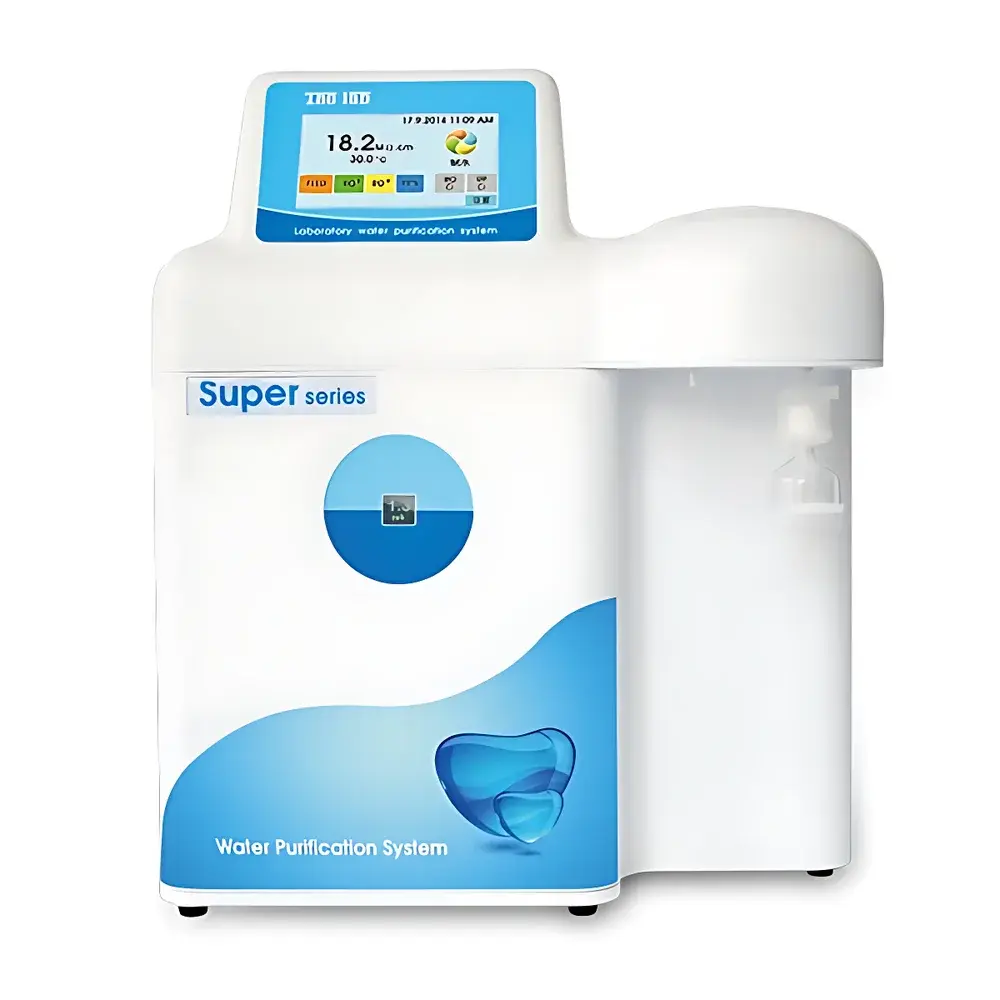
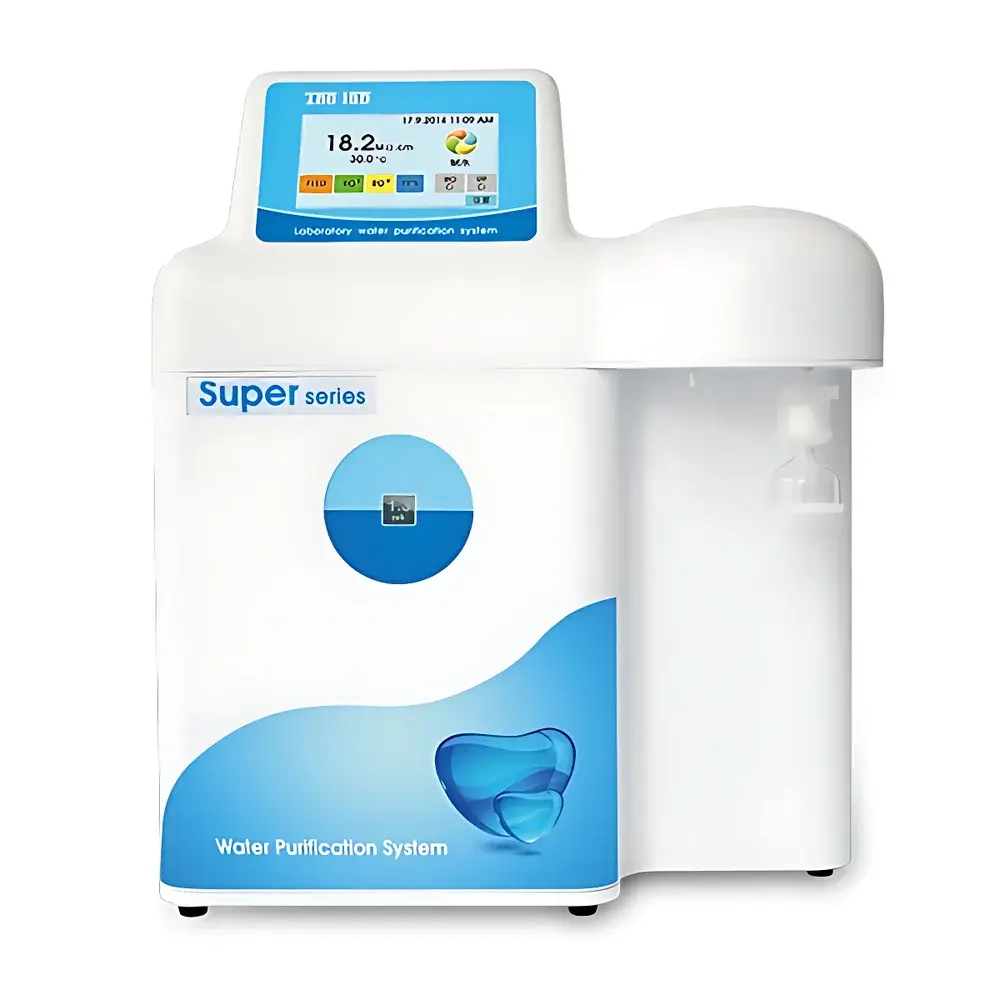
The Lab Super Full-Touchscreen Ultra-Pure Water System
| Brand | The Lab |
|---|---|
| Origin | USA |
| Model | Super |
| Purified Water Grade | Type I (ASTM D1193-20) |
| Resistivity | 18.2 MΩ·cm @ 25 °C |
| Heavy Metals & Soluble Silica | <0.01 ppb |
| Total Organic Carbon (TOC) | <3 ppb |
| Microbial Count | <0.01 CFU/mL |
| Endotoxin | <0.001 EU/mL |
| Particles (>0.1 µm) | <1 particle/mL |
| Production Rate | 10 L/h (RO/EDI), Up to 2.0 L/min (UP water, tank-fed) |
| Integrated TOC Monitor | Yes |
| Compliance | ASTM D1193, ISO 3696, USP <643>, EP 2.2.44, JP 16, CLSI A2, CAP, GB/T 6682-2008, GB/T 33087-2016 |
Overview
The Lab Super Full-Touchscreen Ultra-Pure Water System is an integrated, GMP-aligned laboratory water purification platform engineered for precision-critical applications in pharmaceutical R&D, biotechnology, molecular diagnostics, and analytical chemistry laboratories. It employs a rigorously validated multi-stage purification architecture—comprising dual-stage reverse osmosis (RO), Ionpure® continuous electrodeionization (EDI), and ultraviolet photo-oxidation—to convert municipal tap water into Type I ultrapure water meeting or exceeding the most stringent international specifications. The system operates on a closed-loop circulation principle with real-time conductivity and TOC monitoring, ensuring continuous compliance with USP , EP 2.2.44, and ASTM D1193-20 Grade I requirements. Its design prioritizes operational integrity, data traceability, and long-term stability under variable feedwater conditions—including fluctuating hardness, chlorine load, and organic burden—without requiring chemical regeneration or DI cartridge replacement.
Key Features
- 7-inch full-color 16:9 capacitive touchscreen interface with intuitive icon-driven navigation, password-protected parameter configuration (dual-level administrator/user access), and embedded real-time clock for GLP-compliant consumable lifecycle tracking
- Four-point online water quality monitoring: feedwater, secondary RO permeate, EDI product water, and final UP water—with configurable alarm thresholds for resistivity, TOC, temperature, and flow rate
- Dedicated miniaturized TOC analyzer using membrane-conductometric detection per USP methodology; features micro-injection pump control, selective ion filtration, and trace-level calibration capability (<1 ppb LOD)
- Triple-pump architecture: primary RO boost pump, EDI recirculation pump, and independent sanitization pump enabling automated hot-water or chemical-free ozone-based disinfection cycles
- NSF-certified fluid path components (tubing, fittings, valves); 1/16″ internal ID PFA/PEEK piping to minimize extractables and TOC leaching
- Optimized dual-RO stage with Dow FilmTec™ membranes, KDF-55/carbon prefiltration, and programmable anti-scaling flush cycles extending membrane service life beyond 3 years under typical lab use
- Integrated 50 L conical-bottom PE storage tank with 0.2 µm hydrophobic air filter, optional 254/185 nm dual-wavelength UV irradiation module (12-month lamp life), and UF (5 kDa MWCO) + double-layer PES terminal filtration (0.45 + 0.1 µm)
Sample Compatibility & Compliance
The Super system delivers consistent Type I water suitable for HPLC mobile phase preparation, LC-MS solvent formulation, cell culture media supplementation, ELISA assay buffers, and nucleic acid handling (RNase/DNase-free variants available). All wetted materials—including polyethylene tanks, PFA manifolds, 316L stainless steel UV chambers, and PES filters—are certified compliant with USP Class VI, ISO 10993, and FDA 21 CFR Part 11–ready audit trails. Data integrity is maintained via onboard SD card logging (12 months of timestamped conductivity/TOC/flow records), encrypted Wi-Fi transmission to local network servers, and optional cloud-based archival with role-based access control. The system supports full electronic signature functionality and meets GLP/GMP documentation requirements for regulated environments.
Software & Data Management
Embedded firmware provides comprehensive data governance: automatic event logging (alarms, maintenance prompts, calibration actions), user-defined report generation (PDF/CSV), and time-stamped audit trails for all critical parameters. Historical trends are visualized directly on-screen or exported via USB port. Remote diagnostics, over-the-air software updates, and secure firmware rollback capability are supported through TLS 1.2–encrypted connections. All stored data conforms to ALCOA+ principles (Attributable, Legible, Contemporaneous, Original, Accurate, Complete, Consistent, Enduring, Available) and may be archived in accordance with 21 CFR Part 11 Subpart B requirements when paired with validated third-party LIMS integration.
Applications
- HPLC, UHPLC, and LC-MS grade solvent preparation where sub-ppb TOC and <0.01 CFU/mL microbial limits prevent column fouling and baseline drift
- Cell line expansion, stem cell differentiation, and IVF media formulation requiring endotoxin <0.001 EU/mL and RNase/DNase <1 pg/mL
- Atomic absorption spectroscopy (AAS), ICP-MS, and GF-AAS diluent preparation demanding ultra-low heavy metal background (<0.01 ppb)
- Next-generation sequencing library prep, qPCR master mix preparation, and CRISPR reagent dilution where silica and organics compromise enzymatic fidelity
- Calibration standard preparation for clinical chemistry analyzers operating under CLIA and CAP accreditation frameworks
FAQ
What standards does the Super system comply with?
It meets ASTM D1193-20 Type I, ISO 3696 Grade 1, USP , EP 2.2.44, JP 16, CLSI A2, and GB/T 6682-2008 Class I specifications.
Can the system operate without a water storage tank?
Yes—it supports direct-draw mode with optional pressurized reservoir compatibility, though continuous circulation from the 50 L tank is recommended for stable TOC/resistivity performance.
Is TOC measurement performed continuously or intermittently?
The integrated TOC module performs fully automated, uninterrupted analysis at user-configurable intervals (default: every 15 minutes) with no manual sampling required.
How is system validation supported?
Factory-installed IQ/OQ documentation templates, as-built P&IDs, material certifications (RoHS, REACH, NSF), and electronic calibration logs are provided; PQ protocols align with ASTM E2915 and ISO/IEC 17025.
What maintenance intervals are recommended for consumables?
Pre-filters: 6–12 months; RO membranes: 24–36 months; EDI stack: 36–60 months; UP polishing cartridge: 6–12 months (dependent on feedwater quality and daily usage volume).



