
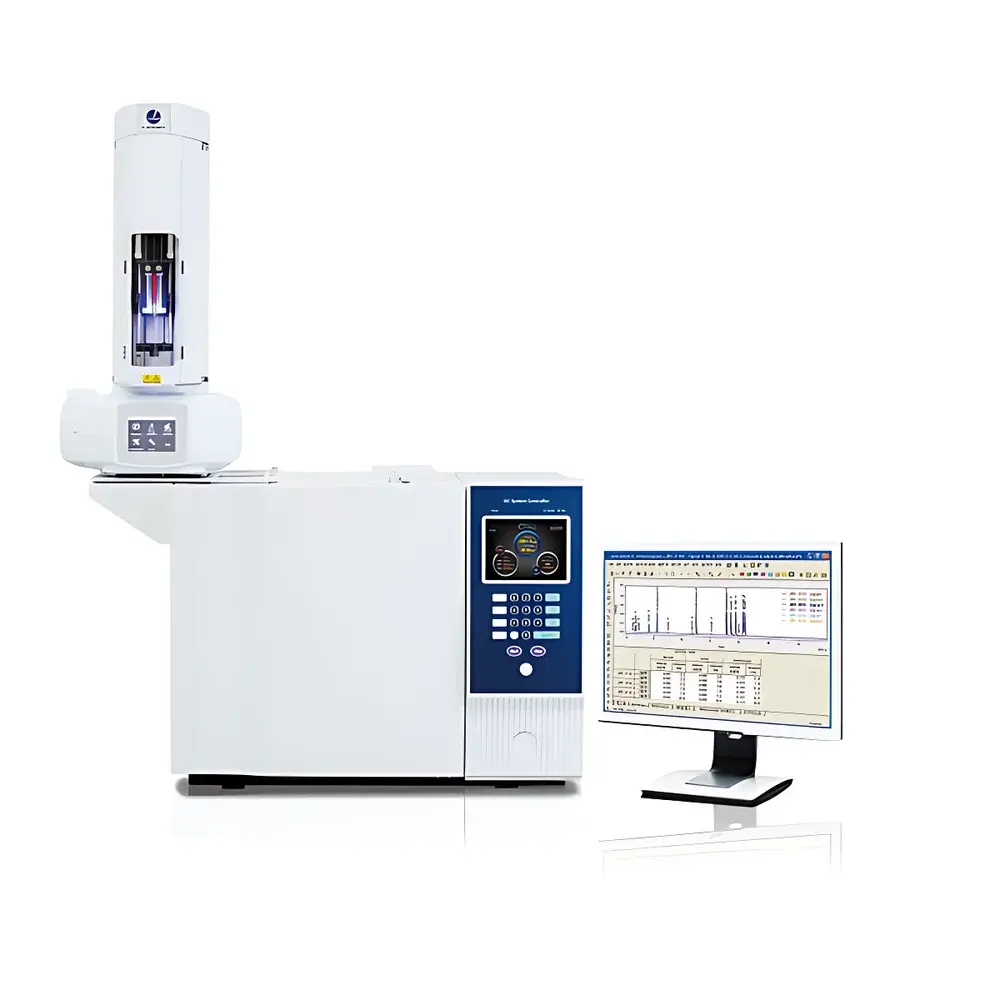
LABA G5 GC Advanced Laboratory Gas Chromatograph
| Brand | LABA |
|---|---|
| Origin | USA |
| Model | G5 GC |
| Instrument Type | Laboratory Gas Chromatograph |
| Application Scope | Universal |
| Temperature Control Range | Ambient to 850 °C |
| Oven Ramp Rate | 0.01–500 °C/min |
| Oven Cool-down Rate | ~1 min (850 °C → 0 °C) |
| Carrier Gas Flow Range & Control | 0–25,000 mL/min |
| Carrier Gas Pressure Range & Control | 0.001–100,000 psi |
| Injector Maximum Operating Temperature | 850 °C |
| Injector Pressure Setting Range | 0.001–100,000 psi |
| Injector Total Flow Setting Range | 0.0001–10,000 mL/min |
| Detector Sensitivity (ECD) | ≤10⁻¹⁵ g/s (for γ-HCH) |
Overview
The LABA G5 GC represents the fifth-generation evolution of laboratory-scale gas chromatography systems, engineered for high-precision separation and quantitative analysis of volatile and semi-volatile organic compounds. Based on the fundamental principle of differential partitioning between a mobile phase (inert carrier gas) and a stationary phase (capillary column coating), the G5 GC delivers enhanced resolution, retention time reproducibility, and method robustness across diverse sample matrices. Its architecture integrates advanced pneumatic control, thermally optimized oven design, and modular detector compatibility—making it suitable for regulated environments where trace-level detection, method transferability, and long-term system stability are critical. Designed and assembled in the USA, the instrument complies with core mechanical and electrical safety standards applicable to analytical instrumentation deployed in ISO/IEC 17025-accredited laboratories.
Key Features
- Enhanced APC (Advanced Pressure Control) modules across all gas delivery subsystems—injector, column oven, and detector—ensuring <±0.001 psi pressure stability and <±0.01 mL/min flow accuracy under dynamic gradient conditions.
- Ultra-fast thermal management: capable of ramping from ambient to 850 °C at up to 500 °C/min and cooling from 850 °C to 0 °C in approximately 60 seconds, significantly reducing cycle time without compromising column integrity or baseline stability.
- 26-step programmable temperature ramping with independent hold times, enabling precise elution window control for complex mixtures such as pesticide residues, flavor volatiles, or petrochemical fractions.
- High-temperature injector system rated to 850 °C, compatible with both split/splitless, PTV, and cold-on-column injection modes—supporting thermally labile and high-boiling analytes without degradation.
- Modular detector bay accommodating simultaneous installation of up to three detectors—including FID, TCD, ECD, NPD, and MS interfaces—with independent temperature zoning and real-time signal synchronization.
- 12.1-inch high-resolution capacitive touchscreen interface with intuitive icon-driven navigation, offline method editing, and embedded diagnostics—designed to minimize operator training time while maintaining full audit trail compliance.
Sample Compatibility & Compliance
The G5 GC supports liquid, gaseous, and solid-phase microextraction (SPME) samples across environmental, food, pharmaceutical, forensic, and industrial applications. It is routinely deployed for EPA Method 8081B (organochlorine pesticides), ASTM D3606 (benzene/toluene in gasoline), USP (residual solvents), and ISO 11843-3 (detection limit validation). All firmware and data handling routines adhere to ALCOA+ principles (Attributable, Legible, Contemporaneous, Original, Accurate, Complete, Consistent, Enduring, Available) and support 21 CFR Part 11-compliant electronic signatures when paired with validated chromatography data systems (CDS). System qualification documentation—including IQ/OQ/PQ protocols—is provided per ICH Q2(R2) and ISO/IEC 17025 requirements.
Software & Data Management
The instrument operates natively with LABA ChromaSuite™ v5.x—a 64-bit, multi-user CDS built on a SQL Server backend. It features automated calibration curve generation, peak integration with customizable baselines (valley-to-valley, tangent skim, exponential skimming), forced retention time locking (RTL), and batch processing with error flagging. Raw data files (.lcd) are stored with embedded metadata (instrument ID, method version, user login, timestamp, audit log hash), and export formats include AIA/CDF, CSV, PDF report templates, and XML for LIMS integration. Audit trails record all method modifications, result reprocessing events, and user access attempts—retained for ≥36 months per GLP/GMP archival policies.
Applications
- Environmental: Quantification of VOCs in ambient air (TO-17), SVOCs in soil/sediment (EPA 8270), and halogenated hydrocarbons in water (EPA 504.1).
- Food & Beverage: Residual solvent profiling in spirits (e.g., methanol, ethyl acetate), fatty acid methyl ester (FAME) analysis in edible oils, and off-flavor compound identification in dairy and fermented products.
- Pharmaceutical: Residual solvent testing per ICH Q3C, assay of chiral impurities using cyclodextrin columns, and stability-indicating methods for API degradation products.
- Forensics & Toxicology: Detection of accelerants in arson debris (ASTM E1618), blood alcohol quantification (headspace-GC/FID), and toxicant screening in postmortem specimens.
- Industrial Chemistry: Monomer purity assessment in polymer feedstocks, catalyst poisoning analysis in petrochemical reformers, and quality control of synthetic fragrances and dyes.
FAQ
What regulatory standards does the G5 GC support for data integrity?
The system meets 21 CFR Part 11 requirements when used with ChromaSuite™ v5.x in validated configurations, including role-based access control, electronic signatures, and immutable audit trails.
Can the G5 GC be integrated into an existing LIMS environment?
Yes—it provides native HL7 and ASTM E1384-compliant interfaces, plus RESTful API endpoints for direct LIMS synchronization of methods, results, and QC metrics.
Is method transfer from legacy GC platforms supported?
ChromaSuite includes backward-compatible method import tools for Agilent, Thermo, and Shimadzu GC methods, with automatic parameter mapping and validation-ready reports.
What maintenance intervals are recommended for routine operation?
Injector liner replacement every 100–200 injections; column trimming every 3–6 months depending on sample cleanliness; annual full pneumatic calibration and detector performance verification per manufacturer SOPs.
Does the system support unattended overnight operation?
Yes—equipped with automated power-on self-test (POST), scheduled shutdown/restart, and real-time email/SNMP alerts for pressure loss, temperature deviation, or run failure.





