
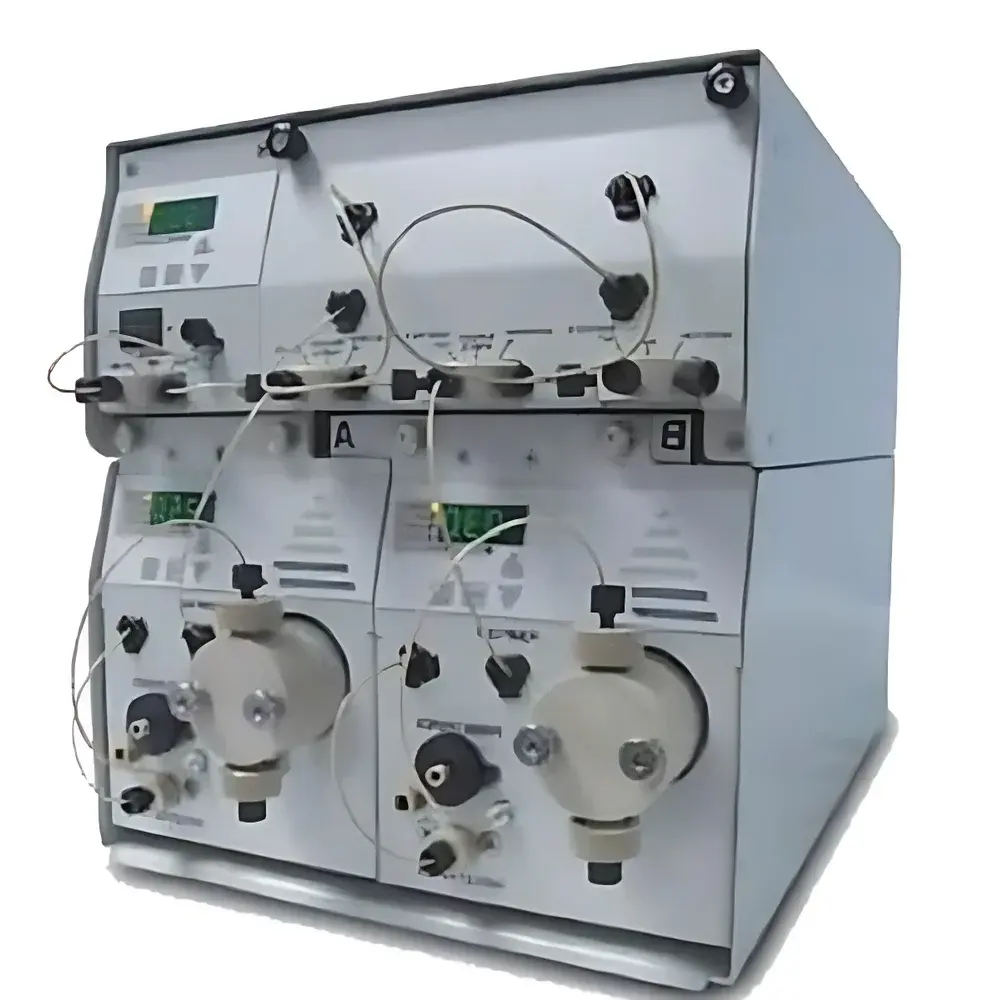
LABA PCR2 Post-Column Derivatization System
| Brand | LABA (Tianjin) |
|---|---|
| Origin | USA |
| Manufacturer Type | Authorized Distributor |
| Product Origin | Imported |
| Model | PCR2 |
| Temperature Range | Ambient to 150 °C |
| Derivatization Reagent Flow Rate | 0.01–5.00 mL/min |
| Reaction Coil Material | PEEK |
Overview
The LABA PCR2 Post-Column Derivatization System is an engineered solution for enhancing detection sensitivity and selectivity in liquid chromatography (LC) applications where analytes lack native chromophores or fluorophores. Operating on the principle of controlled, temperature-regulated chemical reaction downstream of the analytical column, the PCR2 introduces derivatizing reagents into the eluent stream immediately after separation—enabling real-time formation of detectable derivatives without interfering with chromatographic resolution. Designed for integration into both isocratic and gradient HPLC/UHPLC platforms, the system supports a broad spectrum of derivatization chemistries—including o-phthalaldehyde (OPA), ninhydrin, iodine-based, and other nucleophile-selective reactions—making it indispensable for trace-level quantification of primary/secondary amines, thiols, carbonyls, and mycotoxins.
Key Features
- Modular architecture supporting single- or dual-reactor configurations, enabling parallel or sequential derivatization protocols.
- Dual independently controllable reagent pumps (optional), each calibrated for precise flow delivery from 0.01 to 5.00 mL/min with ≤1% RSD over 24 h operation.
- Temperature-controlled reaction zone with PID-regulated heating block (ambient to 150 °C), ±0.5 °C stability at setpoint, and front-panel digital display of both setpoint and real-time coil temperature.
- PEEK-only fluidic path—including pump heads, reaction coils, fittings, and tubing—ensuring chemical inertness toward aggressive reagents (e.g., OPA/borate, iodine/KI, ninhydrin/acetic acid) and compatibility with pH 1–14 mobile phases.
- Integrated pulse dampener minimizing flow pulsation (<2% pressure ripple at 1 mL/min), critical for baseline stability in fluorescence and UV detection.
- Front-accessible interface with intuitive membrane keypad and LCD; all operational parameters—including reagent flow rates, coil temperature, pressure limits, and standby timeout—are configurable locally or via RS-232 serial command protocol (ASCII-based SCPI subset).
- Disposable, plug-and-play reaction coils (standard 0.5–2.0 mL internal volume options) secured with only two PEEK union fittings—reducing dead volume, simplifying maintenance, and eliminating cross-contamination risk between methods.
Sample Compatibility & Compliance
The PCR2 is validated for use in regulated environments requiring documented method robustness and audit readiness. Its hardware design and operational logic align with GLP and GMP principles: all parameter changes are timestamped and logged internally (non-volatile memory), and optional RS-232 logging enables external capture of system events for 21 CFR Part 11-compliant data archives. The system meets ISO/IEC 17025 requirements for ancillary instrumentation used in accredited testing laboratories. It supports derivatization protocols referenced in official methods including AOAC 2005.08 (aflatoxins), EN 15662:2018 (pesticide residues in food), USP (analytical instrument qualification), and ASTM D7977 (mycotoxin analysis in grains).
Software & Data Management
While the PCR2 operates as a standalone hardware module, its RS-232 interface allows bidirectional communication with third-party chromatography data systems (CDS) such as Thermo Chromeleon, Waters Empower, Agilent OpenLab CDS, and Shimadzu LabSolutions. Customizable ASCII commands enable remote initiation/termination of derivatization, dynamic adjustment of temperature and flow during runs, and real-time status polling (e.g., “GET:TEMP”, “SET:FLOW1=0.35”). Internal event logging records every parameter change, thermal cycle, pressure alarm, and pump actuation—exportable as CSV for review during method validation or regulatory inspection. No proprietary software installation is required; configuration is performed via terminal emulator or embedded CDS macros.
Applications
- Amino acid analysis in pharmaceutical intermediates and biologics using OPA or ninhydrin chemistry—achieving sub-picomole detection limits with fluorescence detection.
- Quantification of taurine in dairy, meat, and infant formula matrices per AOAC 999.03 and IDF 193:2011.
- Post-column iodination of aflatoxin B₁ and G₁ in cereals and nuts, followed by UV detection at 365 nm—meeting EU Commission Regulation (EC) No 401/2006 maximum residue level compliance.
- Derivatization of carbamate pesticides (e.g., carbaryl, methomyl) with OPA for enhanced fluorescence response in environmental water and soil extracts.
- Analysis of glycerophospholipids and phosphoethanolamine derivatives in clinical serum samples using alkaline phosphatase-coupled post-column hydrolysis and OPA labeling.
- Residue monitoring of glyphosate and glufosinate in feed crops via FMOC-Cl derivatization and fluorescence detection—aligned with EPA Method 547.1 and SANTE/11312/2021 guidelines.
FAQ
Is the PCR2 compatible with UHPLC systems operating at 1000 bar?
Yes—the PEEK fluidic path and low-dead-volume fittings support backpressures up to 1200 bar; however, optimal derivatization kinetics require residence times >1.5 s, so flow rate adjustments may be necessary for sub-2 µm particle columns.
Can I use acidic or strongly oxidizing reagents like potassium permanganate?
No—while PEEK resists most organic solvents and mild acids/bases, strong oxidizers (e.g., KMnO₄, concentrated HNO₃) will degrade PEEK over time. For such chemistries, stainless-steel-compatible alternatives must be evaluated separately.
Does the system include pressure sensing and automatic shutdown?
Yes—integrated pressure transducers monitor inlet and reactor outlet pressures; user-defined upper/lower thresholds trigger audible alerts and optional pump halt to protect the reaction coil and detector.
How often does the pump require maintenance?
The dual-piston, self-cleaning pump design typically achieves >15,000 h MTBF under continuous operation; routine replacement of pump seals is recommended every 12 months or after 5000 h of active use.
Is method transfer between different HPLC vendors supported?
Yes—since the PCR2 functions independently of vendor-specific electronics, validated methods developed on one platform (e.g., Waters) can be directly deployed on Agilent or Shimadzu systems without recalibration, provided flow and temperature parameters are replicated.
Related Products





