
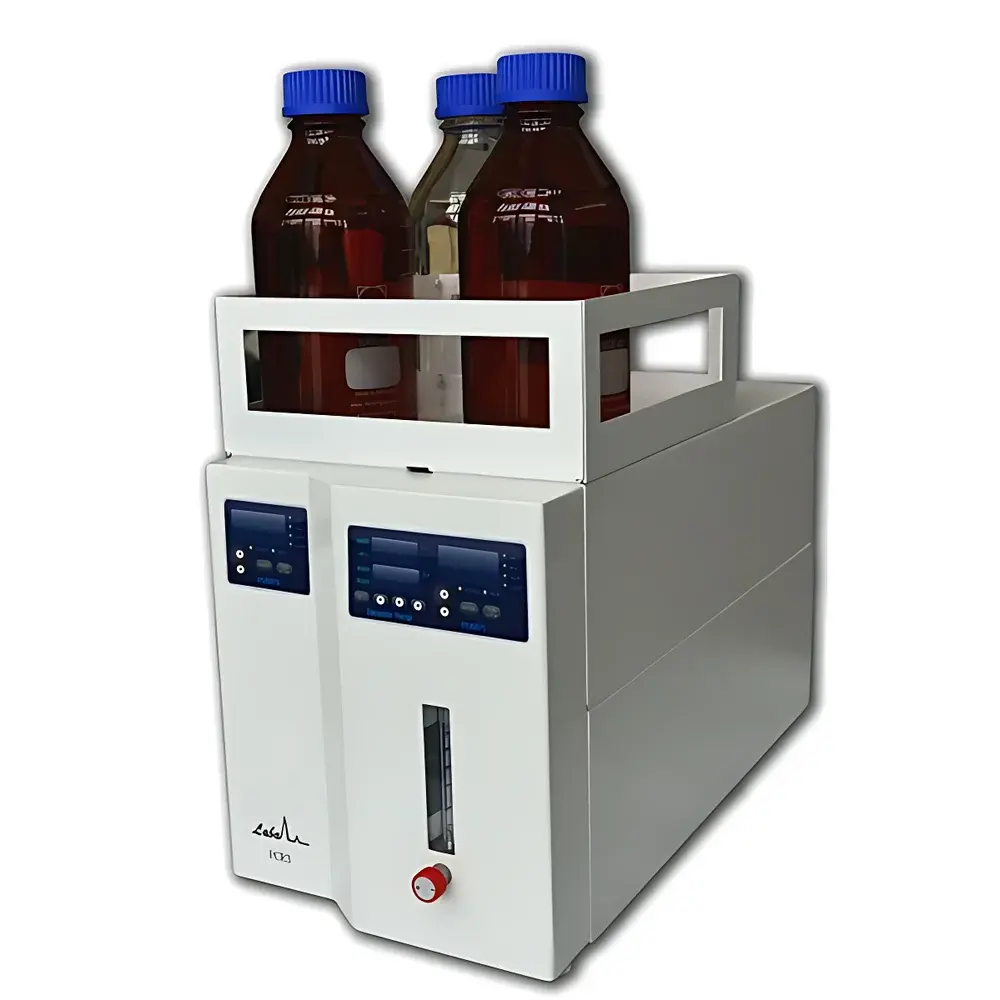
LABA PCR3 Third-Generation Post-Column Derivatization System
| Brand | LABA |
|---|---|
| Origin | USA |
| Model | PCR3 |
| Temperature Range | Ambient to 200 °C |
| Derivatization Reagent Flow Rate | 0.001–10 mL/min |
| Reaction Coil Material | PEEK |
| Compliance | Fully compatible with all HPLC platforms (Agilent, Waters, Shimadzu, Thermo Fisher, etc.) |
| Control Interface | Dual-mode (front-panel keypad + PC via USB/RS-232) |
| Safety Features | Overpressure shutdown, leak detection, thermal overheat protection |
| Fluidic Architecture | Chemically inert, self-cleaning pump head, pressurized reagent reservoirs with N₂ blanket control |
| Reactor Options | Interchangeable, customizable volume reaction coils (standard: 0.5–5 mL internal volume) |
Overview
The LABA PCR3 Third-Generation Post-Column Derivatization System is an engineered solution for enhancing detection sensitivity and selectivity in high-performance liquid chromatography (HPLC) analysis. It operates on the principle of post-separation chemical derivatization—introducing a controlled reagent stream into the eluent immediately after column exit but prior to detection—thereby converting non-chromophoric or weakly fluorescent analytes into highly detectable derivatives. Designed specifically for demanding regulatory and research environments, the PCR3 integrates precision fluid delivery, thermally stabilized reaction kinetics, and chemically inert flow paths to ensure reproducible derivatization efficiency across diverse compound classes including amines, hydrazides, carbamates, and heterocyclic toxins.
Key Features
- High-precision dual-piston syringe pump delivering derivatization reagent at 0.001–10 mL/min with ≤0.1% RSD over extended operation
- Reaction coil temperature control from ambient to 200 °C with ±0.3 °C stability and <60-second thermal equilibration time
- PEEK-based microfluidic path architecture ensuring compatibility with aggressive reagents (e.g., o-phthalaldehyde, ninhydrin, fluorescamine, sodium hydroxide, acidic oxidants)
- Integrated N₂ gas management system with adjustable flow monitoring and pressure-regulated reagent reservoirs to prevent oxidation of labile reagents
- Dual-control architecture: real-time parameter adjustment via intuitive front-panel interface or remote configuration through Windows-compatible software
- Automated safety protocols—including pressure-triggered pump halt, conductive leak detection, and thermal cutoff at 210 °C—meeting IEC 61010-1 requirements for laboratory instrumentation
- Modular reactor design supporting rapid coil exchange; standard configurations include 0.5 mL, 1.0 mL, and 2.5 mL coiled PEEK reactors; custom volumes available upon request
- Self-cleaning pump head cycle reduces seal wear and extends maintenance intervals beyond 6,000 operating hours under typical use conditions
Sample Compatibility & Compliance
The PCR3 supports derivatization of thermally stable and moderately labile compounds across pharmaceutical, environmental, food safety, and clinical toxicology applications. Its chemically resistant fluidic pathway complies with USP , ISO 17025, and FDA 21 CFR Part 11 when operated with audit-trail-enabled software. The system has been validated for use in methods aligned with AOAC Official Methods®, EPA Method 548/549, and EU Commission Regulation (EU) No 519/2014 for pesticide residue analysis. All wetted components meet USP Class VI biocompatibility standards and are free of leachable metals per ASTM F899.
Software & Data Management
The PCR3 communicates via ASCII-based serial protocol (RS-232/USB) and integrates natively with third-party chromatography data systems (CDS) including Empower™, Chromeleon™, and OpenLab CDS. Optional LABA DerivaControl™ software provides method storage, event logging, calibration tracking, and electronic signature support compliant with GLP/GMP workflows. Audit trails record all parameter changes, run start/stop events, and alarm triggers with timestamp and operator ID—fully traceable for regulatory inspection.
Applications
- Quantification of carbamate pesticides (e.g., carbaryl, aldicarb) via fluorescence detection after OPA/ninhydrin derivatization
- Determination of glyphosate and AMPA in water and soil matrices using FMOC-Cl derivatization and LC-FLD
- Analysis of paralytic shellfish toxins (PSTs) including saxitoxin and neosaxitoxin following alkaline hydrolysis and HPLC-FLD
- Measurement of sulfonamide antibiotics in milk and tissue using acid-catalyzed diazotization and visible absorbance detection
- Simultaneous quantification of vitamin B₁ (thiamine) and B₆ (pyridoxine) in fortified foods and dietary supplements
- Screening of trichothecene mycotoxins (e.g., deoxynivalenol, T-2 toxin) in cereal grains using post-column UV activation
- Detection of polyether ionophore antibiotics (e.g., monensin, salinomycin) in animal feed via post-column complexation with metal ions
- Residue analysis of paraquat and diquat in environmental samples using sodium borohydride reduction and UV detection
FAQ
Can the PCR3 be integrated with UHPLC systems operating above 1000 bar?
Yes—the PEEK reaction coil and high-pressure fittings are rated to 1200 bar; backpressure management is achieved via calibrated restrictors placed pre-detector.
Is the system compatible with gradient elution methods?
Yes—flow rate and temperature parameters remain dynamically stable during gradient runs; optional flow-compensation algorithms adjust reagent delivery in real time.
Does the PCR3 support automated method switching between different derivatization chemistries?
Yes—up to 8 pre-stored methods can be recalled via front panel or CDS command; each includes independent flow, temperature, and timing profiles.
What maintenance is required for long-term operational reliability?
Routine tasks include quarterly seal inspection, annual pump calibration verification, and biannual replacement of N₂ filter cartridges; no routine solvent flushing is required due to the self-cleaning pump cycle.
Can reaction coil dead volume be minimized for fast HPLC separations?
Yes—low-dispersion 0.2 mL micro-coils are available for sub-2-minute chromatographic runs without peak broadening or carryover.






