
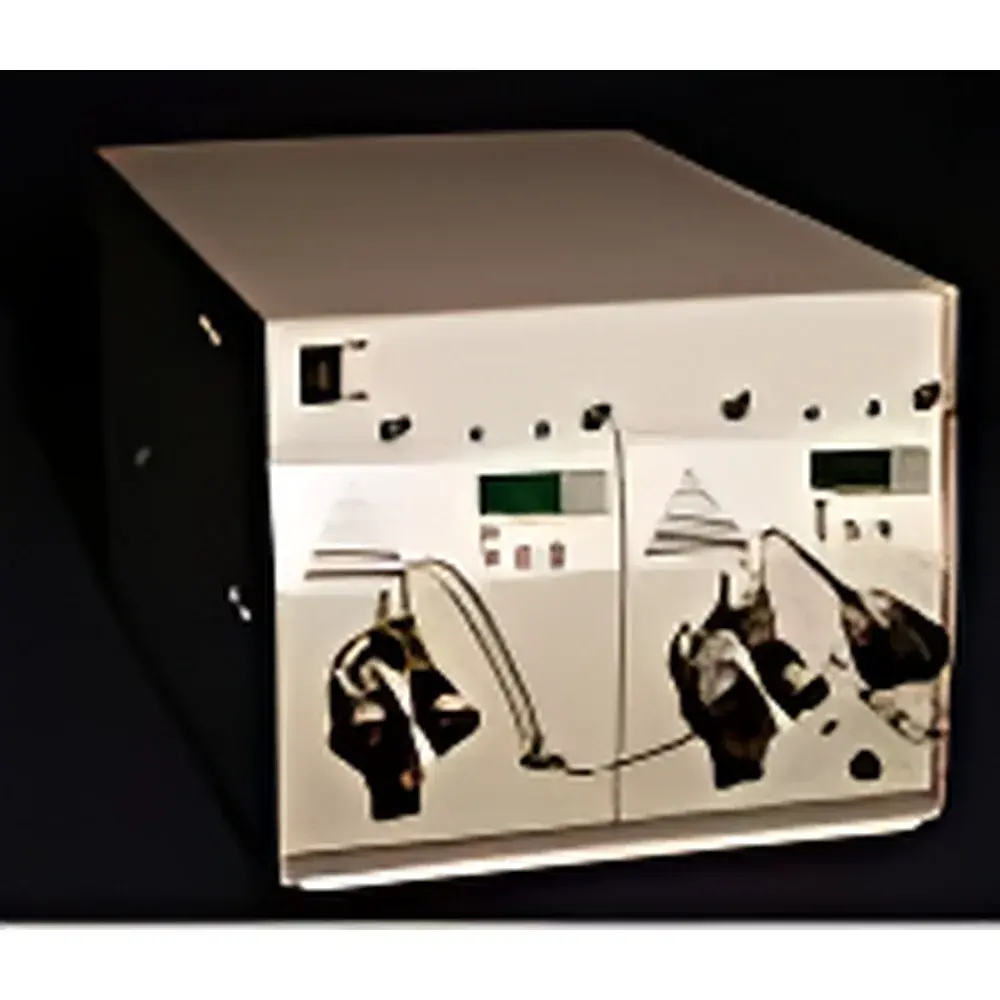
LabAlliance LABA-2000 Binary Integrated HPLC Pump
| Origin | USA |
|---|---|
| Manufacturer Type | Authorized Distributor |
| Origin Category | Imported |
| Model | LABA-2000 |
| Instrument Type | Syringe Pump / Dual-Channel High-Pressure Solvent Delivery Pump |
| Flow Rate Range | 0–1000 mL/min |
| Maximum Speed | 6000 rpm |
| Construction Options | Full Stainless Steel or Full PEEK Fluid Path |
| Interface | RS-232 |
| Safety Features | Real-time Pressure Monitoring with High/Low Pressure Cut-off |
| Control | Local Keypad + LED Display + Remote Command Support |
Overview
The LabAlliance LABA-2000 Binary Integrated HPLC Pump is a dual-channel, high-pressure solvent delivery system engineered for precision, reliability, and long-term operational stability in analytical and preparative liquid chromatography workflows. Operating on positive displacement peristaltic and syringe-driven hybrid principles—optimized for both continuous low-flow precision and high-throughput solvent delivery—the LABA-2000 integrates two independently controllable pump modules within a single chassis. Each channel supports fully autonomous operation or synchronized gradient formation via programmable flow ratio control. Designed to meet the mechanical and chemical demands of modern HPLC, UHPLC, and LC-MS sample introduction systems, the pump delivers consistent volumetric accuracy across its full 0–1000 mL/min range while maintaining pressure stability up to 400 bar (dependent on configuration and fluid path material). Its architecture adheres to fundamental fluid dynamics constraints for laminar, pulse-free delivery—critical for minimizing column backpressure fluctuations and preserving chromatographic resolution.
Key Features
- Dual independent pump modules with isolated fluid paths—enabling standalone use or binary gradient generation
- Real-time pressure monitoring with automatic shutdown upon detection of overpressure (>400 bar) or underpressure (<5 bar), compliant with ISO 13849-1 functional safety principles
- Full stainless steel or optional all-PEEK wetted components—validated for compatibility with aggressive solvents (e.g., THF, DCM, concentrated acids/bases) and compliant with USP Class VI biocompatibility requirements
- Patented in-line self-cleaning mechanism activated during idle or purge cycles—reducing particulate accumulation and extending seal life without manual disassembly
- Drawer-style pump head assembly—allowing rapid access to tubing, check valves, and sealing components for GLP-aligned maintenance logging
- Integrated quick-drain valve and auto-purge sequence—minimizing solvent carryover between methods and supporting method transfer validation per ICH Q2(R2)
- Local control via tactile keypad with high-contrast LED display (backlit, 4-digit flow/pressure readout) plus RS-232 serial interface for integration into LIMS or CDS platforms (e.g., Empower, Chromeleon, OpenLab)
- Bi-directional communication protocol supporting SCPI command set—enabling remote parameter setting, status polling, and event-triggered alerts
Sample Compatibility & Compliance
The LABA-2000 accommodates a broad range of mobile phases used in reversed-phase, HILIC, ion-pairing, and size-exclusion chromatography—including aqueous buffers, organic modifiers, and viscous polymer solutions (up to 40% w/v PEG 20k). Its dual check-valve design prevents backflow under transient pressure differentials, ensuring retention time reproducibility (RSD < 0.2% over 24 h, per ASTM D7091-22 calibration protocol). Fluid path materials are certified to ASTM F2028 (PEEK) and ASTM A276 (316L SS), with documentation provided for FDA 21 CFR Part 11 audit trails when paired with compliant CDS software. The system meets CE marking requirements for electromagnetic compatibility (EN 61326-1) and low-voltage safety (EN 61010-1).
Software & Data Management
While the LABA-2000 operates autonomously via front-panel controls, its RS-232 interface enables full command-line integration with third-party chromatography data systems. It supports ASCII-based SCPI commands for flow rate, pressure limit, run/pause state, and diagnostic queries. When deployed in regulated environments, timestamped operational logs—including pressure excursions, motor current anomalies, and valve actuation events—are exportable as CSV for inclusion in 21 CFR Part 11-compliant electronic records. Firmware updates are performed via secure serial handshake; version history and checksum verification are retained in non-volatile memory.
Applications
- Isocratic and linear/non-linear binary gradient elution in analytical HPLC (USP , EP 2.2.46)
- Mobile phase delivery for preparative-scale purification (10–100 g injections) with flow consistency critical to fraction reproducibility
- Automated solvent recycling loops in green chemistry workflows (e.g., ethanol/water mixtures)
- Calibration standard delivery in flow injection analysis (FIA) and sequential injection analysis (SIA) systems
- Pressurized solvent delivery in accelerated solvent extraction (ASE) pre-conditioning modules
- Integration into custom-built hyphenated systems (e.g., LC-NMR, LC-ICP-MS) requiring stable, low-pulse flow profiles
FAQ
What is the maximum operating pressure for the LABA-2000 with stainless steel versus PEEK fluid paths?
Stainless steel configurations support up to 400 bar at 25°C; PEEK paths are rated to 250 bar with temperature derating above 40°C.
Can the LABA-2000 be validated under GMP conditions?
Yes—its deterministic control logic, hardware-enforced pressure limits, and RS-232 audit trail capability support IQ/OQ/PQ protocols aligned with Annex 11 and ASTM E2500-22.
Is firmware upgrade supported in the field?
Yes—upgrades are delivered as signed hex files and installed via terminal emulator; version rollback is retained in dual-bank flash memory.
How often should the pump seals be replaced under continuous operation?
With typical acetonitrile/water usage at 1 mL/min, PEEK seals require replacement every 9–12 months; stainless steel check valves show no measurable wear after 18 months per accelerated life testing (ASTM D3359-21).



