
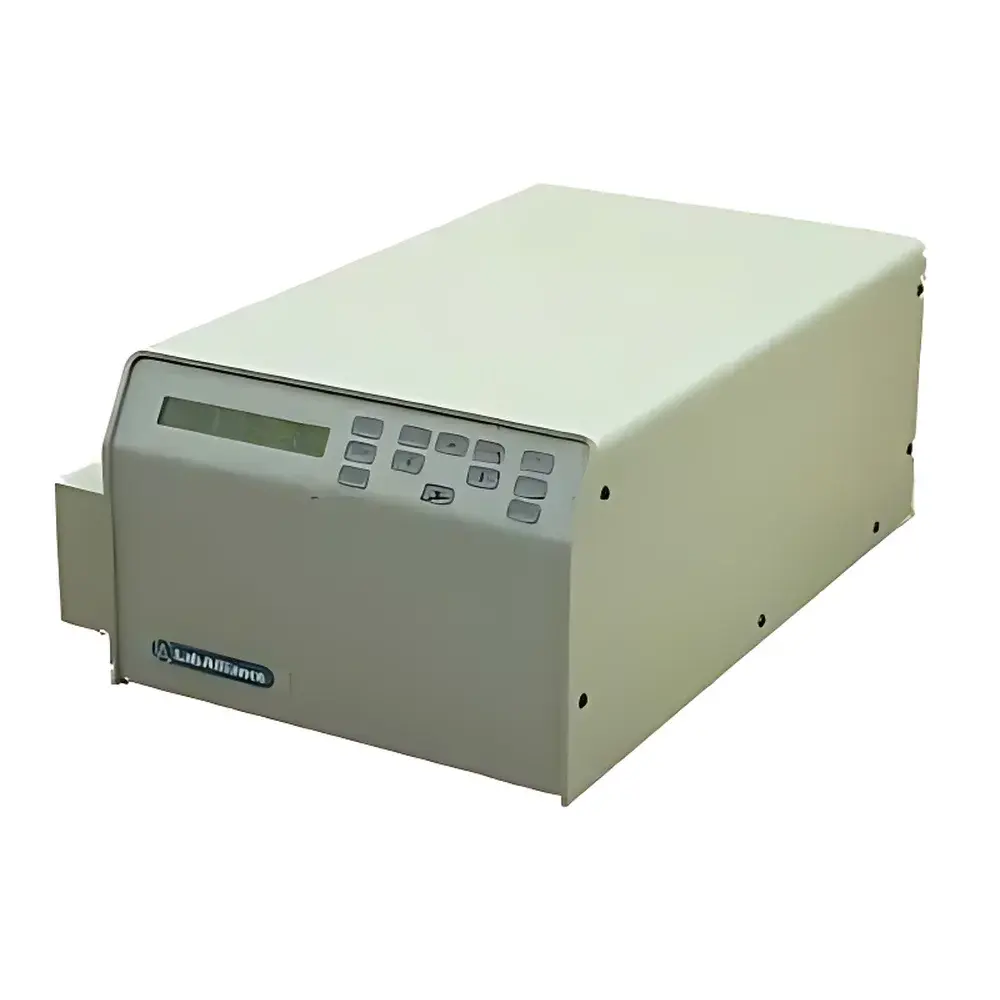
Laballiance Model 201/525 UV-Vis Absorbance Detector
| Brand | Laballiance |
|---|---|
| Origin | USA |
| Model | 201/525 |
| Wavelength Range | 190–380 nm (Model 201), 190–365 nm (Model 525) + Tungsten Lamp 366–800 nm |
| Dual-Wavelength Capability | 190–450 nm or 366–800 nm |
| Spectral Bandwidth | 6 nm |
| Wavelength Accuracy | ±1.0 nm |
| Wavelength Repeatability | ±0.1 nm |
| Noise | < ±1.0 × 10⁻⁵ AU @ 254 nm (single wavelength) |
| Absorbance Range | 0.0005–3.0 AUFS |
| Absorbance Linearity | >99% to 2.0 AU @ 254 nm |
| Optical Design | Concave holographic grating monochromator, dual-beam with fiber-optic beam splitter |
| Analog Output | Dual-channel, full-scale selectable |
| Power Supply | 220 V, 50/60 Hz |
| Dimensions | 30.5 cm W × 40.6 cm D × 17.8 cm H (12″ × 16″ × 7″) |
| Weight | 14 kg (31 lb) |
Overview
The Laballiance Model 201/525 UV-Vis Absorbance Detector is a high-performance, dual-beam spectrophotometric detector engineered for integration with analytical and preparative liquid chromatography systems. Based on a concave holographic grating monochromator architecture and fiber-optic beam splitting, it delivers stable, low-noise absorbance measurements across a broad spectral range—190–380 nm (Model 201) or 190–365 nm (Model 525) with extended tungsten-lamp coverage up to 800 nm. Its dual-wavelength capability enables simultaneous detection at two user-defined wavelengths within the 190–450 nm or 366–800 nm ranges, supporting both quantitative multi-component analysis and real-time peak purity assessment via absorbance ratio tracking. The detector supports stop-flow and continuous-flow spectral scanning without pump interruption—a critical feature for method development and unknown compound characterization in regulated and research environments.
Key Features
- Dual-wavelength detection with independent gain and time constant control per channel, enabling optimized sensitivity for co-eluting analytes.
- Programmable absorbance range (0.0005–3.0 AUFS) and dynamic baseline correction algorithms ensure linear response across wide concentration gradients.
- Front-panel interface with intuitive menu navigation and real-time parameter display simplifies method setup, including complex time-programmed wavelength switching and scan protocols.
- Modular optical design with side-accessible deuterium and tungsten lamps minimizes downtime during routine lamp replacement.
- Low electronic and photometric noise (< ±1.0 × 10⁻⁵ AU @ 254 nm single-wavelength; < ±2.5 × 10⁻⁵ AU in dual-wavelength mode) supports trace-level quantitation in compliance with ICH Q2(R2) and USP validation requirements.
- Wavelength accuracy of ±1.0 nm and repeatability of ±0.1 nm ensure consistent method transfer between instruments and laboratories.
Sample Compatibility & Compliance
The Model 201/525 accommodates a comprehensive suite of flow cell configurations—including stainless steel (SS), Kel-F® (chemically inert and biocompatible), and high-pressure microbore cells rated to 7000 psi—supporting applications from analytical HPLC (9 µL, 6 mm path) to microfluidic and preparative-scale separations. All wetted materials comply with USP Class VI and ISO 10993-5 cytotoxicity standards. The detector’s analog output channels and TTL-compatible start/stop/reset signals integrate seamlessly with legacy and modern LC controllers. While not inherently 21 CFR Part 11 compliant, its analog architecture permits integration into validated systems when paired with audit-trail-enabled data acquisition software meeting GLP/GMP documentation requirements.
Software & Data Management
As a standalone spectrophotometer, the detector supports automated wavelength scanning across user-defined ranges (e.g., 200–400 nm), with peak-triggered spectral acquisition for post-run identification of unknown eluents. Raw absorbance data is output as dual-channel analog voltages (±1 V or 0–1 V, full-scale selectable), compatible with chart recorders, analog-input DAQ systems, and third-party chromatography data systems (CDS). For digital integration, optional RS-232 or USB-to-analog interface modules enable remote configuration and status monitoring. All operational parameters—including lamp status, wavelength setpoint, and absorbance gain—are accessible via front-panel display or external command protocol, facilitating routine IQ/OQ verification.
Applications
- Pharmaceutical QC testing of active pharmaceutical ingredients (APIs) and excipients per USP monographs requiring dual-wavelength ratio verification.
- Biopharmaceutical process monitoring, including monoclonal antibody aggregation analysis using 280/260 nm ratios.
- Environmental contaminant screening (e.g., PAHs, nitrosamines) where spectral confirmation supports regulatory reporting under EPA Method 8330B.
- Natural product isolation workflows requiring real-time spectral fingerprinting during fraction collection.
- Method development for gradient HPLC methods where variable-wavelength optimization improves selectivity and resolution.
- Academic and industrial research labs performing kinetic studies, equilibrium binding assays, or enzyme activity profiling via continuous absorbance monitoring.
FAQ
What is the difference between Model 201 and Model 525?
Model 201 incorporates both deuterium and tungsten lamps for full UV-Vis coverage (190–800 nm), while Model 525 uses only a deuterium lamp (190–365 nm), optimized for high-sensitivity UV detection below 370 nm.
Can the detector perform full-spectrum scans during an ongoing HPLC run?
Yes—the instrument supports uninterrupted spectral scanning without stopping the LC pump, enabling real-time acquisition of UV-Vis spectra for each eluting peak.
Is the flow cell interchangeable without recalibration?
Yes—optical alignment is factory-optimized for all standard flow cells (SS, Kel-F®, PEEK-lined); no user calibration is required when swapping between compatible pathlengths and volumes.
Does the detector support GLP-compliant data handling?
The analog output architecture requires external CDS software with audit trail, electronic signature, and secure data storage capabilities to meet GLP and 21 CFR Part 11 requirements.
What maintenance intervals are recommended for the deuterium lamp?
Typical deuterium lamp lifetime is 1000–2000 hours under normal operation; performance should be verified quarterly via absorbance noise and wavelength accuracy checks per ASTM E275-22.






