
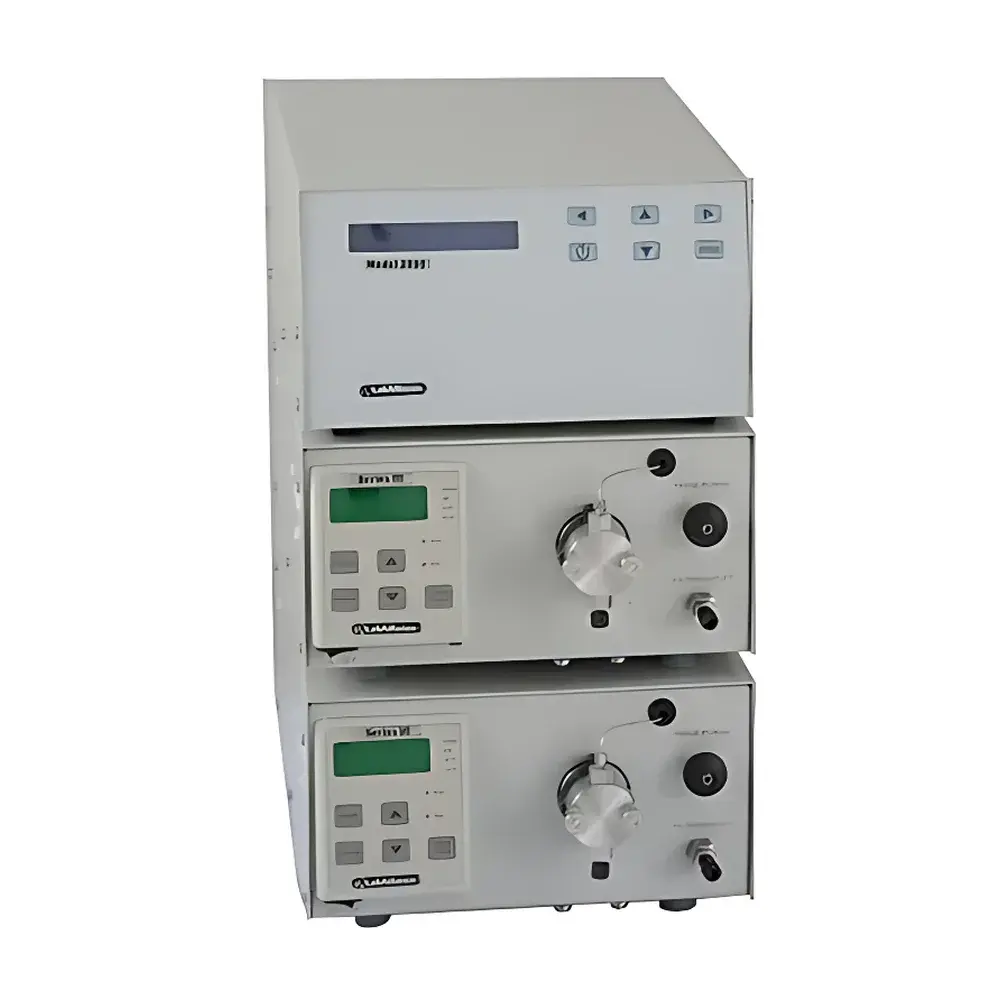
Laballiance PC2001 Binary Gradient HPLC System
| Brand | Laballiance |
|---|---|
| Origin | USA |
| Model | PC2001 |
| Instrument Type | Conventional High-Performance Liquid Chromatograph |
| Flow Rate Range | 0.001–20.000 mL/min (configurable for 10 mL/min or 80 mL/min total flow via pump head interchange) |
| Maximum Pressure | 6000 psi |
| Injection Positions | 120 |
| Injection Volume Range | 1–100 µL |
| Column Oven Temperature Range | (Ambient + 10 °C) to 150 °C |
| UV-Vis Wavelength Range | 190–800 nm |
| Data Acquisition Rate | 100 Hz |
| Pressure Accuracy | ±1% of full-scale pressure |
| Flow Accuracy | ±2% |
| Flow Precision | ≤0.2% RSD |
| Baseline Noise | <±1.0×10⁻⁵ AU |
| Baseline Drift | <2.0×10⁻⁴ AU/hr |
| Wavelength Accuracy | ±1.0 nm |
Overview
The Laballiance PC2001 Binary Gradient HPLC System is a modular, high-fidelity liquid chromatography platform engineered for method development, routine QC/QA analysis, and regulatory-compliant applications in pharmaceutical, environmental, food safety, and academic laboratories. Built upon dual Series III high-pressure reciprocating piston pumps, the system implements high-pressure binary gradient mixing—where mobile phases are precisely metered and blended *after* the pump heads but *before* the injector—ensuring superior gradient accuracy, minimal dwell volume (<150 µL), and exceptional retention time reproducibility across repeated runs. This architecture eliminates low-pressure mixing artifacts such as solvent compressibility-induced delay or compositional lag, making the PC2001 particularly suitable for fast gradient methods, UHPLC-compatible column formats (down to 2.1 mm ID), and multi-method workflows requiring rapid reconfiguration between isocratic and gradient elution modes.
Key Features
- Modular Dual-Pump Architecture: Two independently controlled Series III pumps enable true binary gradient formation at high pressure; pump heads are field-interchangeable to support either standard (10 mL/min total) or high-flow (80 mL/min total) configurations without hardware modification.
- Integrated Column Compartment: Temperature-controlled oven with programmable range from ambient +10 °C to 150 °C ensures precise thermal management for retention time stability and method robustness—critical for ICH Q5 and USP compliance.
- UV-Vis Detection Capability: Fixed-wavelength or scanning detector covering 190–800 nm with ±1.0 nm wavelength accuracy, baseline noise <±1.0×10⁻⁵ AU, and drift <2.0×10⁻⁴ AU/hr—meeting ASTM E2637 and ISO 17025 performance criteria for photometric detection.
- Self-Cleaning Seal Technology: Patented dynamic seal flushing mechanism continuously purges pump head cavities during operation, significantly extending seal lifetime and reducing unscheduled downtime.
- Tool-Free Maintenance Design: Seal replacement achievable in under 5 minutes without specialized tools—minimizing instrument idle time and supporting GLP/GMP-aligned maintenance log documentation.
- Flexible Injection Options: Manual loop injector (1–100 µL range) included; 120-position autosampler available as optional upgrade for unattended operation and sample queue management.
Sample Compatibility & Compliance
The PC2001 supports reversed-phase, normal-phase, ion-exchange, and size-exclusion chromatographic modes using standard 4.6 mm, 3.0 mm, and 2.1 mm ID analytical columns. Its 6000 psi maximum pressure rating accommodates sub-2 µm particle packings and high-viscosity mobile phases (e.g., aqueous polymer solutions). The system complies with key regulatory requirements for data integrity: audit trail functionality, electronic signature support, and user-access-level controls are fully implemented within the Laballiance Chromatography Workstation software—enabling alignment with FDA 21 CFR Part 11, EU Annex 11, and ISO/IEC 17025 documentation standards. All critical parameters—including flow rate, pressure, temperature, and wavelength—are logged with timestamps and operator identification for traceability.
Software & Data Management
The Laballiance Chromatography Workstation provides bilingual (English/Chinese) interface support without compromising technical depth. It offers real-time monitoring of all hardware parameters, gradient programming with up to 20-step profiles, peak integration using tangent skim, baseline correction algorithms, and customizable report templates exportable to PDF, CSV, or XML. Raw data files adhere to ANDI/MSD format conventions for cross-platform compatibility. The software includes built-in validation tools for system suitability testing (SST), including resolution, tailing factor, and theoretical plate calculations per USP . Audit trails record all method edits, sequence changes, and result modifications with immutable timestamps—essential for GxP-regulated environments.
Applications
The PC2001 is routinely deployed in dissolution testing (USP ), residual solvent analysis (ICH Q3C), impurity profiling of APIs (ICH Q2(R2)), pesticide residue screening (AOAC 2007.01), and natural product fingerprinting. Its wide flow range and thermal stability make it equally effective for preparative-scale method scouting (10–80 mL/min) and analytical-scale quantitation (0.2–5 mL/min). Laboratories performing forced degradation studies benefit from its consistent gradient fidelity across pH- and temperature-stressed conditions.
FAQ
Can the PC2001 be upgraded to support fluorescence or ELSD detection?
Yes—the system features standardized analog/digital I/O ports and mechanical mounting interfaces compatible with third-party fluorescence detectors (e.g., Agilent G1321B) and evaporative light-scattering detectors (e.g., Sedex 85). Integration requires only configuration within the workstation software.
Is the dwell volume characterized and documented for method transfer?
Yes—the system’s dwell volume is measured per ASTM D7597 and reported as ≤145 µL (±5 µL) in the factory acceptance test (FAT) report supplied with each unit.
Does the workstation support 21 CFR Part 11 compliance out-of-the-box?
Yes—electronic signatures, role-based access control, and tamper-evident audit trails are enabled by default; a complete validation package (IQ/OQ/PQ protocols and test scripts) is available upon request.
What column oven calibration certificates are provided?
Each unit ships with NIST-traceable temperature calibration data across the full operating range (ambient +10 °C to 150 °C), verified using calibrated PT100 sensors and documented in the calibration certificate.
How is pump seal lifetime extended via the self-cleaning function?
The system routes a small portion of high-purity flush solvent through dedicated micro-channels adjacent to the seal interface during every pump stroke—preventing salt crystallization and buffer precipitation that typically cause premature seal wear in phosphate- or acetate-based mobile phases.






