
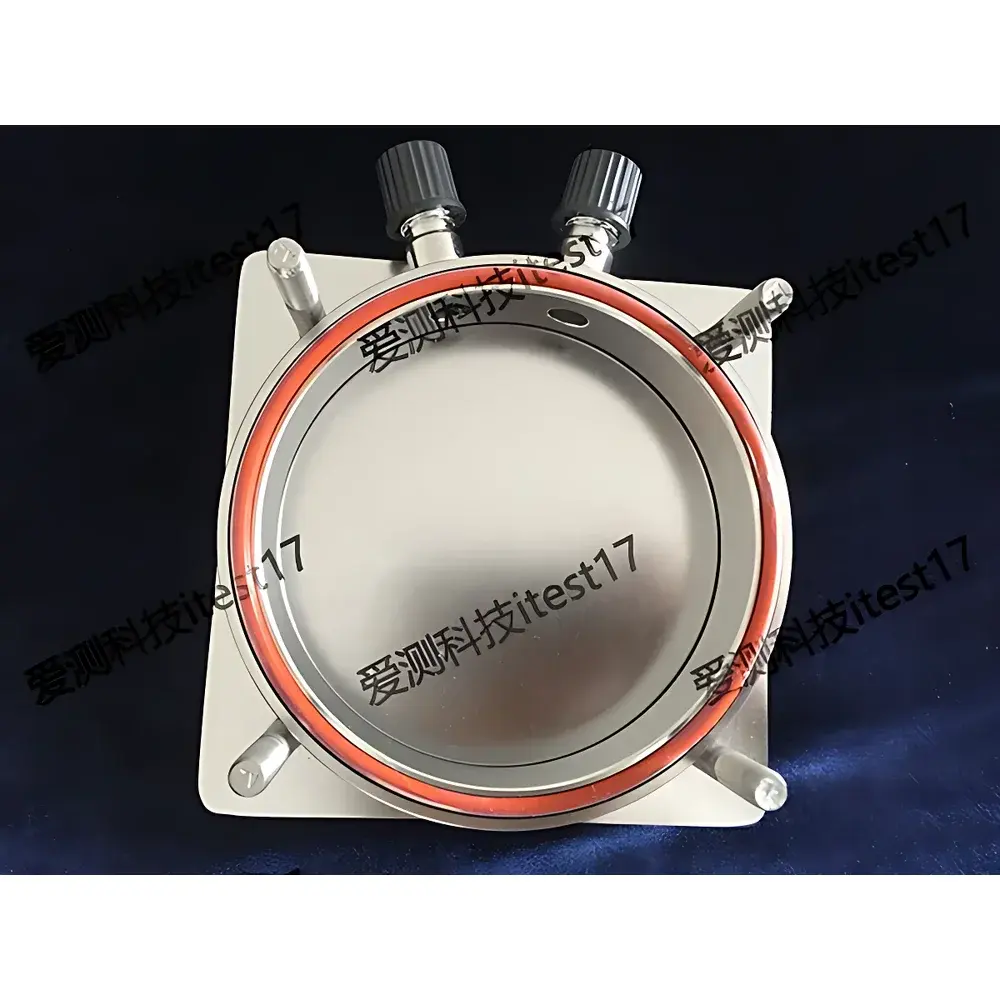
LABC DN120 Migration Cell for Food Contact Materials
| Brand | LABC |
|---|---|
| Origin | Germany |
| Model | DN120 |
| Cell Volume | ~200 mL |
| Single-Side Contact Area | ~1.00 dm² |
| Double-Side Contact Area | ~2.00 dm² |
| Construction | Stainless Steel Body |
| Cap Thread | GL14 |
| Cap Material | PBT Housing with PTFE/Silicone Seal |
| Sealing Elements | Two FEP/Silicone O-Rings (Top & Bottom Grooves) |
| Compliance | EU Regulation No. 10/2011, EN 13130, ISO 21768, GB 5009.156–2016 |
Overview
The LABC DN120 Migration Cell is a precision-engineered, stainless-steel migration test assembly designed specifically for standardized food contact material (FCM) testing in accordance with EU Regulation (EC) No. 10/2011, EN 13130 series standards, ISO 21768, and China’s GB 5009.156–2016. It implements the principle of static immersion migration testing—where a defined surface area of the test specimen is exposed to a food simulant under controlled temperature and time conditions—to quantify the transfer of substances from packaging or processing materials into food simulants. The cell’s geometry ensures reproducible contact area, consistent headspace-to-volume ratio, and minimal edge effects, enabling compliance with regulatory requirements for total migration (QM) and specific migration (QM(S)) determinations. Its modular, tool-free assembly facilitates rapid sample exchange and minimizes cross-contamination risk between sequential tests.
Key Features
- Stainless steel (AISI 316L-grade) body ensuring chemical inertness, thermal stability, and resistance to corrosion by acidic, alcoholic, and fatty food simulants (e.g., 3% acetic acid, 10% ethanol, olive oil, isooctane).
- DN120 center ring configuration providing a nominal single-sided contact area of 1.00 dm² and double-sided area of 2.00 dm²—precisely aligned with EN 13130-1 and GB 5009.156–2016 geometric specifications.
- GL14-threaded cap system with dual-seal design: PBT housing for mechanical robustness and a PTFE/silicone composite gasket for low-extractability sealing under thermal cycling (4–100 °C).
- Included FEP/silicone O-rings (top and bottom grooves) certified for low leachables and compatibility with aggressive simulants; replaceable without disassembly of the main body.
- No internal adhesives, coatings, or polymer inserts—eliminating potential interference from extractable compounds during analytical quantification (e.g., GC-MS, HPLC-UV).
- Modular construction enables full traceability: each component (base, center ring, cap, O-rings) is individually identifiable and compatible with GLP-compliant lab inventory management.
Sample Compatibility & Compliance
The DN120 Migration Cell accommodates rigid and semi-rigid flat specimens up to 3 mm thickness—including plastic films, laminates, coated papers, molded polyolefins, and metalized substrates—when mounted using standard clamping protocols. Curved or irregularly shaped samples may be tested using optional support inserts (sold separately). All materials contacting simulants comply with FDA 21 CFR §177.1520 and EU Plastics Regulation Annex I restrictions on restricted substances. The cell has been validated for use in laboratories accredited to ISO/IEC 17025 and routinely audited under GMP/GLP frameworks. Test reports generated using this cell meet evidentiary requirements for EU market access declarations and Chinese NHC registration dossiers.
Software & Data Management
While the DN120 Migration Cell is a passive hardware device, its geometric and material specifications are fully integrated into LABC’s optional digital workflow suite (LABC-MigTrack v3.2), which supports audit-trail-enabled test planning, parameter logging (temperature, duration, simulant batch ID), and automated report generation compliant with 21 CFR Part 11. Raw data files (CSV, PDF) include embedded metadata referencing EN 13130-2:2022 calibration procedures and traceable reference to certified reference materials (CRMs) used in parallel blank and recovery validation runs.
Applications
- Regulatory migration testing of plastic packaging for infant formula, ready-to-eat meals, and chilled dairy products.
- Validation of barrier coatings on paperboard trays and aluminum foil laminates.
- Leachables assessment for pharmaceutical secondary packaging (e.g., blister lidding foils, HDPE bottles).
- Comparative studies of antioxidant migration from polypropylene containers under accelerated aging (e.g., 40 °C/10 days per EN 1186-1).
- Method development and interlaboratory comparison studies supporting ISO/TC 61/WG 11 standardization efforts.
FAQ
Is the DN120 Migration Cell suitable for fatty food simulants such as olive oil or isooctane?
Yes—the stainless steel body and FEP/silicone O-rings are chemically resistant to non-polar simulants up to 100 °C for durations specified in EU 10/2011 Annex IV.
Can the same cell be reused across multiple test series?
Yes, provided it undergoes validated cleaning (e.g., ultrasonication in acetone followed by rinsing with methanol and air-drying in Class 1000 clean environment) and passes post-cleaning blank testing per EN 13130-1 Clause 7.3.
Does the cell include documentation for ISO/IEC 17025 accreditation?
Each unit ships with a Certificate of Conformance listing material certifications (EN 10204 3.1), dimensional verification report, and traceable calibration data for contact area and volume.
What is the maximum operating temperature?
The cell is rated for continuous use up to 100 °C; short-term exposure to 121 °C is permissible for sterilization cycles when using the PTFE/silicone seal variant.
Are replacement O-rings available as consumables?
Yes—FEP/silicone O-rings (DN120-specific groove dimensions) are supplied in certified lots with CoA and are cataloged under part number LABC-OR-DN120-FS-10.






