
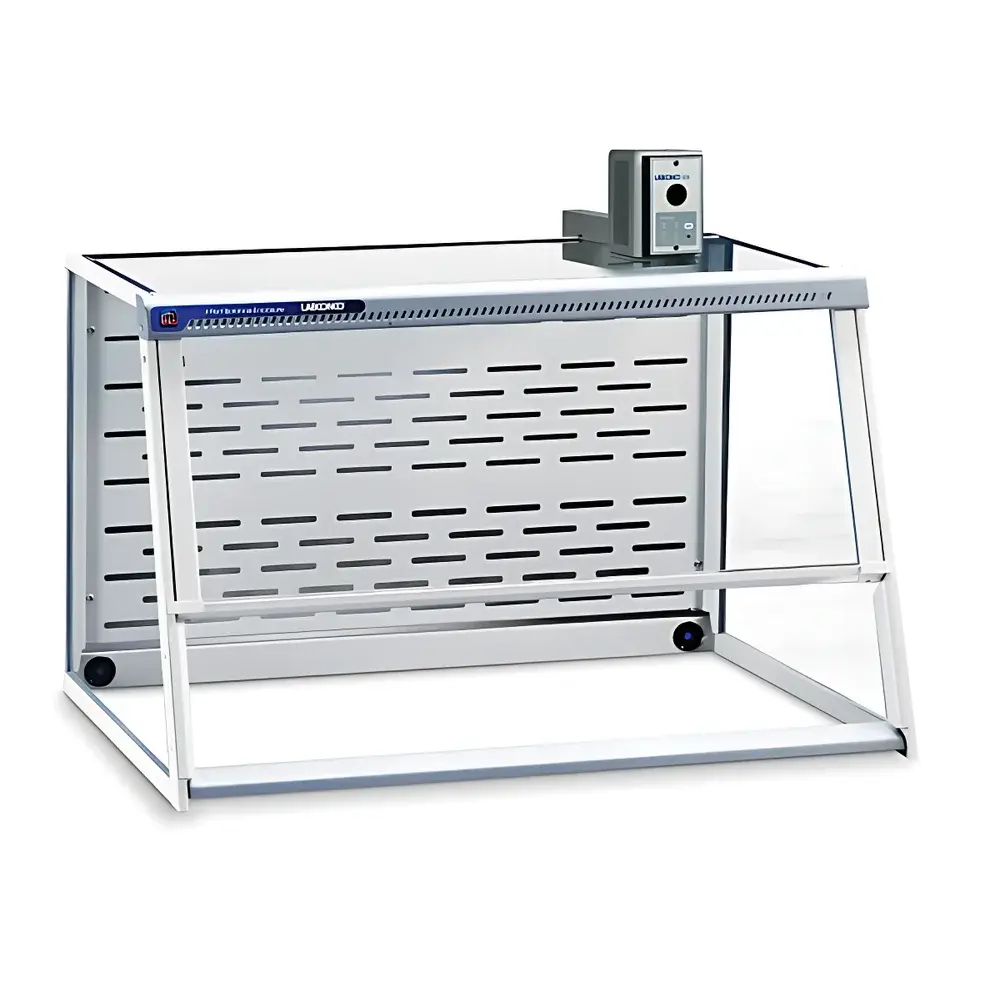
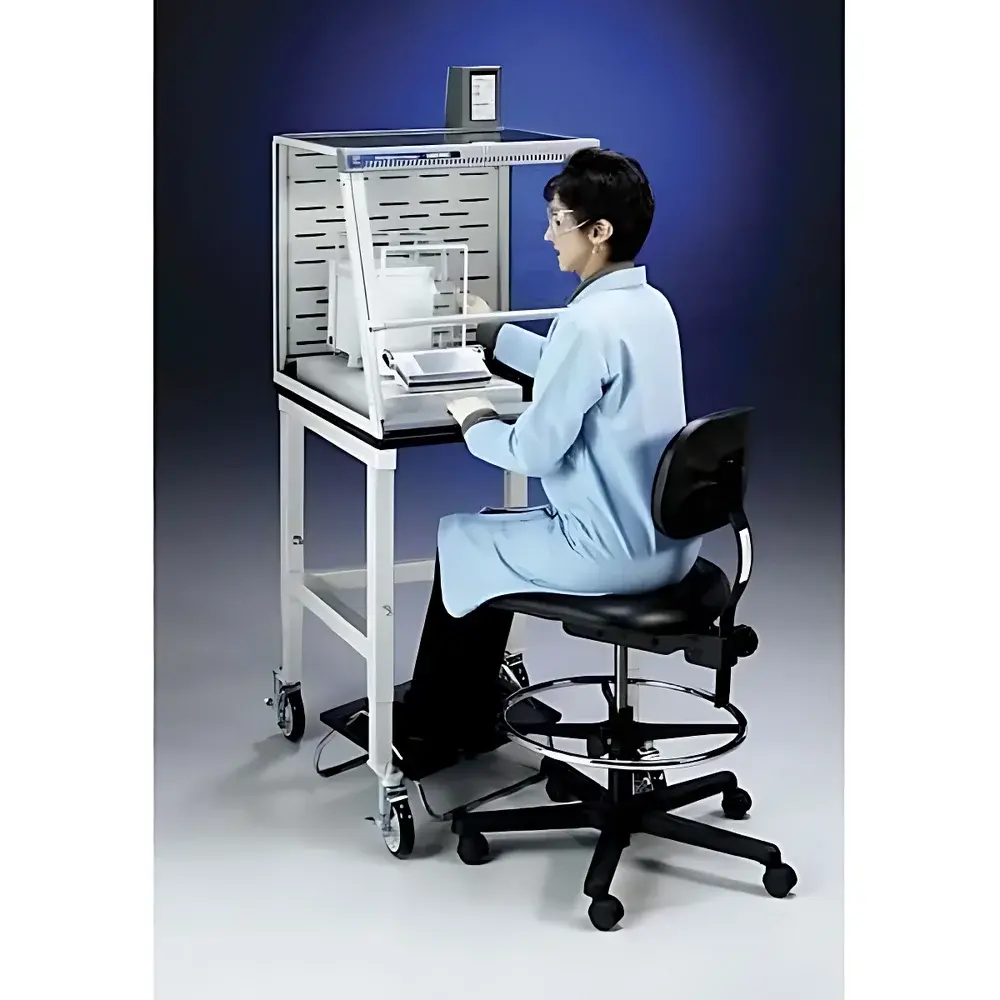
Labconco XPert™ 2-Foot Balance Enclosure with Guardian Jr. Airflow Monitor
| Brand | LABCONCO |
|---|---|
| Origin | USA |
| Model | 3930221 |
| Dimensions (W×D×H) | 24" × 29" × 28.6" (61 cm × 73.7 cm × 72.6 cm) |
| Operating Voltage | 230 V, 50/60 Hz |
| Window Opening Height | 8.0" (20.3 cm) |
| Working Face Velocity | 60–80 fpm (0.30–0.41 m/s) |
| Static Pressure at Work Height | 0.02–0.03" H₂O (5–7.5 Pa) |
| Exhaust Flow Rate | 70–95 CFM (1.98–2.69 m³/min) |
| Compliance | ANSI Z9.5, Modified ASHRAE 110, SEFA 1 |
| Construction | Epoxy-coated steel and aluminum frame with tempered safety glass panels |
| Air Handling | Requires external blower or FilterMate® portable exhaust unit |
| Optional Accessories | Lighting kit, work surface, support base |
| Weight (shipping) | 110 lbs (50 kg) |
| Integrated Monitoring | Guardian Jr. airflow alarm only (no digital readout) |
| HEPA Filtration | Not included |
| Ergonomic Angle | 20° sash tilt |
Overview
The Labconco XPert™ 2-Foot Balance Enclosure is an engineered solution for precision weighing and handling of sensitive or volatile materials in analytical, pharmaceutical, and research laboratories. Designed around the fundamental principles of laminar airflow containment and environmental isolation, this enclosure operates as a low-flow, negative-pressure ventilated hood—distinct from fume hoods or biosafety cabinets—optimized specifically for balance stability rather than chemical vapor capture. Its core function is to mitigate three primary sources of measurement error: airborne particulate interference (e.g., powders, sublimates, aerosols), electrostatic charge accumulation, and mechanical vibration transmission from the lab floor or adjacent equipment. By maintaining a controlled, unidirectional airflow across the balance pan at a user-defined face velocity (60–80 fpm), the enclosure prevents drift and buoyancy artifacts while preserving sample integrity during extended gravimetric procedures.
Key Features
- Ergonomic 20° inclined sash constructed from optically clear, solvent-resistant tempered safety glass—superior to standard optical glass in resistance to chemical fogging, scratching, and thermal shock.
- Integrated Guardian Jr. airflow monitoring system providing audible and visual alarm activation when face velocity falls below the set threshold (e.g., <60 fpm), ensuring continuous verification of operational safety margins.
- Robust structural architecture: epoxy-coated steel chassis combined with aluminum framing delivers long-term dimensional stability and corrosion resistance in environments exposed to solvents, humidity, or routine cleaning agents.
- Two dedicated utility ports (1.5″ diameter) accommodate power cables, pneumatic lines, or data conduits without compromising airflow integrity or sash seal performance.
- Modular compatibility: designed for integration with Labconco’s FilterMate® portable exhaust unit or remote centrifugal blowers; supports both ducted (outdoor exhaust) and recirculated (filtered room-return) configurations.
- Minimal maintenance footprint: non-porous surfaces and sealed joints reduce dust accumulation and eliminate the need for frequent interior wiping or recalibration due to static buildup.
Sample Compatibility & Compliance
This enclosure is validated for use with analytical balances (0.1 µg–0.1 mg readability), microbalances, and ultra-microbalances requiring ISO 17025-compliant environmental control. It accommodates standard balance footprints up to 24″ wide and permits unrestricted access via its 8″-high vertical sash lift—locking securely at 20″ clearance for oversized containers or multi-step weighing protocols. The device complies with ANSI Z9.5-2022 (Laboratory Ventilation), modified ASHRAE 110-2016 (facing velocity and tracer gas containment testing methodology), and SEFA 1-2020 (Structural and Performance Requirements for Laboratory Fume Hoods and Enclosures). While not certified for hazardous vapor containment per OSHA or NFPA standards, its design meets GLP/GMP facility requirements for environmental control documentation under FDA 21 CFR Part 11 when paired with audit-trail-capable airflow logging systems (e.g., Guardian 1000 upgrade).
Software & Data Management
The Guardian Jr. monitor provides real-time status indication via LED and buzzer but does not include digital flow logging or USB/RS-485 output. For regulatory traceability, users may upgrade to the Guardian 1000 model, which delivers continuous numeric airflow readouts, configurable alarm thresholds, and optional analog voltage output (0–5 VDC) compatible with building management systems (BMS) or LIMS-integrated environmental monitoring platforms. All XPert enclosures support manual calibration verification per ASTM E1157-21 (Standard Specification for Laboratory Balances) through standardized face velocity mapping using calibrated hot-wire anemometers at nine defined grid points.
Applications
- Gravimetric analysis of hygroscopic, volatile, or electrostatically charged reference standards (e.g., USP Reference Standards, NIST SRMs).
- Weighing of active pharmaceutical ingredients (APIs) prior to dissolution or tablet formulation under cGMP Annex 1-aligned conditions.
- Preparation of calibration solutions for ICP-MS, HPLC, or GC-MS where nanogram-level accuracy is required.
- Handling of radioactive tracers or nanomaterials where airborne dispersion must be minimized without full containment.
- Long-duration stability-indicating assays involving sequential mass measurements over hours or days.
FAQ
Does this enclosure provide HEPA filtration?
No. The XPert 2-Foot Balance Enclosure is a ventilated containment system—not a filtered recirculating cabinet. HEPA filtration requires optional add-on modules and is not factory-integrated.
Can it be used for weighing toxic compounds?
It is not rated for occupational exposure control of highly toxic or carcinogenic substances. Use only for low-hazard volatility scenarios where containment is secondary to balance stability.
Is lighting included?
No built-in illumination is provided. A separately ordered Labconco Lighting Kit (P/N 3930222) mounts internally without disrupting airflow patterns.
What benchtop depth is required?
Minimum recommended work surface depth is 30″ (76 cm) to ensure full sash travel and prevent airflow turbulence at the rear edge.
How often should airflow verification be performed?
Per ISO/IEC 17025:2017 Clause 6.4.3, face velocity must be verified before each critical weighing session or at least daily in high-throughput labs; full ASHRAE 110 tracer testing is recommended annually.



