
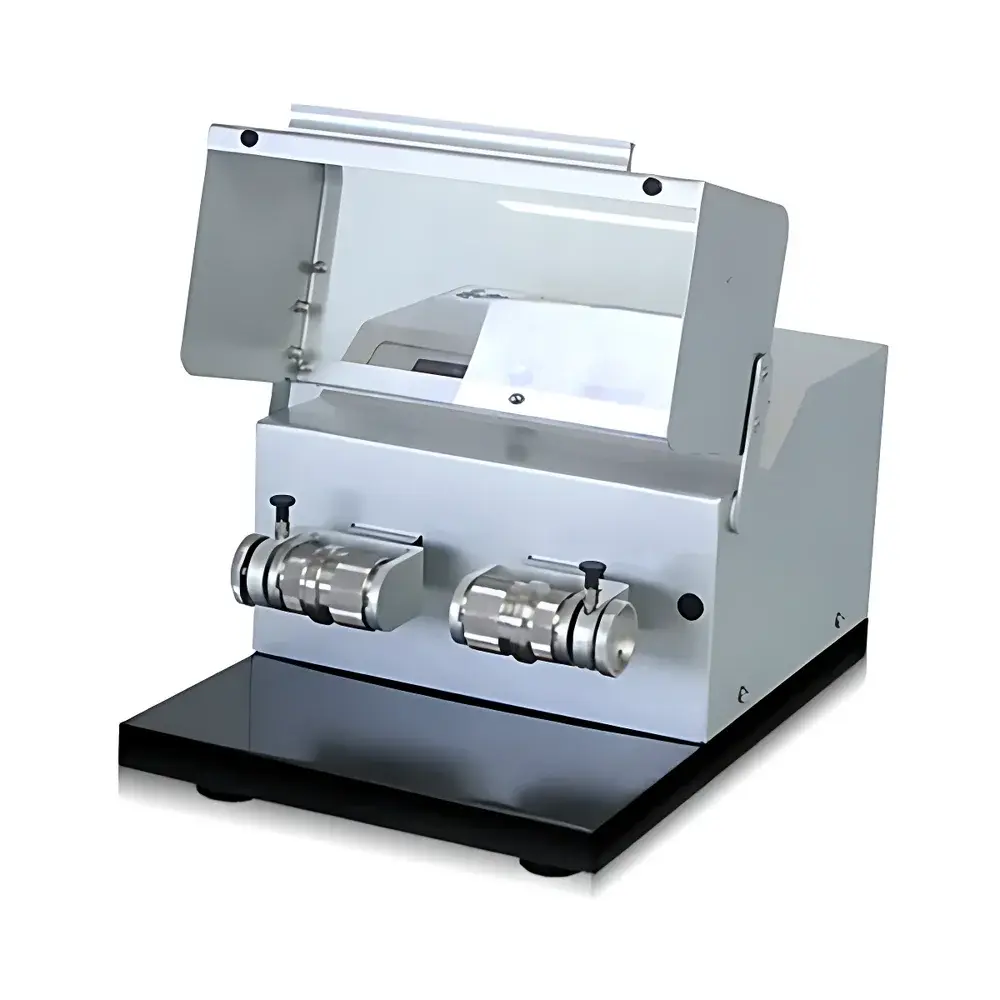
LABE BM100 Series Vibratory Ball Mill
| Brand | LABE |
|---|---|
| Origin | Shanghai, China |
| Model | BM100 |
| Instrument Type | Vibratory Ball Mill |
| Sample Applicability | Hard, brittle, fibrous, elastic, and soft materials |
| Max. Feed Size | ≤8 mm |
| Final Particle Size | ~5–10 µm |
| Batch Capacity | 2 sample containers (0.2–20 mL each) |
| Vibration Frequency Range | 60–1800 rpm (1–30 Hz) |
| Grinding Time Setting | 1 s–99 min 59 s |
| Power Consumption | 250 W |
| Dimensions (W×H×D) | 320×240×450 mm |
| Net Weight | ~26 kg |
| Safety | Electromagnetic lid interlock system |
| Compliance | ISO 9001, ISO 14001, ISO 45001, CE, RoHS |
Overview
The LABE BM100 Series Vibratory Ball Mill is a compact, benchtop laboratory instrument engineered for high-efficiency size reduction, homogenization, and cell disruption of small-volume samples. It operates on the principle of high-frequency horizontal oscillation—where grinding jars undergo controlled reciprocating motion, inducing inertial impact and shear forces between grinding balls and the inner arc-shaped jar surface. This mechanism enables rapid comminution without significant thermal buildup, making it suitable for both ambient-temperature and cryogenic grinding protocols. Unlike planetary or centrifugal ball mills, the BM100’s vibratory architecture delivers consistent energy input across dual independent grinding chambers, ensuring reproducible particle size distribution in the 5–10 µm range for most brittle and hard materials. Its design targets applications where speed, containment integrity, and minimal sample heating are critical—particularly in molecular biology, pharmaceutical QA/QC, geochemical sample preparation, and advanced materials R&D.
Key Features
- Dual-chamber configuration supporting simultaneous processing of two independent samples (0.2–20 mL each), with optional high-throughput accessories including 5-, 12-, 24-, 48-, and 96-well plate adapters for up to 192 parallel biological samples.
- Digital time and frequency control interface (1 s–99 min 59 s; 60–1800 rpm) with real-time display and programmable memory for method recall and SOP compliance.
- Electromagnetically interlocked safety lid: automatic motor shutdown upon lid opening during operation—meeting IEC 61000-6-2 EMC and EN 61000-6-4 emission standards.
- Hermetically sealed, screw-top grinding jars (stainless steel, tungsten carbide, agate, or PTFE-lined options) designed for zero cross-contamination and solvent-compatible wet milling.
- Cryogenic compatibility: optimized for liquid nitrogen pre-cooling; jars retain vacuum-tight seal throughout freezing, grinding, and gradual warm-up—preventing condensation-induced moisture contamination in hygroscopic or RNA-sensitive samples.
- Robust cast-aluminum chassis with vibration-damping feet ensures stable operation at maximum frequency and minimizes transmission to adjacent instrumentation.
Sample Compatibility & Compliance
The BM100 accommodates a broad spectrum of sample types—including hard minerals (e.g., quartz, feldspar), brittle ceramics, metallic alloys, biological tissues (bone, hair, plant matter), polymers, pharmaceutical tablets, and environmental matrices (soil, sludge). Its ability to process samples with variable mechanical properties (hardness, elasticity, fibrosity) stems from adjustable kinetic energy input via frequency tuning and jar/ball material selection. All structural components comply with RoHS Directive 2011/65/EU for hazardous substance restriction. The device bears CE marking under the Machinery Directive 2006/42/EC and Electromagnetic Compatibility Directive 2014/30/EU. Quality management adheres to ISO 9001:2015, environmental stewardship to ISO 14001:2015, and occupational health to ISO 45001:2018—supporting GLP and GMP-aligned laboratory workflows requiring documented traceability and audit readiness.
Software & Data Management
While the BM100 operates via standalone digital panel control, its parameter settings (time, frequency, pause intervals) are fully recordable in lab notebooks or LIMS-integrated electronic logs. For regulated environments, users may implement 21 CFR Part 11-compliant data capture using external timestamped video monitoring or connected USB data loggers (optional accessory). Method templates can be archived per sample type—for instance, “Plant Tissue RNA Extraction Protocol v2.1” or “Mineralogical XRD Prep Cycle”—enabling operator-independent execution and reducing inter-user variability. No proprietary software is required; all operational metadata remains human-readable and exportable as plain-text CSV.
Applications
- Molecular biology: Rapid lysis of mammalian cells, yeast, bacteria, and plant tissues for nucleic acid isolation—validated for downstream qPCR and NGS library prep.
- Pharmaceutical development: Uniform size reduction of active pharmaceutical ingredients (APIs) and excipients prior to dissolution testing (per USP & Ph. Eur. guidelines).
- Geochemical analysis: Preparation of rock and soil powders for XRF, XRD, and ICP-MS—achieving homogeneity without phase segregation or preferential attrition.
- Materials science: Alloy powder synthesis, ceramic precursor blending, and nanocomposite dispersion in solvent media.
- Environmental testing: Homogenization of heterogeneous waste streams (e.g., microplastics in sediment) for contaminant extraction and quantification.
FAQ
What is the recommended maintenance schedule for the BM100?
Perform visual inspection of jar seals and clamping mechanisms before each use. Clean exterior surfaces with isopropyl alcohol weekly. Lubricate the oscillation drive shaft annually using ISO VG 68 synthetic grease—only by certified service personnel.
Can the BM100 be used for abrasive samples like silicon carbide?
Yes—when equipped with tungsten carbide or zirconia grinding jars and balls. Avoid stainless steel jars for highly abrasive materials to prevent metal contamination and premature wear.
Is the BM100 compatible with automated lab workflows?
It supports semi-automation via TTL-triggered start/stop signals (optional I/O module). Full integration with robotic arms requires third-party gripper calibration and is validated on case-by-case basis.
Does the BM100 meet FDA requirements for pharmaceutical manufacturing?
As a Class I laboratory device, it complies with general controls under 21 CFR Part 820. For GMP production use, validation documentation (IQ/OQ/PQ) must be generated per site-specific SOPs—LABE provides technical specifications and test reports to support this process.
What is the typical service life under continuous R&D use?
With proper load balancing and adherence to max. 8 mm feed size limits, the BM100 demonstrates >10,000 operational hours before major component replacement—based on accelerated life testing per ISO 13849-1.



