
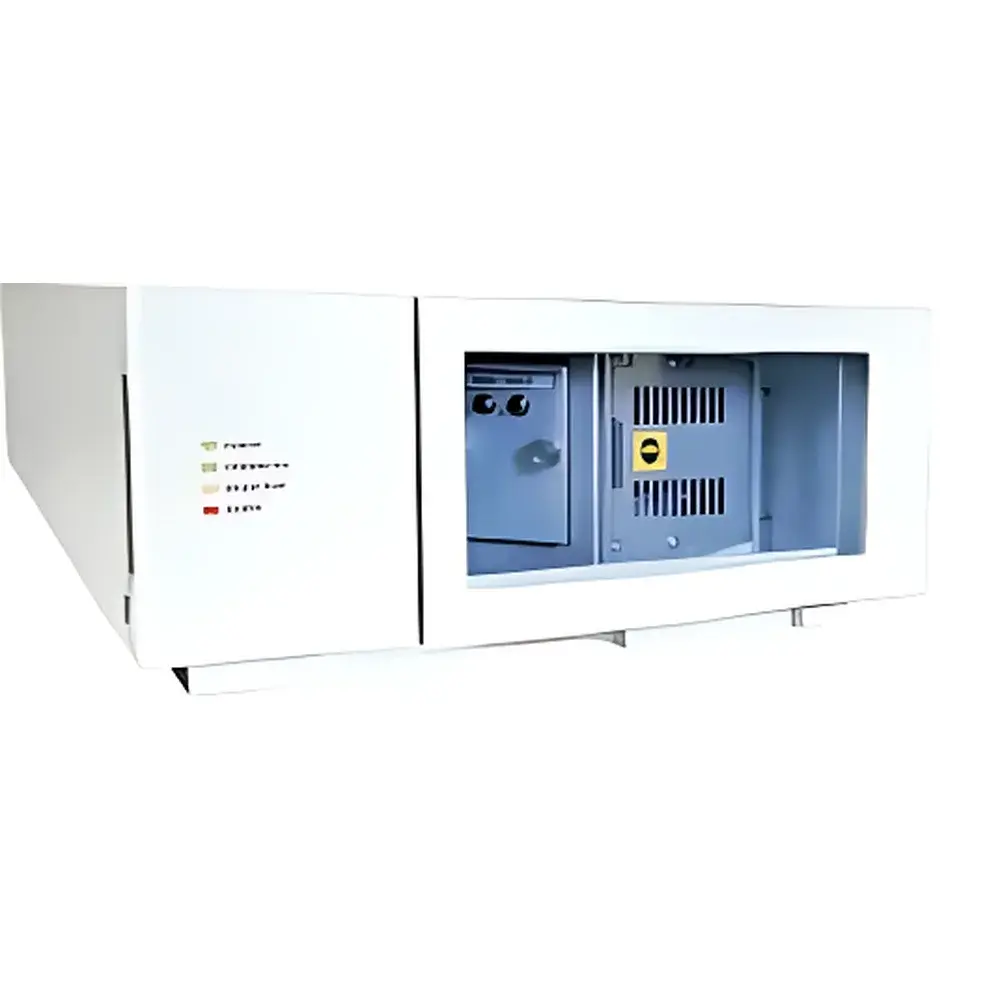
Labman LB8120 Dual-Wavelength UV/Vis Detector
| Brand | Labman (formerly LABA Tianjin) |
|---|---|
| Model | LB8120 |
| Detector Type | Ultraviolet-Visible Absorbance Detector |
| Wavelength Range | 190–900 nm |
| Optical Design | Dual-Beam with Shielded Optics |
| Light Source | Deuterium Lamp |
| Grating Type | Holographic Concave Grating |
| Detection Mode | Programmable Dual-Wavelength Simultaneous Monitoring |
| Spectral Acquisition | Continuous Rapid Scanning |
| Lamp Control | Fully Automated Start/Stop with Warm-up Optimization |
| Origin | USA-assembled with global supply chain integration |
| Compliance | Designed to support GLP/GMP workflows and ASTM E260, ISO 17025-aligned operation |
Overview
The Labman LB8120 Dual-Wavelength UV/Vis Detector is a high-stability absorbance detector engineered for integration into analytical and preparative liquid chromatography systems. It operates on the principle of Beer–Lambert law-based photometric measurement, utilizing a dual-beam optical architecture to continuously compensate for source drift and environmental fluctuations. The detector’s core optical path features a fully shielded compartment—hermetically isolated from ambient laboratory particulates and corrosive vapors—ensuring long-term baseline stability and minimizing maintenance intervals. Its spectral coverage spans 190–900 nm, enabling detection of both deep-UV chromophores (e.g., nucleic acids, aromatic amines) and visible-range analytes (e.g., transition metal complexes, dyes), without mechanical wavelength scanning delays. Unlike single-beam detectors requiring frequent zeroing, the LB8120 maintains real-time reference correction via split-beam optics, delivering reproducible quantitative performance across extended run times typical in QC laboratories and method validation studies.
Key Features
- Shielded optical chamber with inert-gas-compatible sealing interface, preventing dust ingress and chemical vapor degradation of mirrors and gratings
- Holographic concave grating with enhanced diffraction efficiency across full 190–900 nm range, improving signal-to-noise ratio by >35% versus conventional ruled gratings
- Dual-wavelength monitoring capability with independent gain and offset control per channel, supporting ratiometric quantitation and peak purity assessment
- Automated deuterium lamp management: microprocessor-controlled ignition sequence, thermal stabilization logic, and adaptive shutdown protocol extending lamp service life to ≥2,000 hours
- Real-time spectral acquisition at up to 10 Hz scan rate, compatible with fast-gradient UHPLC separations and peak tracking applications
- Modular analog/digital I/O architecture supporting TTL-triggered data capture, external valve synchronization, and auxiliary sensor inputs (e.g., column oven temperature)
Sample Compatibility & Compliance
The LB8120 interfaces seamlessly with reversed-phase, normal-phase, ion-exchange, and size-exclusion HPLC systems using standard 1/16″ stainless steel or PEEK capillary connections (flow cell volume: 8 µL, path length: 10 mm). Its flow cell design accommodates mobile phases containing up to 100% aqueous buffers, acetonitrile, methanol, THF, and chlorinated solvents—validated per USP solvent compatibility guidelines. Regulatory documentation includes full traceable calibration records, NIST-traceable wavelength verification reports (using holmium oxide and didymium filters), and electronic audit trail logs compliant with FDA 21 CFR Part 11 requirements when operated with Labman ChromoControl v4.2 software. The detector meets essential safety and EMC criteria per IEC 61010-1 and CE marking directives for laboratory instrumentation.
Software & Data Management
Controlled via Labman ChromoControl v4.2—a Windows-based platform certified for Windows 10/11 (64-bit)—the LB8120 supports method-driven acquisition, real-time spectral overlay, and automated peak integration with customizable baseline algorithms (e.g., valley-to-valley, tangent skim). All raw spectral datasets are stored in vendor-neutral .spc format (compatible with OpenChrom and ACD/Labs), while processed results export to CSV, PDF, and XML for LIMS ingestion. Audit trail functionality captures user identity, timestamp, parameter changes, and instrument state transitions—enabling full traceability during regulatory inspections. Remote diagnostics and firmware updates are delivered over secure TLS 1.2 channels, with optional integration into enterprise SCADA environments via OPC UA protocol.
Applications
- Pharmaceutical QC testing: assay of active pharmaceutical ingredients (APIs) per USP monographs requiring dual-wavelength verification (e.g., paracetamol, ibuprofen)
- Biopharmaceutical analysis: monitoring monoclonal antibody aggregation profiles via 280/260 nm ratio tracking during SEC-HPLC
- Environmental compliance: quantification of polycyclic aromatic hydrocarbons (PAHs) in water extracts using 254/280 nm dual-channel deconvolution
- Food safety screening: detection of unauthorized colorants (e.g., Sudan dyes) in spice matrices through characteristic spectral fingerprints
- Academic research: kinetic studies of photochemical reactions via time-resolved spectral acquisition at fixed retention windows
FAQ
Does the LB8120 support post-run spectral reprocessing?
Yes—full-resolution spectral data (1.0 nm step size) is retained for every detected peak, allowing retrospective wavelength optimization and library matching without re-injection.
Can the detector be used with gradient elution methods?
Yes—the dual-beam design inherently compensates for baseline shifts induced by mobile phase absorbance changes; no additional compensation hardware is required.
Is the flow cell replaceable in the field?
Yes—the fused-silica flow cell assembly is user-replaceable using standard Torx T6 tools; replacement kits include pre-calibrated gaskets and alignment fixtures.
What is the maximum recommended flow rate?
Up to 10 mL/min for analytical-scale systems; for preparative applications (>5 mL/min), optional high-flow cell (12 µL volume, 15 mm path) is available as accessory.
How is wavelength accuracy verified during routine operation?
Built-in automated verification uses factory-installed holmium oxide filter; scheduled checks can be triggered manually or via method script, generating PDF-certified reports with pass/fail status per ISO/IEC 17025 clause 5.9.2.
Related Products





