
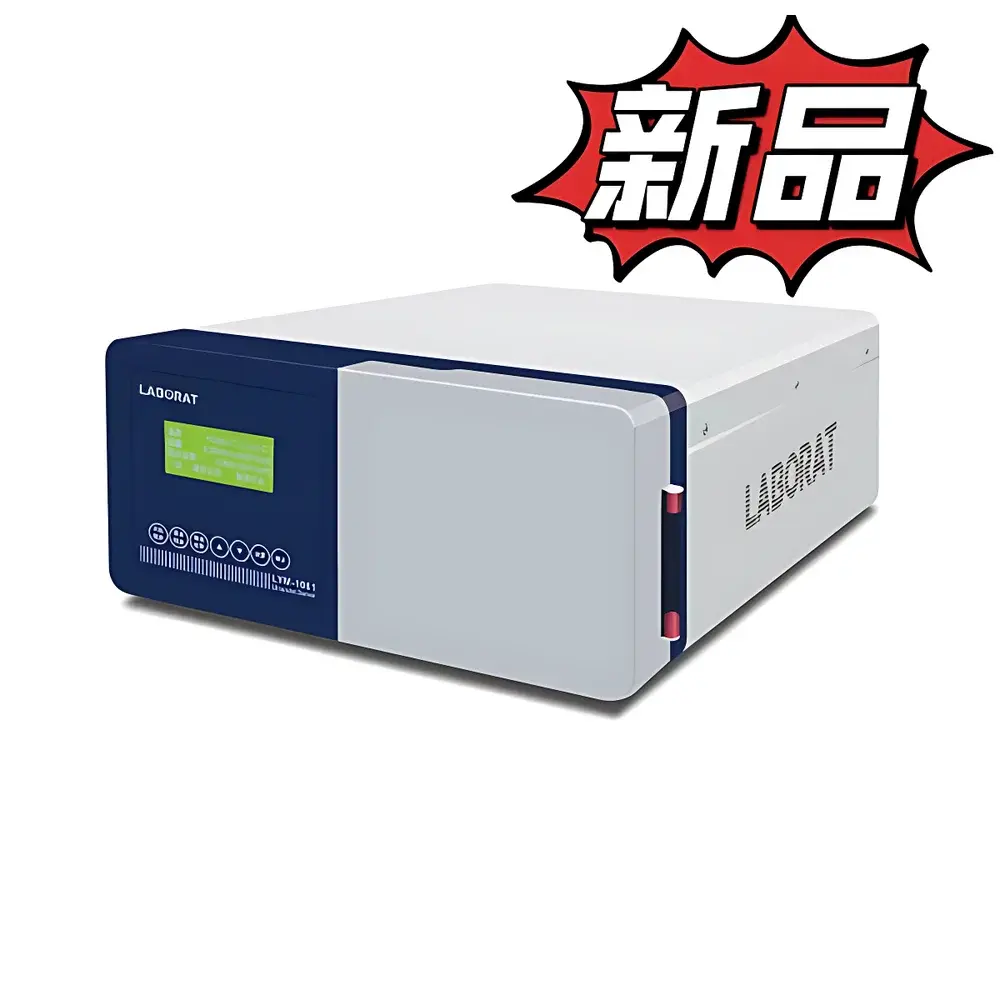
LABORAT LYM-1061 Post-Column Derivatization System
| Brand | LABORAT |
|---|---|
| Model | LYM-1061 |
| Derivatization Volume Options | 0.50 / 0.75 / 1.00 / 1.50 mL |
| Reaction Loop Material | Polyetheretherketone (PEEK), Polytetrafluoroethylene (PTFE), 316L Stainless Steel |
| Operating Temperature Range | Ambient + 5.0 °C to 150.0 °C |
| Flow Rate Control Range | 0.001–4.999 mL/min |
| Pump Fluid Path | Full-PEEK chemically inert construction |
| Reaction Coil Layout | 1.2 cm annular configuration |
| Real-time Instrument Status Monitoring | Yes |
| Optional Piston Wash | 1 mL/min |
Overview
The LABORAT LYM-1061 Post-Column Derivatization System is an engineered interface designed for integration with high-performance liquid chromatography (HPLC) and ultra-high-performance liquid chromatography (UHPLC) platforms. It enables on-line, post-separation chemical derivatization—introducing a controlled, stoichiometric reaction between eluted analytes and a precisely metered reagent stream immediately after column effluent exit but prior to detector entry. This system operates on the principle of kinetic-driven, temperature-regulated heterogeneous or homogeneous phase reactions—commonly applied to enhance detectability of low-UV-absorbing, non-fluorescent, or electrochemically silent compounds such as amino acids, amines, carbonyls, hydrazides, and certain pharmaceutical impurities. Unlike pre-column derivatization, the LYM-1061 eliminates risks of column contamination, reaction by-product carryover, and analyte degradation during storage—ensuring higher method robustness and analytical reproducibility in regulated environments.
Key Features
- Chemically inert fluidic path constructed entirely from polyetheretherketone (PEEK), PTFE, and 316L stainless steel—compatible with aggressive reagents including o-phthalaldehyde (OPA), ninhydrin, fluorescamine, and acidic/basic oxidative systems.
- Annular 1.2 cm reaction coil geometry minimizes axial dispersion and back-diffusion effects, reducing band broadening and preserving chromatographic resolution during derivatization.
- Precise flow control across 0.001–4.999 mL/min range with ≤0.1% RSD repeatability—critical for maintaining consistent reagent-to-analyte molar ratios under gradient elution conditions.
- Thermostatically regulated reaction zone with programmable setpoint accuracy of ±0.3 °C over 5–150 °C ambient-referenced range—supporting both thermal acceleration of slow reactions and stabilization of labile derivatives.
- Integrated real-time status monitoring system provides continuous feedback on pump operation, temperature stability, pressure trends, and valve actuation cycles—facilitating preventive maintenance and audit-ready operational logs.
- Optional piston wash module (1 mL/min) extends pump lifetime when handling viscous or particulate-laden reagents, complying with long-term unattended operation requirements in QC laboratories.
Sample Compatibility & Compliance
The LYM-1061 supports derivatization of small-molecule analytes across diverse regulatory application domains—including residual solvent analysis per ICH Q2(R2), amino acid profiling per USP <621>, and mycotoxin quantification per AOAC 2012.01. Its material compatibility aligns with FDA-recommended extractables/leachables assessment protocols (USP <1663>), and its sealed, low-dead-volume architecture meets ISO 17025 traceability requirements for calibration verification. The system is designed to operate within GLP/GMP-compliant workflows, supporting electronic record integrity through time-stamped event logging and user-access-controlled parameter locking—fully compatible with 21 CFR Part 11–compliant data management infrastructures when interfaced via RS-232 or Ethernet.
Software & Data Management
The LYM-1061 communicates with host HPLC data systems via standard ASCII command protocol, enabling synchronized method triggering, temperature ramping, and flow-rate modulation directly from chromatography data software (CDS). While the base unit does not include embedded touchscreen or local data storage, it supports full remote configuration and diagnostic access through LABORAT’s optional PC-based control suite—offering sequence-based method templates, calibration curve import/export (CSV), and audit-trail generation for instrument usage history. All firmware updates are delivered via signed binary packages, ensuring cryptographic integrity and version-controlled deployment.
Applications
- Quantitative determination of primary and secondary amines in pharmaceutical intermediates using OPA or FMOC-Cl derivatization.
- Enhanced sensitivity detection of aldehydes and ketones via DNPH derivatization for environmental water analysis (EPA Method 8315A).
- Routine analysis of β-lactam antibiotics via iodine-mediated oxidation followed by UV detection at 260 nm.
- Stabilized detection of catecholamines in biological matrices using triethylamine-catalyzed peroxidase coupling.
- Support for multi-step derivatization workflows when cascaded with auxiliary reagent modules (e.g., LYM-2021 dual-reagent configuration).
FAQ
Is the LYM-1061 compatible with UHPLC systems operating above 1000 bar?
Yes—the fluidic design maintains mechanical integrity up to 1200 bar system pressure; however, optimal derivatization efficiency requires matching dwell volume and reaction kinetics to sub-2 µm particle column configurations.
Can the system be validated for GMP use?
Yes—its modular architecture, deterministic flow control, and temperature stability support IQ/OQ/PQ documentation per ASTM E2500 and Annex 11 guidelines; validation templates are available upon request.
Does the LYM-1061 require external cooling for low-temperature derivatization?
No—the LYM-1061 operates in heating-only mode (ambient + 5 °C to 150 °C); for sub-ambient applications, the LYM-1062 variant with integrated Peltier cooling is recommended.
What reagent compatibility documentation is provided?
LABORAT supplies a certified chemical resistance matrix covering >120 common derivatization reagents—including solvents, catalysts, and oxidants—with documented exposure limits and recommended maintenance intervals.
Is remote diagnostics supported?
Yes—via optional Ethernet interface and LABORAT Remote Diagnostics Protocol (LRDP), enabling secure firmware update, log export, and real-time sensor telemetry without physical access.
Related Products






