
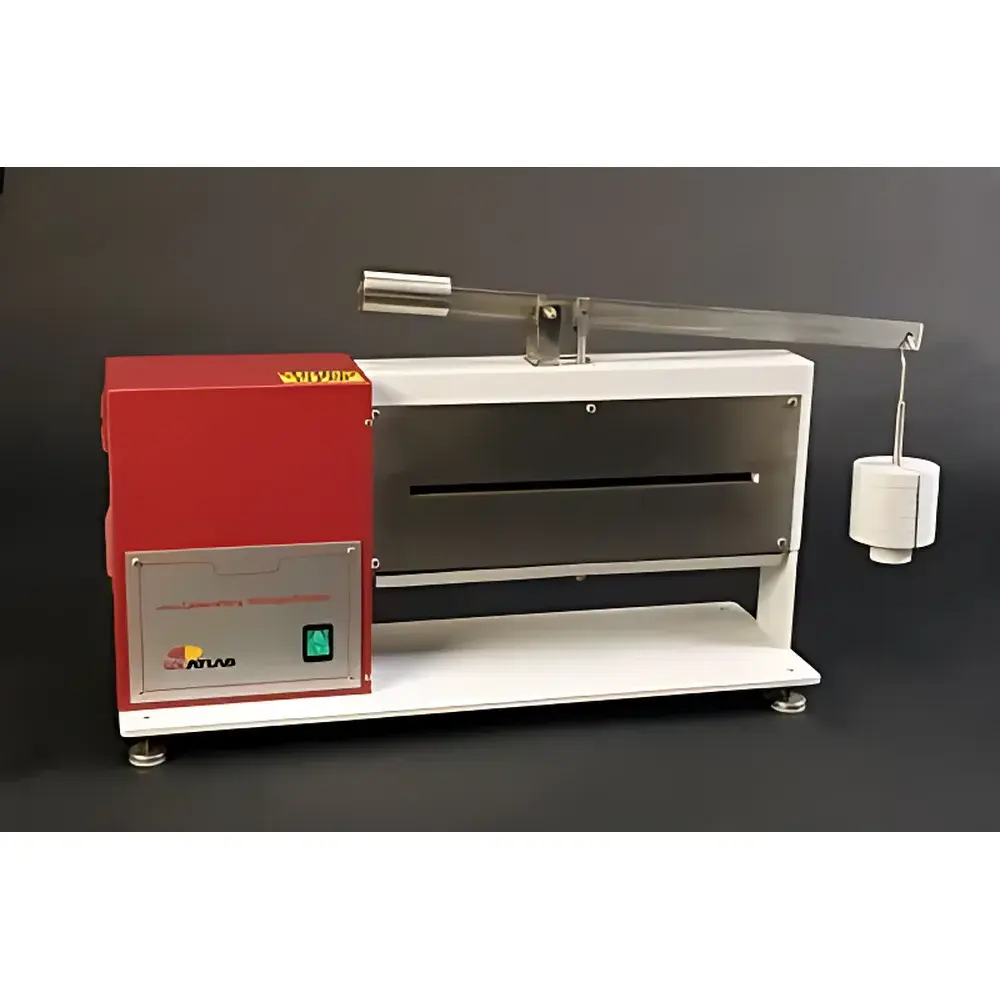
Laboratory Mangle / Drying Press (SDLATLAS D394)
| Brand | SDLATLAS |
|---|---|
| Origin | Guangdong, China |
| Manufacturer Type | Direct Manufacturer |
| Country of Origin | China |
| Model | D394 |
| Quotation | Upon Request |
| Working Width | 300 mm (12 in) |
| Roller Diameter (Neoprene) | 54 mm (2.125 in) |
| Linear Speed | 25 mm/s (1 in/s) |
| Static Load Capacity | 50 kg (105 lb) ± 2.3 kg (5 lb) |
Overview
The SDLATLAS D394 Laboratory Mangle is a precision-engineered textile conditioning and moisture extraction device designed for standardized sample preparation in dyeing, printing, and finishing laboratories. Operating on the principle of controlled mechanical compression between two parallel rollers — one fixed neoprene-coated roller and one adjustable top roller — the instrument applies consistent linear pressure to uniformly remove excess liquor from fabric specimens. This process simulates industrial padding or mangle operations while maintaining reproducible, traceable parameters essential for method validation and inter-laboratory comparability. The D394 conforms to core procedural requirements outlined in ISO 105-X12, AATCC Test Method 179, and GB/T 4669 — standards governing moisture content measurement, colorfastness specimen conditioning, and dimensional stability testing. Its compact benchtop footprint and manually adjustable load mechanism enable rapid setup for small-batch R&D, quality control, and pre-qualification of dye formulations.
Key Features
- Fixed lower roller with 54 mm diameter neoprene surface (Shore A 60–65 hardness), engineered for uniform compression and resistance to chemical degradation from common dye baths and auxiliaries.
- Vertically adjustable upper roller with calibrated static loading system, delivering precise force application up to 50 kg (±2.3 kg tolerance) without hydraulic or pneumatic components — ensuring long-term mechanical stability and minimal maintenance.
- Consistent linear transport speed of 25 mm/s (1 in/s), achieved via gear-motor drive with integrated speed regulation; eliminates slippage and ensures repeatable dwell time under pressure across all fabric types.
- 300 mm working width accommodates standard textile test swatches (e.g., 100 × 100 mm, 150 × 150 mm) and aligns with ISO and AATCC specimen dimension guidelines.
- Optional removable stainless-steel trough enables containment and recovery of expressed liquor for subsequent analysis (e.g., pH, conductivity, dye concentration), supporting closed-loop process evaluation and effluent characterization.
- All structural components fabricated from corrosion-resistant anodized aluminum and stainless steel; compliant with laboratory environmental safety protocols for wet-process instrumentation.
Sample Compatibility & Compliance
The D394 accommodates woven, knitted, nonwoven, and technical textiles ranging from lightweight voiles (<50 g/m²) to heavy-duty canvas (>400 g/m²). Its low-speed, high-torque design prevents fiber distortion or surface pilling during expression, preserving sample integrity for downstream testing (e.g., colorimetric assessment, tensile strength, or shrinkage analysis). The instrument supports GLP-aligned documentation practices: load calibration certificates, speed verification logs, and roller surface inspection records can be maintained per internal SOPs. While not certified to IEC 61000-6-2/6-4, its EMI profile meets Class B limits for laboratory environments. It is routinely deployed in facilities operating under ISO/IEC 17025-accredited textile testing scopes.
Software & Data Management
The D394 operates as a standalone mechanical unit with no embedded microcontroller or digital interface. All operational parameters — applied load, speed, and dwell time — are set manually and verified using external metrology tools (e.g., calibrated load cells, tachometers, stopwatches). This analog architecture ensures immunity to firmware obsolescence, cybersecurity vulnerabilities, or software validation overhead. Laboratories requiring electronic audit trails may integrate the D394 into broader LIMS workflows by logging parameter entries and operator IDs in structured spreadsheets or validated ELN templates compliant with 21 CFR Part 11 when used in regulated dye formulation development.
Applications
- Standardized padding of fabric specimens prior to colorfastness testing (e.g., ISO 105-C06, AATCC 61).
- Moisture content normalization for dimensional stability assays (ISO 5077, AATCC 135).
- Liquor expression efficiency studies during reactive dye fixation optimization.
- Pre-drying step before infrared moisture analyzers or gravimetric residual moisture determination.
- Calibration reference tool for industrial mangle performance benchmarking in mill QA labs.
- Supporting R&D of waterless dyeing technologies by quantifying baseline liquor retention profiles.
FAQ
Is the D394 suitable for continuous operation in high-throughput QC labs?
Yes — its robust mechanical architecture and absence of thermal or electronic subsystems allow uninterrupted use for 8+ hours per shift, provided routine roller cleaning and load calibration are performed daily.
Can the neoprene roller be replaced with alternative elastomers for aggressive chemical exposure?
SDLATLAS offers optional rollers with EPDM or Viton® coatings upon request; compatibility must be verified against specific bath chemistry (pH, oxidants, solvents) per ASTM D471 guidelines.
Does the instrument include traceable calibration documentation?
A factory-issued load calibration certificate (traceable to NIM China) and speed verification report are supplied with each unit; users are responsible for periodic re-verification per ISO/IEC 17025 Clause 6.5.
What maintenance intervals are recommended?
Weekly visual inspection of roller surface integrity and bearing smoothness; monthly torque check of load adjustment mechanism; annual replacement of neoprene roller if Shore hardness deviates >5 points from initial specification.
Is the removable trough compatible with automated liquid handling systems?
The trough features standardized 304 stainless-steel flanges and 1/4″ NPT drain ports, enabling direct connection to peristaltic pumps or vacuum-assisted collection manifolds in semi-automated setups.





