
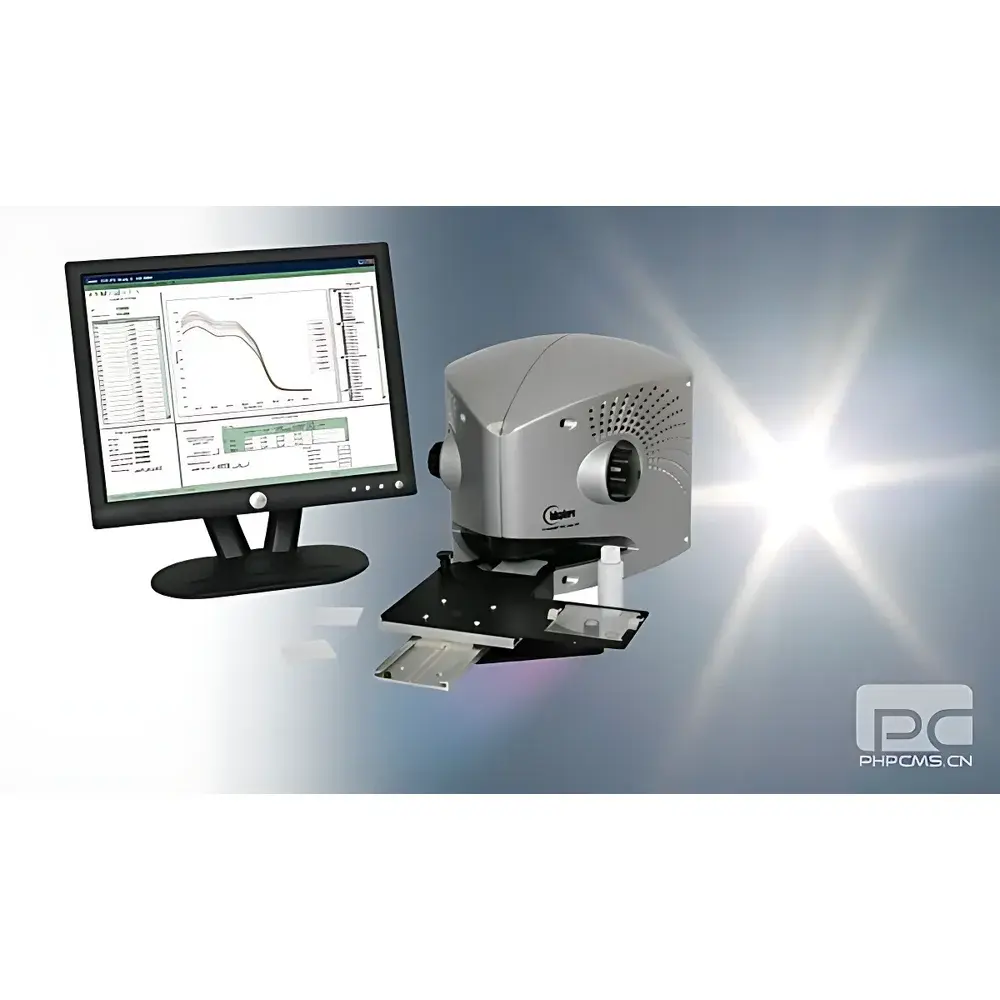
Labsphere UV-2000S Cosmetic UV Transmittance Analyzer
| Brand | Moon-BJ |
|---|---|
| Origin | Japan |
| Manufacturer Type | Authorized Distributor |
| Origin Category | Imported Instrument |
| Model | UV-2000S |
| Price Range | USD 14,000 – 28,000 |
Overview
The Labsphere UV-2000S Cosmetic UV Transmittance Analyzer is a purpose-built, regulatory-compliant in vitro spectrophotometric system engineered for precise quantification of ultraviolet (UV) transmittance across sunscreen formulations and topical photoprotective products. It operates on the principle of diffuse transmittance measurement using a d/0 optical geometry—hemispherical illumination with 0° detection—within a high-reflectance Spectralon® integrating sphere. This configuration ensures robust rejection of specular reflectance and minimizes artifacts from sample surface roughness, substrate scattering, or fluorescence interference—critical for accurate SPF, UVA-PF, and critical wavelength determination. Designed to meet the stringent requirements of global sunscreen testing standards—including ISO 24443:2021, COLIPA (now Cosmetics Europe) Guideline 2011, revised Boots Star Rating (2008), and FDA 21 CFR Part 352—the UV-2000S delivers traceable, repeatable, and auditable UV spectral data from 250 nm to 450 nm. Its validated architecture supports full compliance with GLP and GMP-aligned laboratory practices, including instrument qualification, performance verification, and electronic record integrity per FDA 21 CFR Part 11 when deployed with appropriate IT controls.
Key Features
- Optimized d/0 optical configuration with Spectralon® integrating sphere (≥99% reflectance @ 250–450 nm) for true diffuse transmittance measurement
- High-stability pulsed xenon light source with enhanced flash frequency (>100 Hz), minimizing dark current and maximizing dynamic range while limiting cumulative UV exposure to <0.2 J/cm² per scan
- Custom diode-array spectrometer featuring a master holographic grating (not replicated), concave diffraction optics, and extended pixel array for 1 nm data interval and ±1 nm wavelength accuracy
- UV-optimized fiber-optic coupling with solarization-resistant silica fibers and higher-order mode filtering to suppress stray light and improve spectral fidelity
- Manual precision sample positioning stage with pre- and post-irradiation baseline capture capability
- Integrated six-band wavelength calibration standard traceable to NIST-certified references, enabling on-site verification without external service
- Full-spectrum transmittance acquisition completed in <5 seconds, supporting high-throughput R&D and QC workflows
Sample Compatibility & Compliance
The UV-2000S accommodates standard HD6 substrates (e.g., AS-02755-001) with defined 0.79 cm² exposure area and is compatible with both uniform film application and standardized spreading protocols per ISO 24443 Annex A. It supports measurement of emulsions, gels, sprays, and solid sticks applied to synthetic or human stratum corneum-mimetic substrates. The system inherently corrects for substrate-related scattering effects and provides optional reporting of UVA-PF correction factors linked to substrate roughness metrics. All measurement algorithms—including SPF calculation, UVA/UVB ratio, critical wavelength (λc), COLIPA UVA-PF, revised Boots Star Rating, and FDA UV1/UVA—are embedded in firmware and software, ensuring method-consistent execution. System validation adheres to IQ/OQ/PQ principles, with documented evidence supporting compliance with ISO/IEC 17025, ASTM E2997, and EU Commission Recommendation 2006/647/EC.
Software & Data Management
The UV-2000S application software is built on Microsoft .NET Framework and fully compatible with Windows XP SP3 and Windows 7 (32-bit). It provides a menu-driven interface for method selection, sample registration, automated spectral acquisition, real-time data visualization, and one-click report generation. Reports include timestamped metadata (date, time, operator ID, sample ID, substrate lot, test method), raw transmittance spectra, derived parameters (SPF, UVA-PF, λc, UVA/UVB ratio), and pass/fail flags against user-defined acceptance criteria. Audit trails log all parameter changes, calibration events, and report exports. The software incorporates an integrated Performance Verification Protocol (PVP) that guides users through routine checks of wavelength accuracy, photometric linearity, and system repeatability using the included calibration standard. Software updates for newly adopted international methods (e.g., ISO 24443:2021 updates) are provided at no cost to registered users.
Applications
- In vitro SPF and UVA protection factor (UVA-PF) determination during sunscreen formulation development
- Regulatory submission support for FDA OTC Monograph, Health Canada, TGA, and PMDA dossiers
- Batch release testing and stability studies under ICH Q5C guidelines
- Comparative analysis of active ingredient combinations (e.g., avobenzone + octocrylene stabilization)
- Validation of novel UV filters and photostabilizers per OECD TG 439 and ISO 24442
- Quality control of cosmetic products claiming broad-spectrum UV protection claims
- Academic and contract research laboratory use for dermatological photobiology studies
FAQ
Does the UV-2000S require ozone-free operation? Why is this important?
Yes—the pulsed xenon lamp emits negligible ozone-generating VUV radiation (<200 nm), eliminating the need for exhaust ventilation and ensuring operator safety and lab compatibility.
Can the system measure samples on non-HD6 substrates?
While optimized for HelioScreen HD6 substrates, the UV-2000S can accommodate custom substrates with appropriate mechanical alignment; however, quantitative SPF/UVA-PF results remain valid only when used with ISO 24443–qualified substrates.
Is the software compliant with FDA 21 CFR Part 11?
The software supports Part 11 compliance when implemented with institutional controls—including role-based access, electronic signatures, and audit-trail review—and validated in conjunction with enterprise IT infrastructure.
What is the recommended calibration frequency?
Wavelength and photometric verification should be performed daily prior to use; full system performance verification using the six-band standard is recommended weekly or after instrument relocation or maintenance.
Does the UV-2000S support automated sample handling?
No—the UV-2000S employs a manual positioning stage to maintain flexibility across diverse sample formats and ensure operator-controlled application consistency; robotic integration is not supported in this model.
Related Products






