
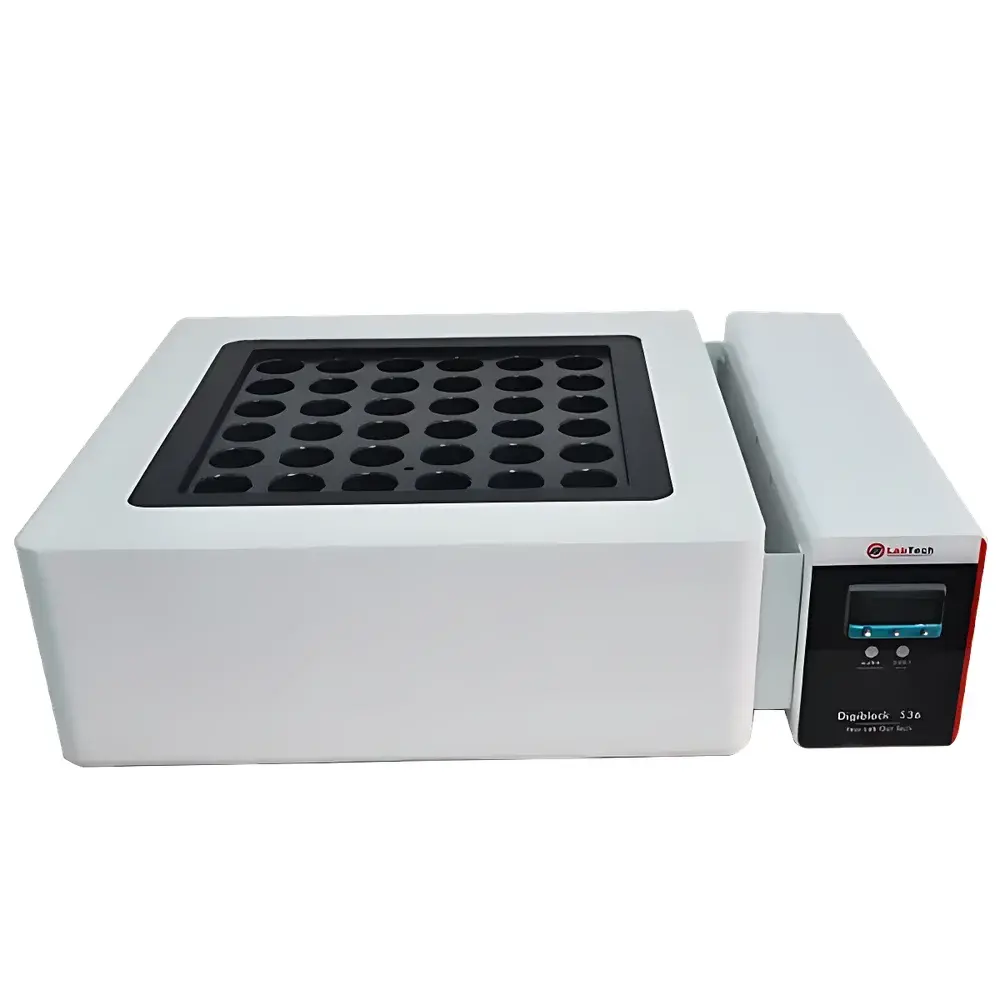
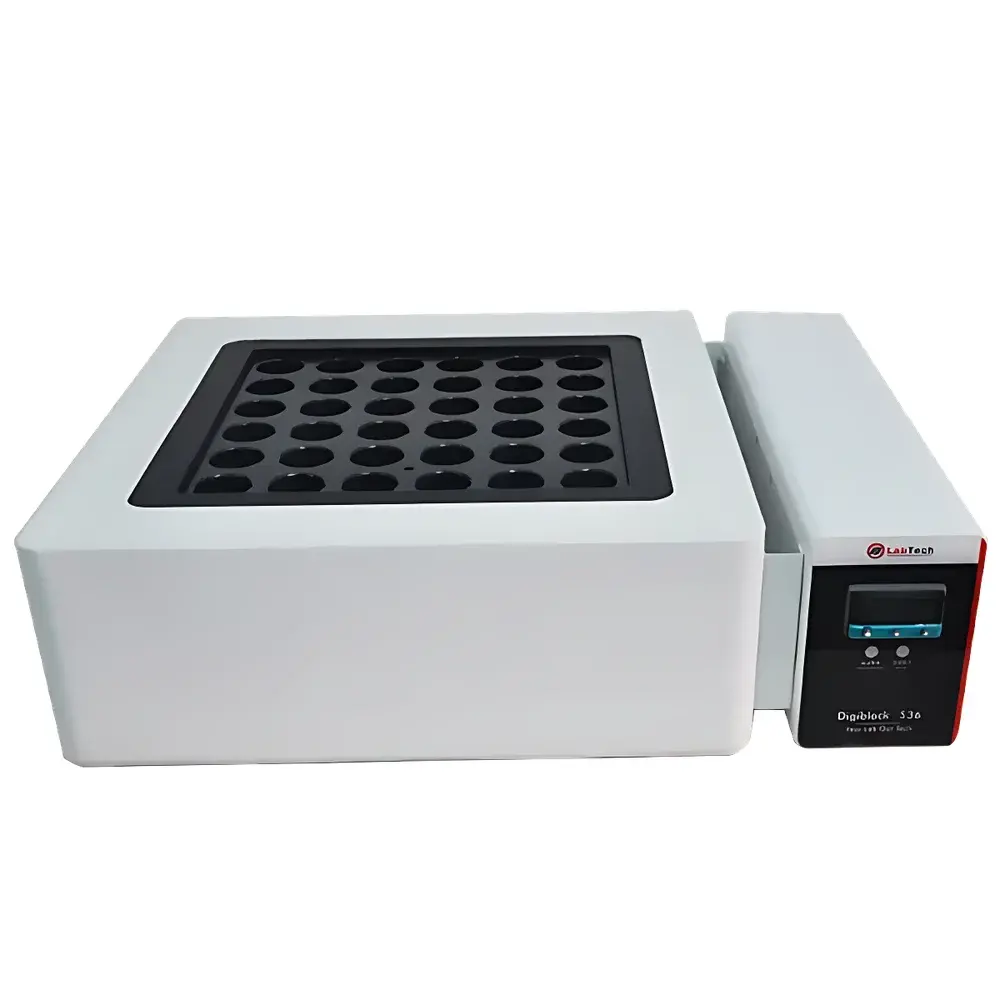
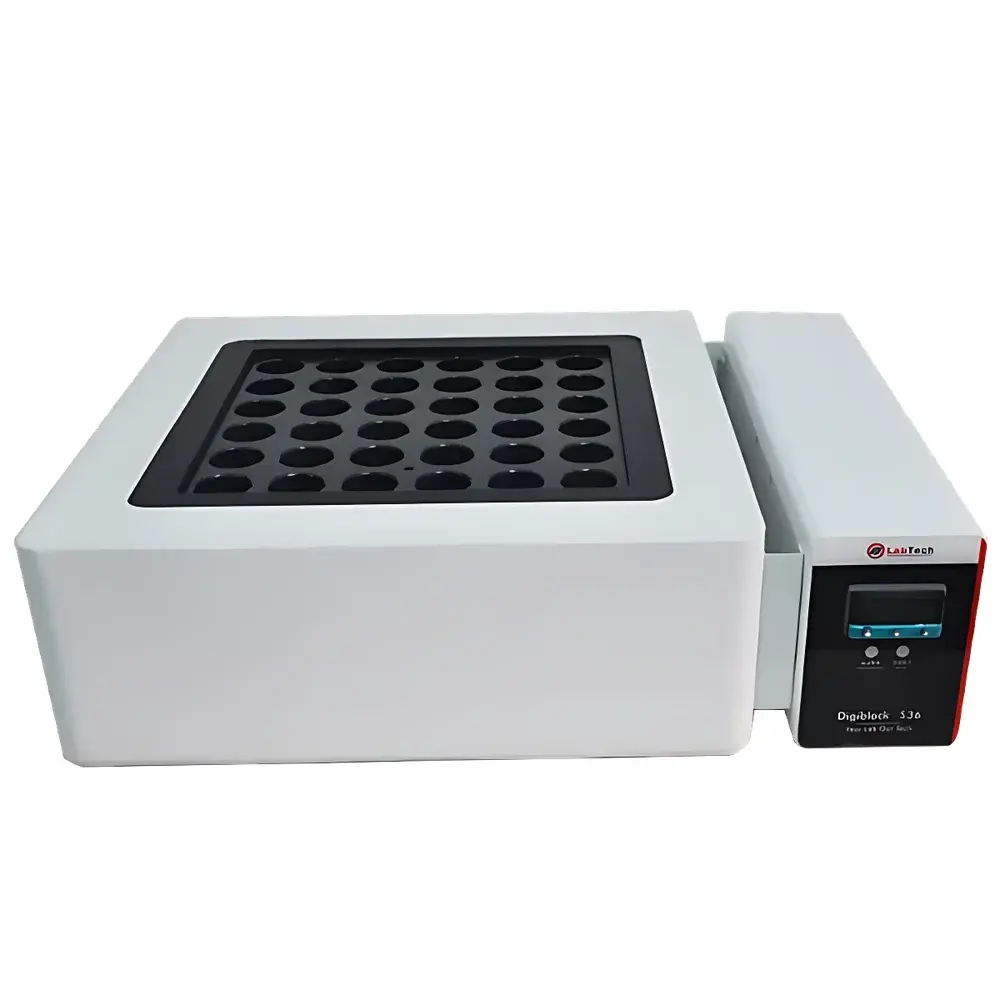
LabTech DigiBlock S16/S36 Electric Heating Digestion Block
| Brand | LabTech |
|---|---|
| Origin | Beijing, China |
| Model | S16/S36 |
| Instrument Type | Electric Heating Digestion System |
| Automation Level | Semi-Automatic |
| Digestion Positions | Configurable (16 or 36) |
| Max Operating Temperature | Up to 220 °C |
| Temperature Control Accuracy | ±0.5 °C @ 100 °C |
| Heating Principle | Uniform Surround-Heating with PID Feedback Control |
| Reagent Channel | Single-tube open-vessel configuration (no integrated reagent dispensing) |
| Safety Features | Dual-stage thermal alarm (visual + audible), 50 °C surface overheat indicator, acid-resistant sealed chassis, optional external solution temperature probe |
Overview
The LabTech DigiBlock S16/S36 Electric Heating Digestion Block is a precision-engineered, semi-automated sample preparation system designed for reproducible, high-throughput open-vessel acid digestion of solid and semi-solid matrices. Based on the proven DigiBlock platform, it employs uniform surround-heating architecture—where heating elements fully encircle each digestion tube—to deliver rapid, homogeneous thermal transfer across all positions. This design eliminates radial temperature gradients and ensures inter-position consistency of ≤±1 °C at 100 °C, a critical requirement for quantitative elemental analysis by ICP-OES, ICP-MS, AAS, and HG-AFS. Unlike microwave digestion systems, the DigiBlock operates under ambient pressure with built-in reflux holes, enabling controlled vapor condensation and return—reducing acid consumption by up to 50% while minimizing volatile element loss. It complies with core regulatory frameworks governing sample preparation, including EPA Methods 3050B, 3051A, and 3052; ISO 11047:1998 (soil digestion); GB/T 22105.1–2008 (soil heavy metals); and HJ 491–2019 (soil and sediment). The system is not intended for closed-vessel high-pressure digestion but excels in routine, method-validated, high-volume digestion workflows requiring traceability, repeatability, and operational safety.
Key Features
- Surround-heating block architecture with imported high-efficiency insulation material, achieving 2–5× faster ramp rates versus conventional hot plates
- PID-controlled temperature regulation with real-time feedback loop, delivering ±0.5 °C stability at setpoints from 30 °C to 220 °C
- Two standard configurations: 16-position (S16) and 36-position (S36) blocks, both compatible with standard 50 mL PTFE or quartz digestion tubes
- Programmable 30-segment heating protocol with independent ramp/hold parameters per segment—enabling full unattended operation
- Integrated reflux hole design supporting HNO₃, HCl, HF, and H₂O₂-based digestions under atmospheric pressure
- Acid-resistant sealed chassis with corrosion-proof stainless-steel housing and chemically inert surface coating
- Dual-layer safety system: visual/audible high-temperature alarm (≥230 °C) and dedicated 50 °C surface overheat indicator light
- Optional external Pt100 probe input for direct solution-phase temperature monitoring—critical for method validation and GLP audit trails
Sample Compatibility & Compliance
The DigiBlock S16/S36 accommodates a broad range of environmental, biological, food, pharmaceutical, and geological samples—including soils, sediments, sludge, plant tissues, animal tissues, food composites, and polymer ash residues. Its open-vessel geometry supports digestion protocols compliant with U.S. EPA SW-846 Method 3050B (acid digestion of sediments and soils), ASTM D5175-16 (determination of metals in wastewater sludge), ISO 17294-2:2016 (ICP-MS water analysis sample prep), and Chinese national standards GB 5009.268–2016 (food metal testing) and HJ 680–2013 (soil arsenic/mercury analysis). All digestion methods performed on this instrument are fully traceable, with temperature logs exportable via USB interface for inclusion in analytical batch records.
Software & Data Management
The embedded controller supports local programming via intuitive keypad interface and stores up to 20 user-defined digestion methods. Temperature profiles—including ramp rate, hold time, and final setpoint—are timestamped and logged internally with resolution of 1 °C/1 s. Data export is supported via USB flash drive in CSV format, enabling integration into LIMS environments. While no proprietary PC software is required, exported logs meet FDA 21 CFR Part 11 requirements for electronic records when paired with institutional SOPs governing data integrity, audit trail retention, and operator authentication. Optional RS-232 or Ethernet modules (sold separately) allow remote monitoring and integration with laboratory automation systems.
Applications
This instrument serves as a primary digestion platform for laboratories performing routine elemental quantification in regulated and non-regulated settings. Typical use cases include: preparation of soil and sediment samples prior to ICP-MS analysis for heavy metal screening per EPA 6020B; digestion of food homogenates for multi-element QA/QC per AOAC 999.10; pharmaceutical excipient testing for residual catalyst metals (e.g., Pd, Pt) per USP ; and geological sample dissolution for rare earth element profiling using ICP-OES. Its “digestion–evaporation–final volume adjustment” workflow within a single tube minimizes analyte loss, cross-contamination, and labor-intensive transfers—making it especially valuable in high-throughput environmental testing labs accredited to ISO/IEC 17025.
FAQ
What types of digestion vessels are compatible with the S16/S36?
Standard 50 mL PTFE, quartz, or borosilicate glass digestion tubes with conical or flat-bottom geometry are supported. Tube height must be between 120–150 mm for optimal heat transfer and reflux efficiency.
Does the system support method validation documentation?
Yes—internal temperature logging, programmable protocols, and USB-exportable CSV files provide full traceability for method validation, internal audits, and ISO/IEC 17025 compliance.
Can the DigiBlock be used with hydrofluoric acid (HF)?
Yes, when equipped with PTFE or quartz digestion tubes and operated within manufacturer-specified concentration and temperature limits (≤150 °C for HF-containing mixtures). The chassis is resistant to HF fumes when properly ventilated.
Is remote control or network connectivity available?
Basic models operate via front-panel interface only. Optional RS-232 or Ethernet communication modules enable remote status monitoring and protocol triggering via SCADA or lab automation middleware.
How does the reflux design reduce reagent consumption?
Reflux holes allow condensed acid vapors to return to the sample matrix during heating, maintaining reaction volume and reducing the need for top-up additions—resulting in up to 50% lower total acid usage compared to hot plate digestion without reflux.



