
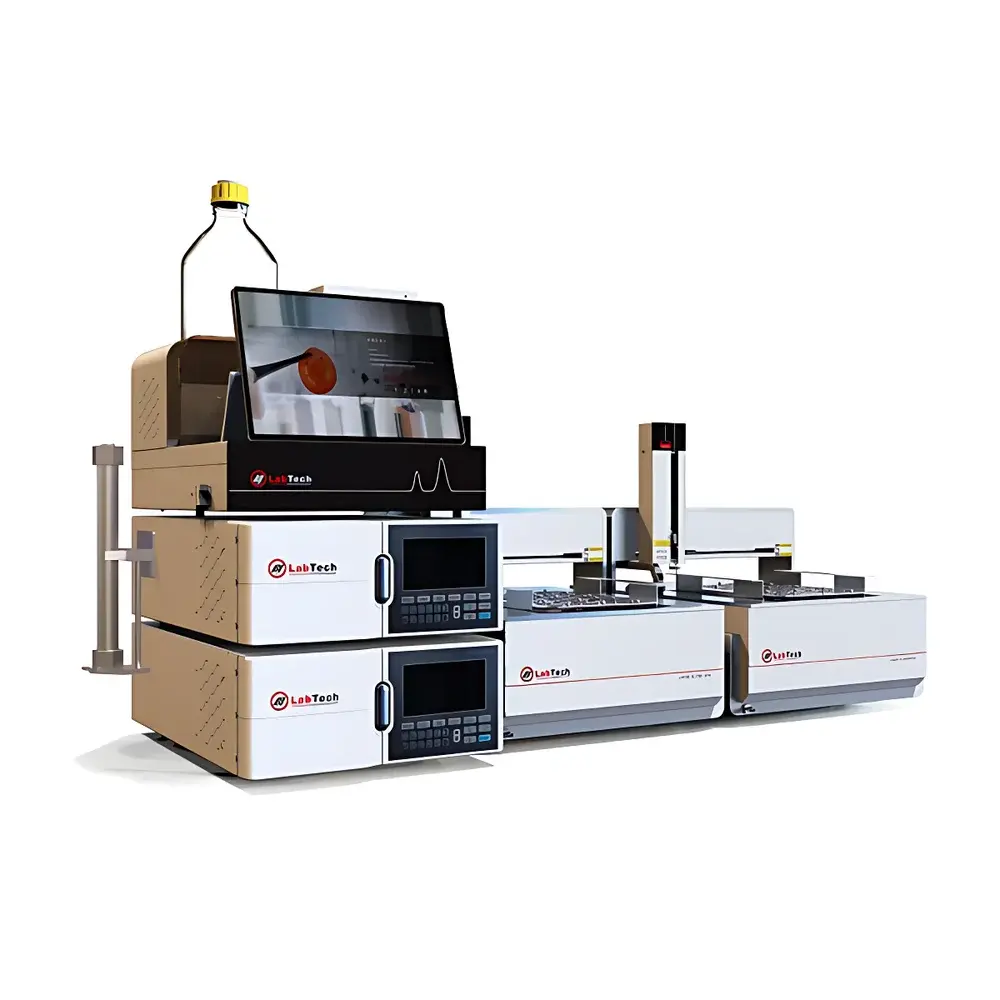
LabTech GPC1000 Automated Gel Permeation Chromatography (GPC) Purification System
| Brand | LabTech |
|---|---|
| Model | GPC1000 |
| Origin | Beijing, China |
| Equipment Type | Automated Gel Purification System |
| Pump Configuration | Dual-piston series solvent delivery pump |
| Detection | Variable-wavelength UV detector (standard) |
| Autosampler | 3D robotic arm with immersion-style needle wash (external & internal) |
| Fraction Collector | Independent 3D positioning collector |
| Column Design | Quick-connect stainless-steel GPC columns with automatic column lock valve |
| Sample Handling | Sealed-loop loading and sealed fraction collection |
| System Architecture | Modular, field-upgradable platform |
| Compliance Ready | Designed for GLP-compliant workflows with audit-trail-capable software logging |
Overview
The LabTech GPC1000 Automated Gel Permeation Chromatography (GPC) Purification System is an integrated, benchtop-scale preparative chromatographic platform engineered for high-throughput, reproducible sample cleanup prior to quantitative analysis. It operates on the principle of size-exclusion chromatography (SEC), wherein analytes are separated based on hydrodynamic volume in solution—larger molecules elute first while smaller contaminants (e.g., lipids, pigments, humic substances) penetrate the porous matrix and elute later. Unlike analytical SEC systems optimized for molecular weight distribution, the GPC1000 is purpose-built for preparative fractionation: its robust fluidic architecture, precise volumetric delivery, and sealed handling pathway ensure minimal analyte loss, oxidation, or volatilization during purification—critical for trace-level analysis in environmental, food safety, and agricultural residue testing.
Key Features
- Modular system architecture enables flexible configuration—users may integrate optional modules including solvent degassers, fraction re-injection ports, or auxiliary detectors without hardware modification.
- Dual-piston series solvent delivery pump delivers stable, pulse-free flow across variable backpressures; engineered for long-term reproducibility in multi-hour GPC runs typical of complex matrices (e.g., soil extracts, fish tissue homogenates).
- High-precision syringe-based autosampler with 3D robotic arm provides accurate, programmable injection volumes (range: 0.1–5 mL per injection, configurable via method editor); needle path includes immersion-style external and internal wash cycles using dual-solvent lines to prevent carryover.
- Stainless-steel quick-connect GPC columns (standard 15 × 300 mm, packed with Bio-Beads SX-3 or equivalent cross-linked polystyrene-divinylbenzene resin) offer mechanical durability, low nonspecific binding, and batch-to-batch retention time stability—validated against ASTM D5296 and ISO 11348 standards for polymer molecular weight calibration protocols.
- Variable-wavelength UV detector (190–400 nm, 1 nm resolution) supports real-time spectral monitoring of elution profiles; absorbance data synchronized with fraction collection triggers enables threshold-based or time-window-based fraction cutting.
- Sealed-loop sample loading and closed-vial fraction collection minimize exposure to ambient air—essential for volatile organochlorines (e.g., PCBs, OCPs), thermally labile mycotoxins, or light-sensitive carotenoids.
- Integrated column lock valve automatically isolates and seals the column post-run, preserving stationary phase hydration and extending column lifetime beyond 200+ injections under routine use conditions.
Sample Compatibility & Compliance
The GPC1000 accommodates a broad range of extract matrices following QuEChERS, Soxhlet, or accelerated solvent extraction (ASE) protocols—including aqueous extracts, hexane/acetone mixtures, dichloromethane eluates, and ethyl acetate supernatants. Its inert stainless-steel fluid path and PTFE-lined valves resist corrosion from halogenated solvents and acidic modifiers. The system supports method validation per EPA Method 3640A (gel permeation chromatography cleanup) and EU SANTE/11312/2021 guidelines for pesticide residue analysis. Software logs—including method parameters, run timestamps, detector signals, and fraction mapping—are structured to support 21 CFR Part 11 compliance when deployed with LabTech’s optional audit-trail-enabled control suite.
Software & Data Management
Control and data acquisition are managed via LabTech GPC Control Suite v3.x—a Windows-based application supporting IEC 62443-aligned user role management (administrator, analyst, reviewer). All method files, raw chromatograms (.chd), and fraction metadata (.xml) are stored in a timestamped, immutable project directory. The software exports ASCII-compatible peak tables and fraction maps for integration with LIMS platforms (e.g., Thermo Fisher SampleManager, LabVantage) via ODBC or CSV. Batch processing mode allows unattended overnight operation of up to 48 samples with dynamic re-injection logic for under-collected fractions.
Applications
The GPC1000 is routinely deployed in accredited laboratories performing multiresidue analysis of persistent organic pollutants (POPs), including polycyclic aromatic hydrocarbons (PAHs), polychlorinated biphenyls (PCBs), organochlorine pesticides (OCPs), and brominated flame retardants (BFRs) in environmental solid and biological samples. In food safety labs, it serves as a critical cleanup step prior to GC-MS/MS analysis of veterinary drug residues (e.g., chloramphenicol, nitrofurans) and mycotoxins (aflatoxins, ochratoxin A). Its compatibility with high-boiling-point solvents also supports purification of lipid-rich extracts from edible oils, dairy products, and animal feed—reducing co-elution interference in subsequent LC-MS analysis.
FAQ
What column dimensions and packing materials are supported?
Standard configuration uses 15 mm × 300 mm stainless-steel columns packed with Bio-Beads SX-3 (200–400 mesh); alternative packings (e.g., Sephadex LH-20, TSK-GEL G4000PWXL) can be installed with minor method recalibration.
Is the system compatible with EPA Method 3640A?
Yes—the flow rate accuracy, UV detection range, and fraction collection precision meet all instrumental performance criteria specified in EPA Method 3640A for gel permeation chromatography cleanup.
Can the GPC1000 interface with third-party mass spectrometers?
While not a direct hyphenated system, the collected fractions are fully compatible with offline introduction into GC-MS, LC-MS/MS, or HRMS platforms; fraction vials conform to ANSI/SLAS 96-well plate footprint for robotic autosampler integration.
What maintenance intervals are recommended for the dual-piston pump?
Pump seals require replacement every 6 months under continuous operation; seal wear diagnostics are logged automatically in the service history module and trigger proactive alerts.
Does the system support method transfer from legacy GPC instruments?
Yes—retention time alignment tools and gradient translation algorithms are embedded in the method editor to facilitate migration from Varian/Agilent or Waters GPC platforms.



