
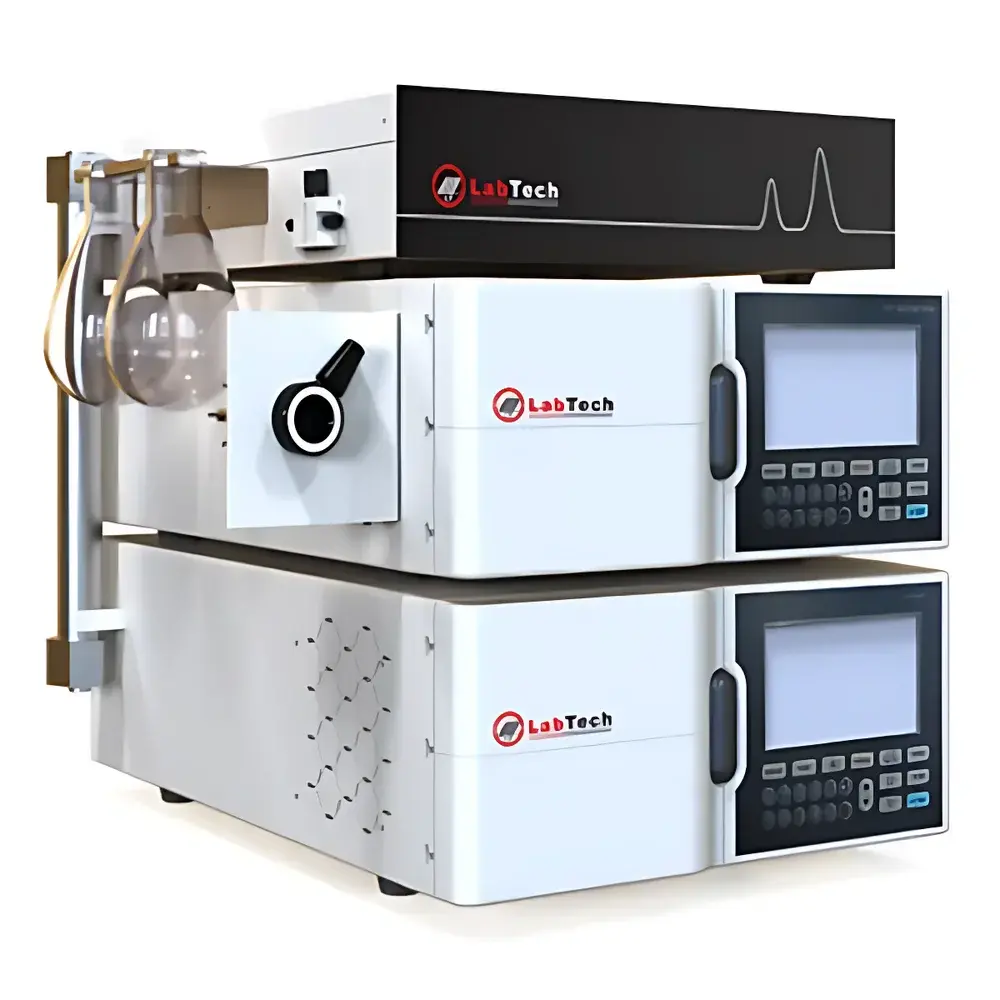
LabTech GPC600 mini Semi-Automatic Gel Permeation Chromatography (GPC) Purification System
| Brand | LabTech |
|---|---|
| Origin | Beijing, China |
| Model | GPC600 mini |
| Flow Rate | Not specified by manufacturer |
| Maximum Operating Pressure | Not specified by manufacturer |
| Flow Stability | Not specified by manufacturer |
| Auto-Sample Injection Volume | Not specified by manufacturer |
| Auto-Sample Capacity | Not specified by manufacturer |
Overview
The LabTech GPC600 mini is a semi-automated gel permeation chromatography (GPC) purification system engineered for reliable, reproducible matrix removal from complex environmental, food, agricultural, and biological extracts. Based on the fundamental principle of size-exclusion chromatography (SEC), the system separates analytes from interfering macromolecules (e.g., lipids, proteins, polymers, humic substances) and low-molecular-weight contaminants (e.g., pigments, salts, residual solvents) according to hydrodynamic volume in solution. This molecular-size-based fractionation enables selective elution of target analytes—typically pesticides, PCBs, PAHs, dioxins, mycotoxins, or veterinary drug residues—into defined collection windows while retaining both high-MW matrix components in the void volume and low-MW interferences in the late-eluting fractions. Unlike fully automated GPC platforms, the GPC600 mini employs manual sample injection via a precision 6-port, 2-position injection valve, followed by fully automated gradient or isocratic solvent delivery, column elution, UV-triggered or time-programmed fraction collection, and integrated solvent management—delivering analytical rigor with operational simplicity.
Key Features
- Semi-automated workflow: Manual injection ensures operator control over sample introduction; all downstream steps—including pump-driven elution, column switching, UV monitoring, and fraction collection—are executed under pre-configured method protocols.
- Stainless-steel GPC columns: Pre-packed, factory-validated columns eliminate column packing variability, reduce method development time, and improve inter-laboratory reproducibility. Columns are compatible with common GPC solvents including cyclohexane, ethyl acetate, dichloromethane, and toluene.
- High-precision dual-plunger reciprocating pump: Delivers stable, pulse-free flow across typical GPC mobile phase viscosities, supporting consistent retention time alignment and minimized baseline drift during extended runs.
- Variable-wavelength UV detector (190–400 nm): Enables real-time monitoring of eluent absorbance for peak-triggered collection or fixed-time window acquisition—critical for optimizing recovery of UV-active target compounds while excluding co-eluting interferents.
- Dual rotary evaporation-compatible collection positions: Two independently addressable collection ports accept standard 50–250 mL round-bottom flasks, enabling seamless transfer to rotary evaporators without intermediate vial transfers—reducing analyte loss, contamination risk, and solvent exposure.
- Modular architecture: Designed for future scalability, the GPC600 mini chassis supports hardware and software upgrades to full automation (e.g., integration with LabTech’s GPC600 UP or GPC1000 series), including robotic autosamplers, multi-column switching manifolds, and advanced fraction tracking modules.
Sample Compatibility & Compliance
The GPC600 mini accommodates a broad range of extract matrices—including soil extracts (EPA Method 3640A), tissue homogenates, edible oil filtrates, honey supernatants, and plant tissue digests—provided they are dissolved in compatible organic solvents and filtered (≤0.45 µm) prior to injection. Its performance aligns with established regulatory frameworks: it supports workflows compliant with U.S. EPA SW-846 Method 3640A (Gel Permeation Chromatography), EU EN 15662:2018 (pesticide residue analysis in food), and ISO 17025-accredited laboratories requiring documented method validation, traceable calibration, and audit-ready operation logs. While the system itself does not include 21 CFR Part 11-compliant electronic signatures, its method storage and run history functions support GLP/GMP-aligned data integrity practices when paired with validated LIMS or ELN systems.
Software & Data Management
Operation is managed via LabTech’s dedicated GPC Control Software, a Windows-based interface supporting method creation, real-time chromatogram visualization, UV absorbance threshold setting, collection window definition, and run log export in CSV or PDF format. All method parameters—including pump flow profile, UV wavelength and sensitivity, collection timing, and valve sequencing—are stored with user ID and timestamp metadata. Software updates are delivered via secure firmware update packages; no cloud connectivity or remote access is embedded—ensuring data sovereignty and network isolation per laboratory IT security policies.
Applications
The GPC600 mini serves as a critical front-end cleanup tool in multi-residue analytical workflows. It is routinely deployed in environmental testing labs for lipid removal from sediment and biota extracts prior to GC-MS/MS analysis of organochlorine pesticides; in food safety labs for pigment and fat elimination from vegetable oil and animal fat samples before LC-MS/MS quantitation of mycotoxins; and in agricultural research for purifying phytochemical extracts prior to HPLC-DAD characterization. Its robustness, solvent efficiency, and compatibility with parallel concentration systems (e.g., TurboVap® or Genevac EZ-2) make it especially suitable for high-throughput screening environments where method ruggedness and minimal operator intervention are prioritized.
FAQ
What sample volumes can be injected manually?
Manual injection volume depends on the selected loop size (standard options: 100 µL, 500 µL, 1 mL); users select the loop during method setup and load samples via syringe through the injection valve port.
Is column regeneration supported?
Yes—the stainless-steel columns are designed for multiple regeneration cycles using appropriate solvent sequences (e.g., THF → methanol → hexane), with performance verified via system suitability tests using polystyrene standards.
Can the system be integrated with third-party concentrators?
Yes—collection flasks conform to standard ISO-K 29/32 or ISO-K 24/29 neck dimensions, ensuring mechanical and vacuum compatibility with major rotary evaporator and nitrogen evaporator platforms.
Does the UV detector require lamp replacement scheduling?
The deuterium lamp has a rated lifetime of ≥1,000 hours; software displays cumulative lamp usage time and triggers maintenance alerts at configurable thresholds.
What solvent compatibility limits apply?
The fluidic path is constructed from chemically resistant stainless steel, PEEK, and fluoropolymer components—compatible with all common GPC solvents except strong oxidizers (e.g., nitric acid) or halogenated solvents above 60 °C.



