
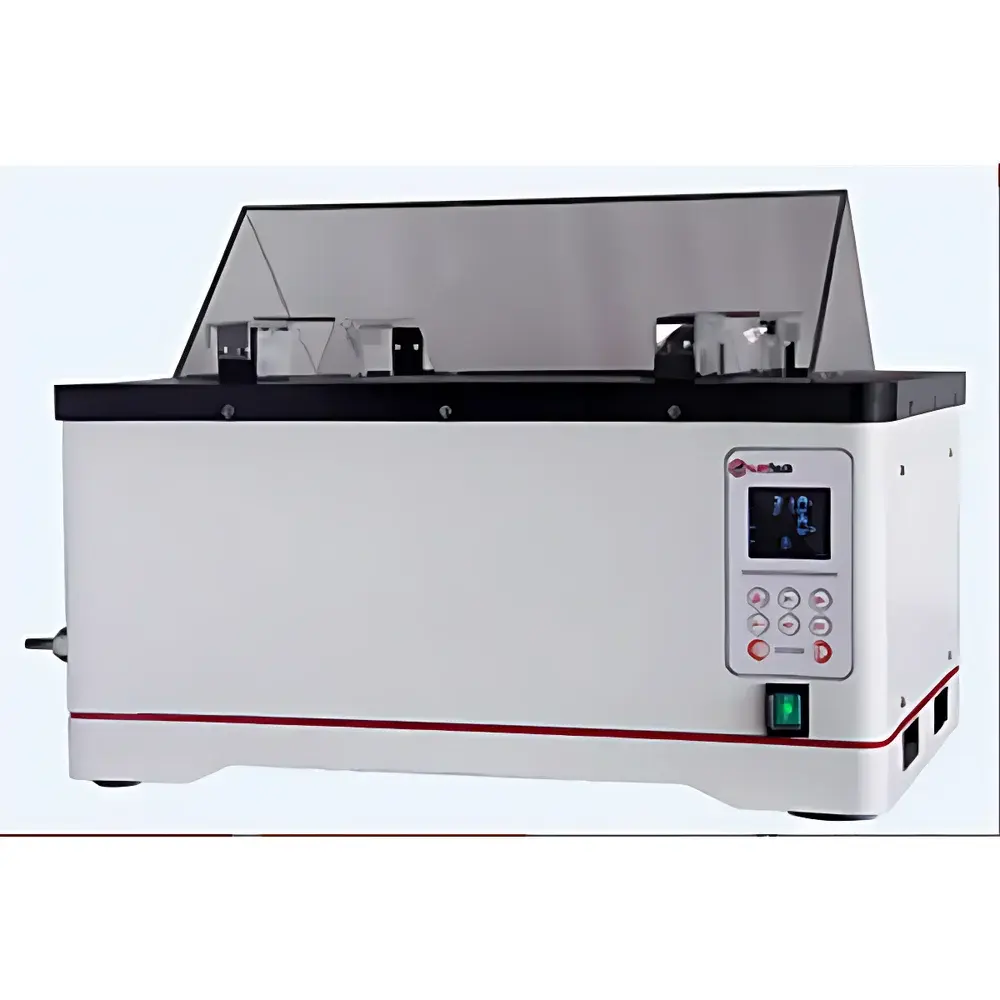
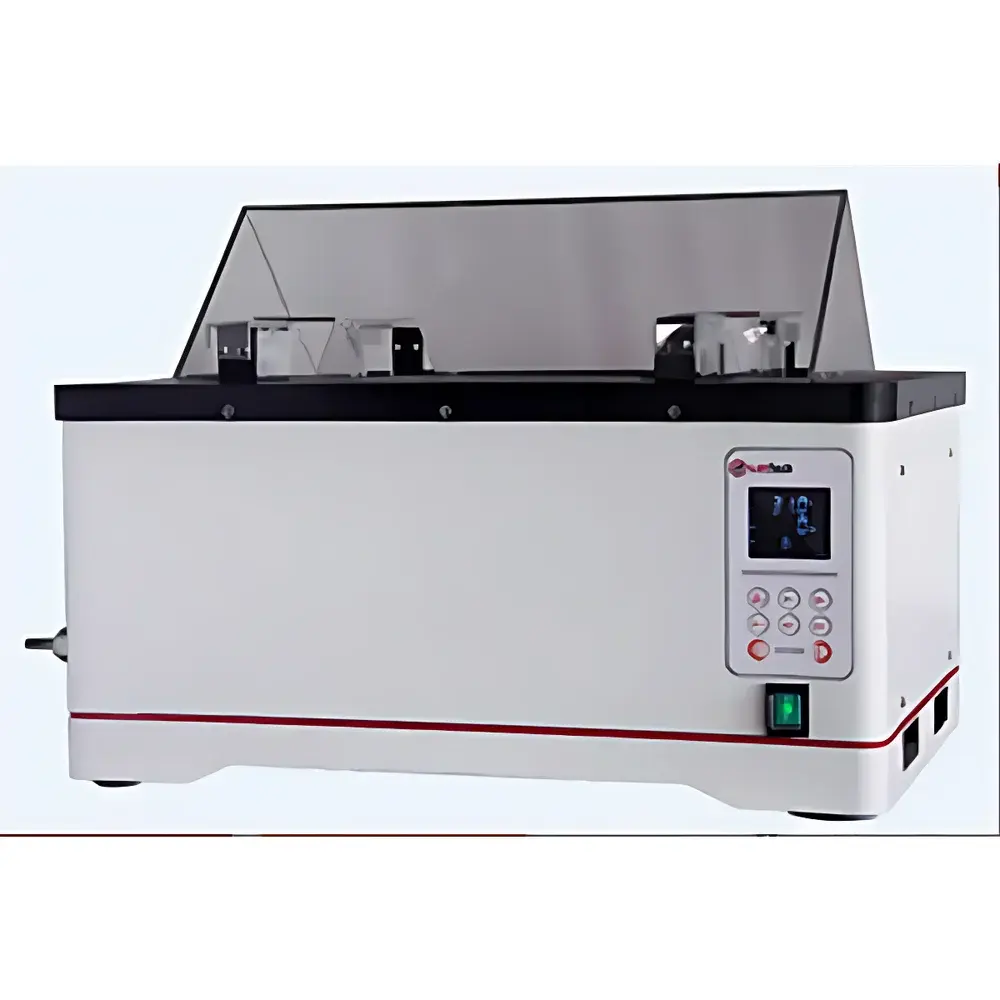
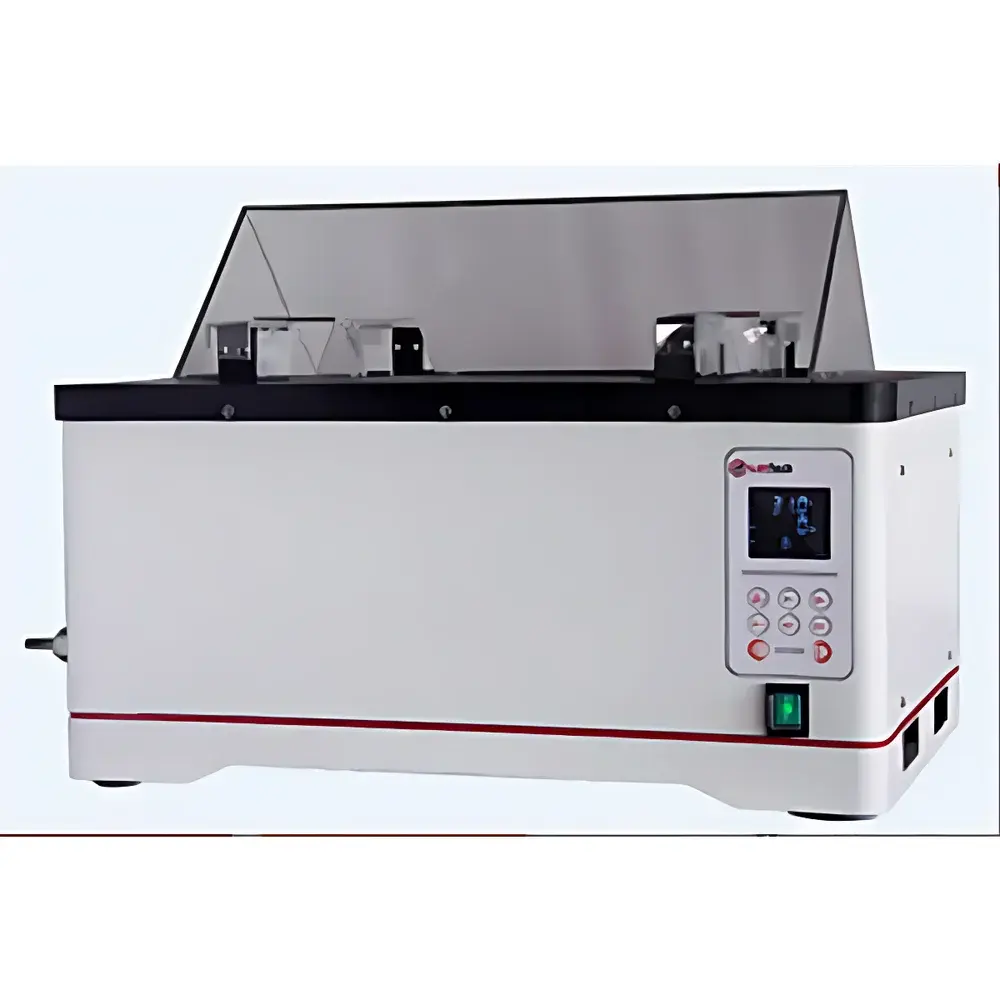
LabTech LW-20 Intelligent Corrosion-Resistant Shaking Water Bath
| Brand | LabTech |
|---|---|
| Model | LW-20 |
| Type | Shaking Water Bath with Corrosion-Resistant Construction |
| Temperature Control | Dual-mode (Heating & Cooling) |
| Circulation | Internal & External Circulation |
| Chamber Material | Fully Plastic Platform + Epoxy-Coated Stainless Steel Bath Vessel |
| Lid | Transparent Acid-Resistant Reflux Cover |
| Control System | Microprocessor-Based PID Controller with Memory Function |
| Oscillation Modes | Reciprocating & Intermittent |
| Oscillation Frequency | Adjustable (0–300 rpm) |
| Timing Modes | 4 Programmable Timer Types (Countdown, Interval, Delayed Start, Continuous) |
| Auto-Recovery | Power-Failure Resume with Method Retention |
| Safety Features | High-Level Overflow Alarm, Self-Diagnostic Fault Codes, Adjustable Auto-Refill Flow Rate |
| Compliance | Designed for GLP-compliant laboratories requiring traceable, repeatable thermal-shaking protocols |
Overview
The LabTech LW-20 Intelligent Corrosion-Resistant Shaking Water Bath is an engineered solution for laboratories routinely handling aggressive chemical environments—particularly those involving concentrated acids (e.g., HCl, HNO₃, HF), strong alkalis (e.g., NaOH, KOH), or oxidizing reagents. Unlike conventional stainless steel water baths, the LW-20 integrates a dual-material architecture: the bath vessel features electrophoretically deposited epoxy-polyester coating over 304 stainless steel to prevent pitting and galvanic corrosion, while the entire working platform—including sample holders, lid supports, and control housing—is constructed from chemically inert polypropylene (PP) and polyoxymethylene (POM). This structural segregation eliminates metallic ion leaching and ensures long-term dimensional stability under sustained exposure to pH 13 conditions. The unit operates on a thermoelectric heating/cooling principle combined with forced convection circulation, enabling precise thermal regulation across the working volume while maintaining mechanical oscillation integrity. Its primary operational domain spans sample digestion pre-treatment, accelerated solvent extraction, enzymatic reaction incubation, and stability testing of corrosion-sensitive reference standards.
Key Features
- Corrosion-Resistant Architecture: Epoxy-coated stainless steel bath vessel paired with fully plastic (PP/POM) platform, tube racks, and reflux lid—eliminating galvanic corrosion pathways and metal contamination risks.
- Intelligent Liquid Management: Integrated auto-refill system with flow-rate adjustment (0.5–5 mL/min), preventing temperature overshoot during top-up and minimizing evaporative loss via transparent acid-resistant reflux lid.
- Programmable Oscillation: Selectable reciprocating or intermittent shaking modes; frequency range 0–300 rpm with ±2 rpm repeatability; stroke amplitude fixed at 25 mm for consistent mixing energy delivery.
- Advanced Thermal Control: PID-based dual-mode temperature regulation (heating/cooling); real-time monitoring with NTC sensor embedded in bath fluid; memory retention for up to 10 user-defined methods.
- Unattended Operation Support: Delayed start scheduling (up to 99 h), four timer logic types (countdown, interval cycling, delayed activation, continuous run), and power-failure recovery that resumes prior method parameters automatically.
- Safety-Centric Design: High-level liquid detection sensor triggers audible/visual alarm before overflow; self-diagnostic firmware reports fault codes (E01–E08) corresponding to sensor disconnection, heater failure, or motor stall.
Sample Compatibility & Compliance
The LW-20 accommodates standard laboratory glassware including borosilicate test tubes (10–50 mL), digestion vessels (up to 100 mL), and custom PP reaction vials. Its all-plastic sample carriers support ISO 8573-1 Class 3 clean air compatibility when used in controlled environments. From a regulatory standpoint, the device’s deterministic control logic, non-volatile parameter storage, and audit-ready error logging align with GLP documentation requirements per OECD Series No. 17 and support 21 CFR Part 11 compliance when integrated with validated LIMS platforms. While not certified as explosion-proof, its sealed electronics and absence of exposed metallic contacts render it suitable for use in fume hoods handling volatile corrosives under EN 14175-3 ventilation guidelines.
Software & Data Management
The LW-20 operates via an embedded 32-bit ARM Cortex-M4 microcontroller running deterministic real-time firmware (v2.1+). All setpoints, timers, oscillation profiles, and event logs are stored in EEPROM with write-cycle endurance >100,000 cycles. Optional RS-485 Modbus RTU interface enables integration into centralized lab automation systems for remote parameter adjustment and status polling. Data export (CSV format) is supported via USB-A port for post-experiment analysis in MATLAB, Python (Pandas), or Excel. Audit trails include timestamped entries for method changes, temperature deviations (>±0.3°C), refill events, and fault occurrences—structured to satisfy internal QA review and external inspection protocols.
Applications
- Acid digestion of geological and environmental samples prior to ICP-MS analysis, where chloride-induced pitting must be avoided.
- Alkaline hydrolysis of polymeric matrices (e.g., PET, nylon) under controlled shear and thermal stress.
- Stability assessment of pH-sensitive biologics in buffer formulations containing citrate or phosphate salts.
- Leaching tests per EPA Method 1311 (TCLP) using acetic acid extractant without bath degradation.
- Pre-analytical conditioning of catalyst slurries in heterogeneous reaction studies requiring reproducible suspension homogeneity.
FAQ
Does the LW-20 support external temperature probe input for sample-specific monitoring?
No—the system relies exclusively on the built-in NTC sensor immersed in the bath fluid. For sample-core temperature validation, users should employ calibrated external probes logged separately.
Can the oscillation function operate independently of temperature control?
Yes—shaking may be activated in ambient mode (no heating/cooling) for room-temperature mixing applications.
Is the reflux lid compatible with organic solvents such as acetone or chloroform?
The lid material (modified ETFE-coated polycarbonate) resists aqueous acids and bases but is not rated for prolonged exposure to halogenated or ketonic solvents; consult LabTech’s Chemical Resistance Guide (Doc #LW-20-CRG-Rev4) before use.
What maintenance intervals are recommended for the auto-refill pump?
The peristaltic pump tubing should be inspected every 6 months and replaced annually under continuous operation; LabTech part number PT-LW20-RF-01 is field-replaceable without tools.
How is calibration traceability established for temperature and timing functions?
Factory calibration uses NIST-traceable dry-block calibrators (Fluke 9143) and timebase analyzers (Keysight 53230A); end-user verification procedures are documented in the Instrument Qualification Kit (IQK-LW20).



