
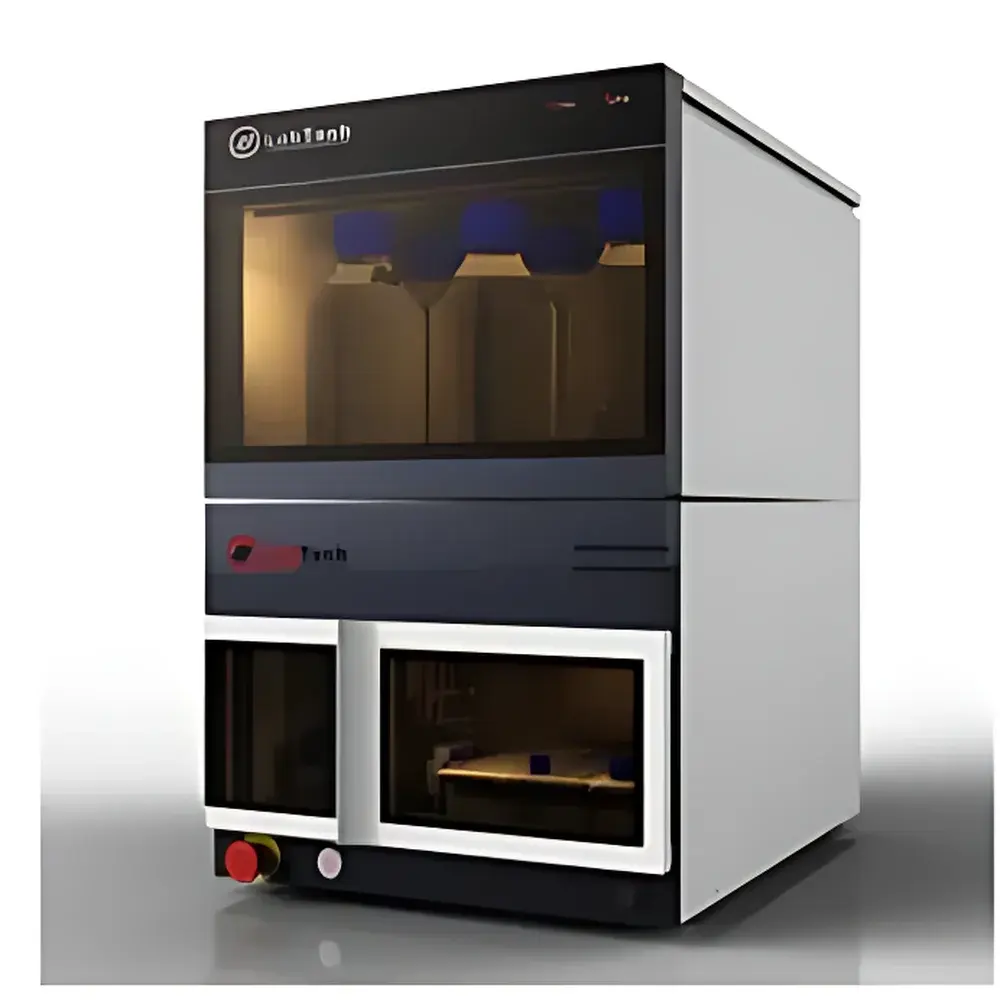
LabTech MiniLab-O Automated Dilution and Standard Preparation System
| Brand | LabTech |
|---|---|
| Model | MiniLab-O |
| Category | Automated Liquid Handling Workstation |
| Origin | Beijing, China |
| Primary Application | Calibration standard preparation, sample dilution, and quantitative liquid dispensing for GC/MS and LC/MS workflows |
| Compliance | Designed to support GLP/GMP-aligned laboratory practices |
| Software | Embedded control software with real-time method visualization and remote monitoring via mobile app |
| Optional Module | Temperature-controlled (heating & cooling) sample deck |
Overview
The LabTech MiniLab-O Automated Dilution and Standard Preparation System is an integrated, benchtop liquid handling workstation engineered for high-accuracy, traceable preparation of calibration standards, quality control samples, and diluted analyte solutions in regulated analytical laboratories. Operating on a dual-syringe pump architecture, the system delivers precise volumetric delivery across a wide dynamic range—enabling reproducible serial dilutions, multi-level calibration curve generation, and complex mixed-standard formulation. Its core functionality supports critical pre-analytical workflows upstream of chromatographic–mass spectrometric platforms (e.g., GC/MS, LC/MS), where quantitative integrity of reference materials directly impacts measurement uncertainty and regulatory compliance. The MiniLab-O is not a general-purpose pipetting robot; rather, it is purpose-built for metrologically rigorous standard preparation—emphasizing traceability, contamination control, and audit-ready process documentation.
Key Features
- Dual independent syringe pumps with automatic mode switching—optimized for low-volume precision (e.g., 1–100 µL) and high-volume transfer (e.g., 100 µL–5 mL)—ensuring consistent accuracy across concentration orders of magnitude.
- Multi-modal mixing capability: programmable aspiration/dispense cycles, air-gap assisted homogenization, and optional vortex-like gas-phase agitation—minimizing carryover and improving solution uniformity for viscous or volatile solvents.
- Integrated needle-wash station with multi-stage solvent rinsing (up to 3 wash solvents) and post-wash nitrogen purge—reducing cross-contamination risk and eliminating residual droplet formation.
- Sealed, light-shielded solvent delivery manifold and reagent reservoirs—preserving photolabile standards (e.g., pesticides, PAHs, vitamins) and minimizing solvent evaporation during extended runs.
- Automated protocol generation engine: software calculates optimal dilution paths, minimizes pipette tip usage, validates volume feasibility against physical constraints, and outputs step-by-step execution logic with error-checking flags.
- Remote operational oversight via secure mobile application—providing real-time status updates (e.g., current step, elapsed time, alarm conditions), push notifications for completion or fault events, and encrypted log export.
Sample Compatibility & Compliance
The MiniLab-O accommodates standard ANSI/SLAS-format microplates (96-well, 384-well), vials (2–20 mL), and custom tube racks. It handles aqueous buffers, organic solvents (acetonitrile, methanol, ethyl acetate), acidified matrices, and surfactant-containing formulations—subject to material compatibility with PTFE, PEEK, and stainless-steel fluidic pathways. While not certified to ISO/IEC 17025 as a standalone instrument, its operational design aligns with key elements of analytical method validation (ICH Q2(R2), USP ) and supports laboratories pursuing FDA 21 CFR Part 11 compliance through electronic audit trails, user access controls, and immutable method/version logging. All calibration and verification procedures follow manufacturer-recommended intervals and documented SOPs—facilitating internal QA audits and external inspections.
Software & Data Management
The embedded control software provides a validated, Windows-based interface supporting method creation, validation, and version-controlled archiving. Each run generates a timestamped, digitally signed execution report—including aspirated/dispensed volumes, mixing cycles, wash sequences, environmental logs (if temperature module active), and deviation alerts. Data exports are compliant with LIMS integration protocols (CSV, XML) and retain full traceability from raw input concentrations to final vial-level assignments. Optional software modules enable automated QC flagging (e.g., out-of-tolerance dilution steps), statistical summary dashboards, and electronic signature capture per ALCOA+ principles.
Applications
- Preparation of multi-point calibration curves for residual solvent analysis (ICH Q3C) and elemental impurity testing (ICH Q3D) in pharmaceutical development.
- Generation of matrix-matched calibration standards for pesticide residue quantification in food commodities (AOAC 2007.01, EN 15662).
- Serial dilution of certified reference materials (CRMs) for environmental monitoring labs conducting PFAS, PCB, or dioxin analysis per EPA Method 1613/8270.
- Automated spiking of internal standards and surrogate recoveries into biological matrices (urine, plasma) prior to LC-MS/MS bioanalysis (FDA Bioanalytical Method Validation Guidance).
- High-throughput QC sample setup for clinical toxicology labs performing therapeutic drug monitoring (TDM) and forensic screening.
FAQ
What is the minimum and maximum dispense volume supported by the MiniLab-O?
The system’s dual-pump architecture enables configurable ranges; typical configurations span 0.5 µL to 5,000 µL per dispense, subject to syringe selection and fluid properties.
Does the MiniLab-O support unattended overnight operation?
Yes—equipped with safety interlocks, leak detection, and end-of-run auto-shutdown, it is rated for continuous operation up to 16 hours with appropriate reagent loading and tip inventory.
Can the system be integrated into an existing LIMS or ELN environment?
It supports standardized data export formats (CSV, XML) and offers optional OPC UA or REST API connectivity for bidirectional workflow orchestration.
Is temperature control of samples mandatory for all applications?
No—the ambient-temperature deck is standard; the thermoelectric heating/cooling module is optional and recommended only for thermally labile standards or viscosity-sensitive solvents.
How is calibration and performance verification performed?
Users perform routine gravimetric verification per ISO 8655-6 using certified weights and Class A volumetric glassware; LabTech provides a documented verification protocol and annual service certification upon request.



