
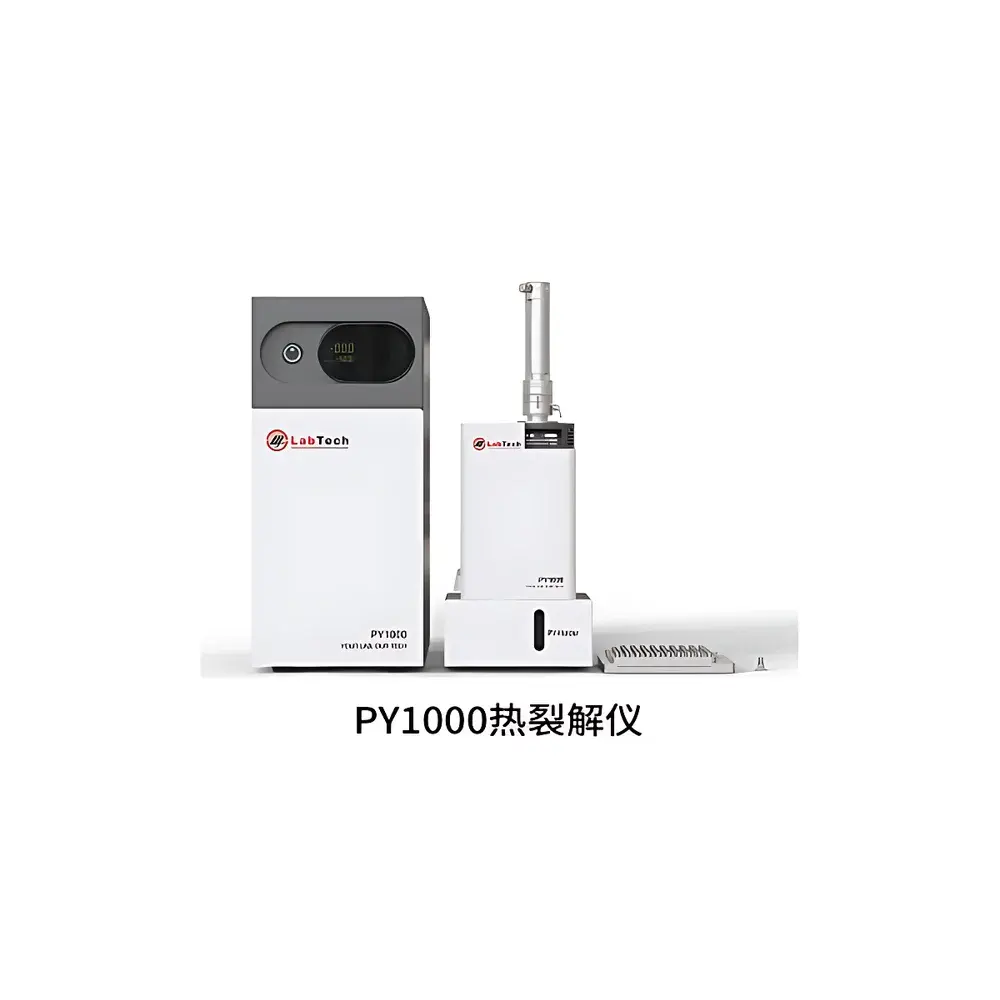
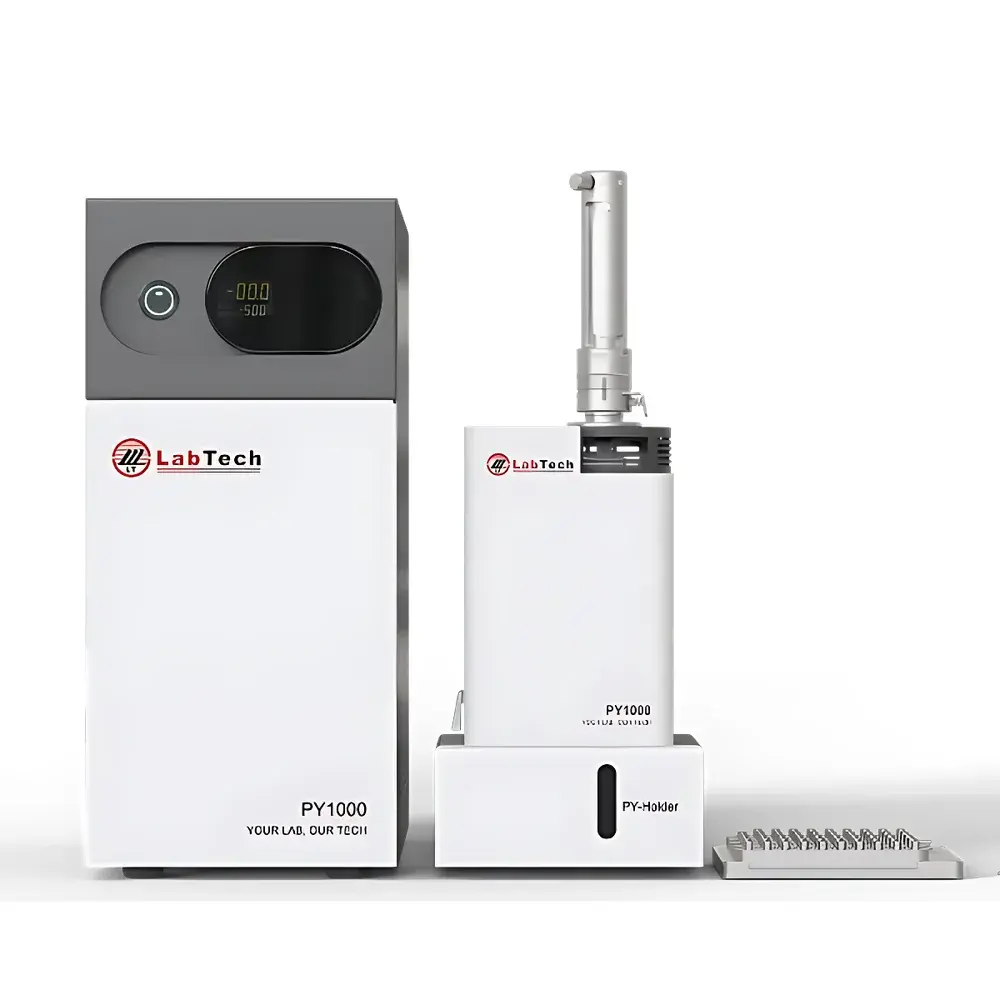
LabTech PY1000 Pyrolyzer
| Brand | LabTech |
|---|---|
| Origin | Beijing, China |
| Manufacturer Type | Direct Manufacturer |
| Product Category | Domestic (China-made) |
| Model | PY1000 Pyrolyzer |
| Pricing | Available Upon Request |
Overview
The LabTech PY1000 Pyrolyzer is a benchtop thermal desorption and flash pyrolysis interface engineered for seamless integration with gas chromatography–mass spectrometry (GC–MS) systems. It operates on the principle of controlled, rapid thermal decomposition—subjecting solid or viscous samples to precisely programmed temperature ramps (up to 1100 °C) in an inert atmosphere, thereby volatilizing thermally labile or non-volatile analytes into gaseous fragments suitable for GC separation and MS detection. Unlike conventional solvent extraction or derivatization workflows, the PY1000 enables direct analysis of polymers, additives, contaminants, and complex organic matrices without chemical pretreatment—delivering enhanced molecular fingerprinting capability for structural elucidation and compositional profiling. Its design aligns with core analytical requirements in regulated environments, supporting method development compliant with ASTM D7213 (for polymer pyrolysis), ISO 17201-4 (for thermal desorption), and USP <621> chromatographic system suitability criteria.
Key Features
- High-temperature ceramic heating module with real-time PID feedback control, ensuring ±0.5 °C temperature stability across the full 100–1100 °C operating range.
- Modular, plug-and-play handheld sample probe—enabling rapid, glove-free insertion and removal of quartz or stainless-steel sample cups under inert purge conditions.
- Large-capacity sample cup geometry accommodating up to 160 μL volume, compatible with bulk polymer pellets, microplastic particles, environmental filter extracts, and viscous residues.
- Dual-stage split flow configuration: primary split at the pyrolyzer outlet reduces column overload and secondary split at the GC inlet minimizes carryover—extending liner and column lifetime while preserving chromatographic resolution.
- Universal mounting interface designed for direct, tool-free coupling to standard GC injection ports (e.g., Agilent 7890/8890, Thermo ISQ, Shimadzu GC-2030), eliminating alignment calibration and enabling field-replaceable installation in under 90 seconds.
- Multi-mode operational flexibility: supports both thermal desorption (TD) of adsorbed volatiles and direct liquid injection (DLI) via optional syringe-compatible adapter—eliminating need for separate TD or liquid autosampler hardware.
Sample Compatibility & Compliance
The PY1000 accommodates diverse sample forms—including thermoplastics (e.g., PE, PP, PET), elastomers, composites, electronic waste (WEEE), soil/sediment extracts, and RoHS-compliant screening matrices. All wetted surfaces are inert quartz or passivated stainless steel, minimizing catalytic degradation and memory effects. The system meets essential regulatory prerequisites for quality-controlled laboratories: hardware architecture supports audit-trail-enabled operation when paired with compliant GC–MS data systems; firmware logs all thermal events, dwell times, and gas flow parameters in timestamped binary format—fully traceable for GLP/GMP documentation and FDA 21 CFR Part 11 compliance when integrated with validated software platforms.
Software & Data Management
The PY1000 is operated via LabTech’s PyroSoft Control Suite—a Windows-based application offering intuitive sequence programming, real-time temperature profile visualization, and event-triggered GC start synchronization. Method templates include preconfigured protocols for polymer identification (ASTM D3418), brominated flame retardant screening (IEC 62321-8), and PAH quantification in tire wear particles. Optional PyroLibrary™ database provides >1,200 reference mass spectra and retention indices for pyrolyzates from >200 commercial polymers and additives. All raw thermal event data (time, temp, flow, pressure) export in ASCII-compatible .csv format for LIMS integration and statistical batch trending.
Applications
- RoHS 2.0 restricted substance screening: rapid identification of polybrominated diphenyl ethers (PBDEs), phthalates, and organophosphorus flame retardants in plastics and circuit boards.
- Forensic polymer analysis: differentiation of automotive paint layers, counterfeit packaging materials, and fiber evidence through characteristic pyrolyzate fingerprints.
- Environmental microplastic characterization: quantification of polymer type (e.g., PS vs. PMMA) and additive leaching profiles (e.g., UV stabilizers, plasticizers) in water, sludge, and biota samples.
- Petrochemical feedstock evaluation: thermal stability assessment of heavy crudes and residue oils via evolving gas analysis (EGA) coupled with GC×GC–TOFMS.
- Pharmaceutical excipient verification: detection of residual solvents, crosslinkers, or degradation products in enteric-coated tablets and polymer-based drug delivery matrices.
FAQ
Is the PY1000 compatible with third-party GC–MS systems from Agilent, Thermo Fisher, and Shimadzu?
Yes—the PY1000 uses standardized mechanical and pneumatic interfaces aligned with ISO 8573-1 compressed air specifications and GC inlet port dimensions per IEC 61000-4-3. No proprietary adapters or firmware modifications are required.
Does the system support method validation per ISO/IEC 17025 requirements?
Yes—full temperature calibration certificates (NIST-traceable), flow verification reports, and system suitability test (SST) protocols are provided with each unit. Firmware supports user-defined acceptance criteria and automated pass/fail reporting.
Can the PY1000 be used for quantitative analysis?
Yes—when coupled with internal standard addition and response factor calibration using certified reference materials (e.g., NIST SRM 2892 for polyethylene), the system achieves RSD <3.5% for replicate pyrolyzate peak areas across 5-day validation runs.
What maintenance intervals are recommended for routine operation?
Ceramic heater inspection and quartz cup cleaning are advised every 200 runs; GC inlet liner replacement frequency depends on sample matrix but typically ranges from 50–150 injections when using dual-split configuration.






