
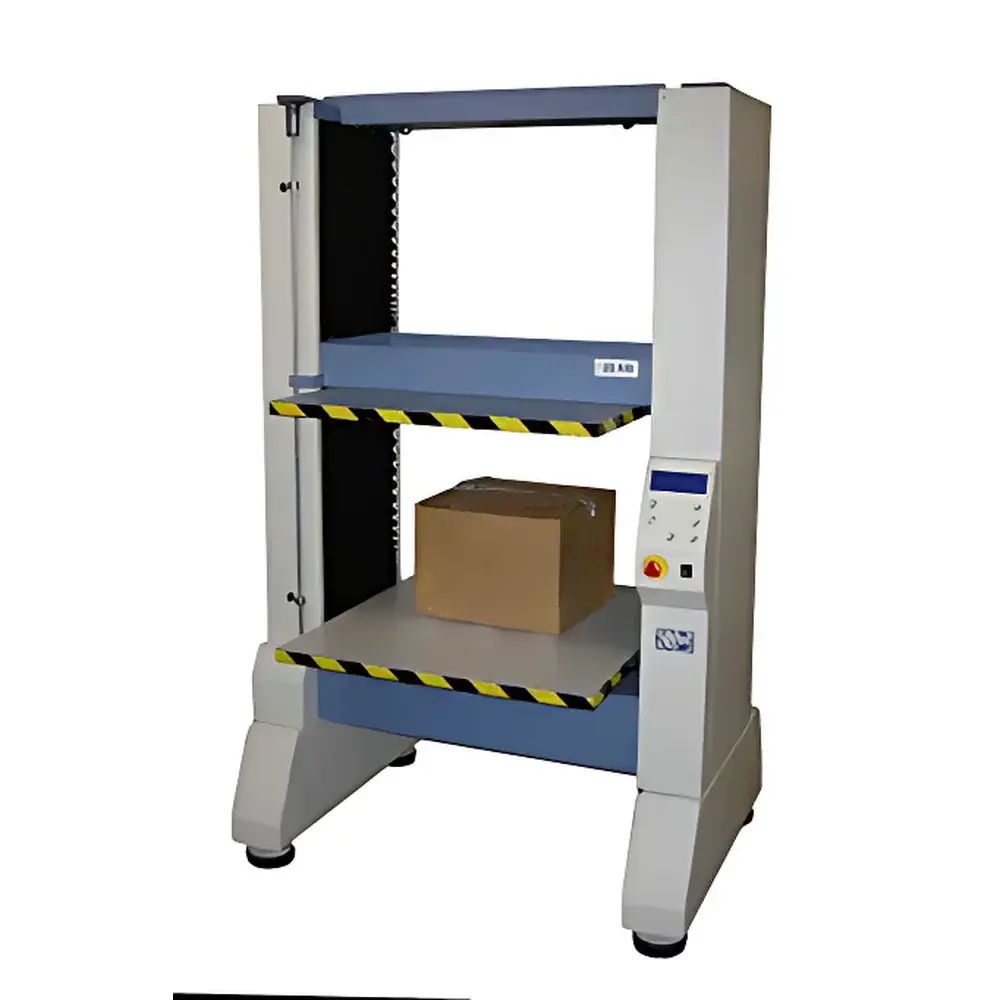
Labthink 050101 Empty Box Compression Tester
| Origin | Spain |
|---|---|
| Manufacturer Type | Authorized Distributor |
| Origin Category | Imported |
| Model | 050101 |
| Price | Upon Request |
| Max Load Capacity | 100 kN (configurable options: 10, 20, 30, 50, 100 kN) |
| Load Accuracy | ±2 N |
| Displacement Resolution | 0.01 mm |
| Crosshead Speed Range | 1–350 mm/min (adjustable) |
| Return Speed | 350 mm/min |
| Platen Dimensions | Up to 1500 × 1500 mm |
| Maximum Test Height | 1500 mm |
| Platen Parallelism | ±1 mm |
| Platen Flatness | <0.25 mm |
| Compliance Standards | DIN EN 22872, ISO 12048, TAPPI T804, UNE 57163/5, FEFCO No. 50, AFNOR H13-001 |
Overview
The Labthink 050101 Empty Box Compression Tester is a precision-engineered mechanical testing system designed specifically for evaluating the compressive strength of unfilled corrugated fiberboard containers under controlled quasi-static loading conditions. Based on the fundamental principle of uniaxial compression testing—where a defined load is applied vertically between two parallel platens—the instrument quantifies the maximum compressive force a box can withstand before structural collapse or specified deformation. This measurement directly correlates with real-world stacking performance in warehousing and logistics environments. The system adheres strictly to internationally recognized packaging standards including ISO 12048 (determination of compression resistance of boxes), DIN EN 22872 (packaging—performance requirements for transport packages), TAPPI T804 (compressive strength of shipping containers), and FEFCO No. 50 (European Federation of Corrugated Board Manufacturers specification for box compression testing). Its modular architecture enables configuration across multiple load ranges (10–100 kN) and platen sizes (up to 1500 × 1500 mm), making it suitable for both laboratory-scale R&D validation and production-line quality assurance workflows.
Key Features
- Triple high-accuracy load cells (±2 N accuracy) ensure redundancy and signal stability during dynamic compression cycles.
- Dual low-friction, precision-ground ball-bearing guided platens minimize lateral deviation and maintain alignment throughout testing.
- DC servo motor coupled with machined ball-screw drive delivers precise crosshead positioning and consistent speed control (1–350 mm/min, programmable in 0.1 mm/min increments).
- Interchangeable platen configurations: adjustable-angle upper platen compliant with ISO/FEFCO specifications and fixed-parallel platen for TAPPI T804 conformance.
- Automatic post-test platen return at 350 mm/min reduces operator intervention and improves throughput in high-volume test environments.
- Integrated safety architecture includes dual emergency stop buttons, top/bottom mechanical limit switches, auto-resetting load cell protection, and real-time fault detection with immediate system halt.
- Platen flatness <0.25 mm and parallelism maintained within ±1 mm across full travel—critical for eliminating eccentric loading artifacts per ASTM D642 and ISO 12048 calibration requirements.
Sample Compatibility & Compliance
The 050101 accommodates standard and oversized corrugated boxes, including regular slotted containers (RSC), half-slotted containers (HSC), and die-cut displays. Its configurable platen size (standard 1000 × 1000 mm; optional up to 1500 × 1500 mm) and 1500 mm maximum compression height support large-format industrial packaging used in beverage, appliance, and automotive sectors. All mechanical and software functions are validated against traceable metrological references and documented per ISO/IEC 17025 requirements. The instrument satisfies audit readiness criteria for GLP and GMP-regulated environments, supporting 21 CFR Part 11-compliant electronic records when paired with certified Labthink data acquisition software.
Software & Data Management
The embedded controller provides real-time display of load (N, kgf, lbf), displacement (mm/in), crosshead speed, loading rate, and elapsed time. Data export is supported via USB and RS-232 interfaces in CSV format for integration with LIMS or statistical process control platforms. Optional PC-based software enables full test method scripting, multi-curve overlay analysis, automatic pass/fail evaluation against user-defined thresholds, and PDF report generation with embedded metadata (operator ID, timestamp, environmental conditions, calibration certificate ID). Audit trails record all parameter changes, test executions, and calibration events—fully compliant with FDA 21 CFR Part 11 requirements for electronic signatures and data integrity.
Applications
- Validation of box design integrity under static stack load simulation.
- Correlation of compression strength with flute type, board grade, moisture content, and ambient conditioning (e.g., 23°C/50% RH per ISO 187).
- Quality control screening of incoming corrugated materials and finished boxes in packaging supplier audits.
- Supporting ISTA 3A/3B and ASTM D4169 distribution cycle validation protocols.
- Research into edge crush test (ECT)-to-compression strength conversion models.
- Tobacco industry compliance testing (per client-specified 30 kN / 1000 × 1000 mm configuration).
FAQ
Does the 050101 comply with ISO 12048 Annex A for platen parallelism verification?
Yes—the system includes a certified parallelism gauge kit and built-in diagnostic mode to verify and document platen alignment per ISO 12048:2021 Annex A requirements.
Can test methods be saved and recalled without PC connectivity?
Yes—up to 20 user-defined test profiles (including speed, load limit, dwell time, and units) are stored in non-volatile memory.
Is third-party calibration certification included with shipment?
A factory-issued ISO/IEC 17025-accredited calibration certificate covering load, displacement, and speed is provided; annual recalibration services are available through Labthink’s global network.
What environmental conditions are required for optimal operation?
Operating temperature: 10–35°C; relative humidity: ≤80% non-condensing; vibration-isolated concrete floor recommended for sub-5 N resolution stability.
How is traceability maintained for load cell calibration?
Each load cell carries a unique serial number linked to its NIST-traceable calibration certificate, with full uncertainty budget documentation supplied upon request.



