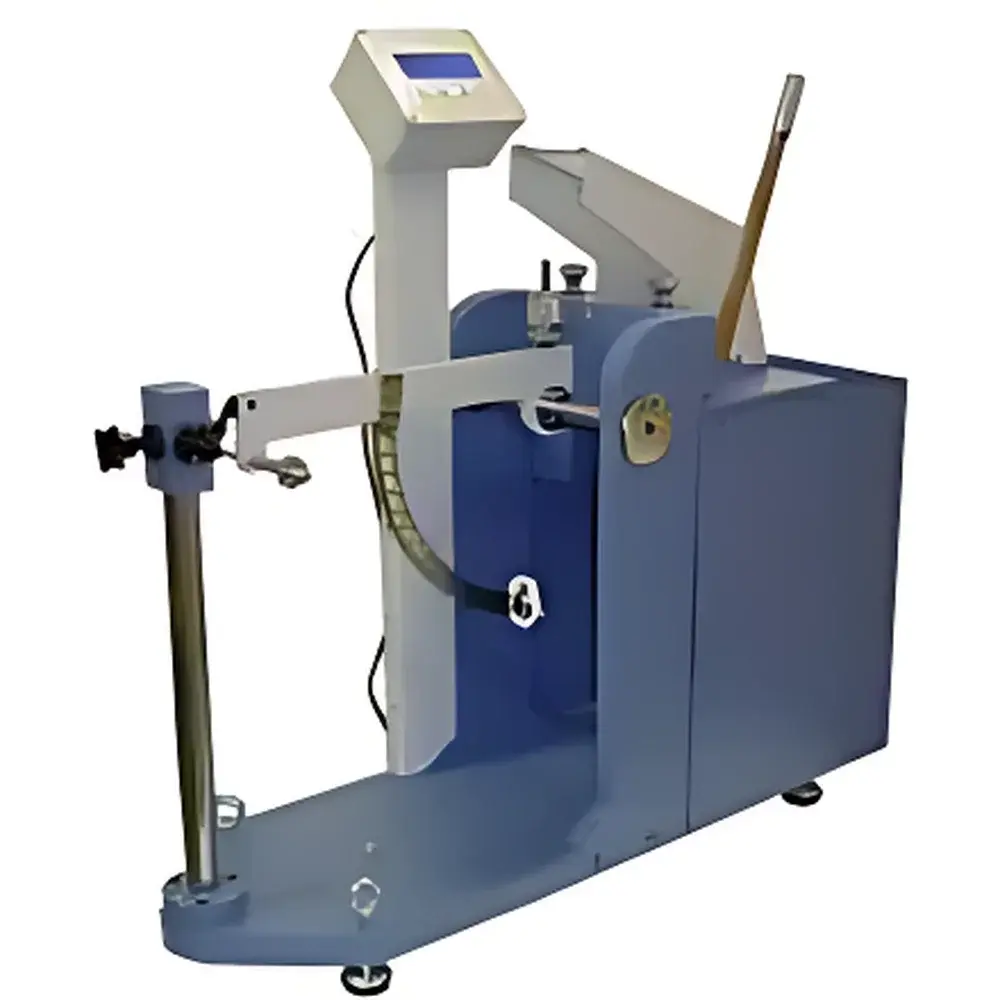
Labthink 060101 Puncture Strength Tester for Corrugated Board and Paperboard
| Origin | Spain |
|---|---|
| Manufacturer Type | Authorized Distributor |
| Origin Category | Imported Instrument |
| Model | 060101 |
| Price | Upon Request |
| Energy Range Options | 0–6 J (0.003 J resolution) |
| Pendulum Angle | 90° arc |
| Impact Tip Geometry | Triangular pyramid (ISO 3036-compliant) |
| Display Accuracy | ±0.1 J |
| Adjustable Clamp Pressure | Yes |
| Data Interface | RS-232 |
| Power Supply | 230 V, 50 Hz |
| Dimensions (W×D×H) | 860 × 365 × 620 mm |
| Weight | 250 kg |
| Software Compatibility | REGISTRA III data acquisition and statistical analysis suite |
Overview
The Labthink 060101 Puncture Strength Tester is a precision mechanical impact instrument engineered for the quantitative determination of puncture resistance in corrugated fiberboard, solid bleached board, linerboard, and other structural packaging papers. It operates on the principle of pendulum impact energy absorption: a calibrated pendulum arm—released from a fixed 90° arc—drives a standardized triangular pyramid tip into a clamped specimen. The energy absorbed during full penetration (measured as the difference between initial potential energy and residual swing energy) directly quantifies the material’s resistance to localized puncture under dynamic loading conditions. This method aligns with fundamental mechanical failure theory for orthotropic fibrous composites, where energy dissipation occurs via fiber rupture, delamination, and matrix deformation. Designed for compliance-driven packaging QA/QC laboratories, the instrument delivers repeatable, traceable results essential for validating package integrity against real-world handling hazards such as fork-lift prongs, stacking pressure points, or automated palletizer impacts.
Key Features
- Robust welded steel frame with vibration-damping base—ensures mechanical stability during high-energy impact cycles and eliminates measurement drift caused by ambient floor resonance.
- 90° precision-machined pendulum arc with four interchangeable pendulum masses (A, B, C, D), enabling seamless range selection without recalibration across 0–6 J to 0–48 J measurement spans.
- Triangular pyramid impact tip conforming to ISO 3036, SCAN P 23, TAPPI T803, and FEFCO No. 5 geometrical specifications—guarantees inter-laboratory comparability and regulatory acceptance.
- Digital display with ±0.1 J accuracy and selectable resolution (0.003–0.024 J depending on range)—provides immediate readout while supporting GLP-compliant manual data recording.
- Independent clamp actuation mechanism with continuously adjustable final clamping pressure—prevents specimen slippage and ensures consistent pre-test stress state across variable basis weights and moisture contents.
- Integrated safety interlock system with insulated housing and automatic pendulum arrest—meets EN 61000-6-2/6-4 electromagnetic compatibility and IEC 61000-4-2 electrostatic discharge requirements.
Sample Compatibility & Compliance
The 060101 accommodates standard test specimens measuring 175 mm × 175 mm (per ISO 3036), with thickness up to 12 mm. Its rigid clamping system maintains uniform edge constraint for both single-wall and triple-wall corrugated boards, as well as laminated paperboard composites. The instrument is validated for conformance with ASTM D781 (Standard Test Method for Puncture Resistance of Paper and Paperboard), ISO 3036 (Paper and Board — Determination of Puncture Resistance), TAPPI T803 (Puncture Resistance of Paper and Paperboard), SCAN P 23, DIN 53142, and FEFCO Recommendation No. 5. All calibration procedures follow ISO/IEC 17025 guidelines, and traceable calibration certificates are issued using NIST-traceable reference standards. For regulated environments, the device supports audit-ready documentation when paired with REGISTRA III software under FDA 21 CFR Part 11-compliant configuration (electronic signatures, audit trails, user access control).
Software & Data Management
When interfaced via RS-232 to the REGISTRA III analytical platform, the 060101 enables automated data capture, statistical process control (SPC), and graphical trend analysis. REGISTRA III calculates mean puncture energy, standard deviation, coefficient of variation, minimum/maximum values, and process capability indices (Cp, Cpk) per test batch. Raw data export is supported in CSV and XML formats for integration into LIMS or ERP systems. The software logs operator ID, timestamp, environmental conditions (optional hygrometer input), and instrument calibration status—fulfilling GLP/GMP documentation requirements. All data modifications are recorded in an immutable audit trail, including timestamps and user credentials.
Applications
- Validation of corrugated box performance for e-commerce shipping durability (ASTM D642 / D4169 correlation).
- Quality gate testing of recycled linerboard to assess fiber degradation impact on puncture resilience.
- R&D evaluation of starch-based barrier coatings on paperboard—quantifying trade-offs between moisture resistance and mechanical toughness.
- Supplier qualification audits requiring third-party puncture data per ISO/IEC 17025-accredited reports.
- Root cause analysis of field failures involving puncture-induced product damage in pharmaceutical secondary packaging.
FAQ
What standards does the 060101 fully comply with for regulatory submissions?
It meets the mechanical and procedural requirements of ISO 3036, ASTM D781, TAPPI T803, SCAN P 23, DIN 53142, and FEFCO No. 5—each verified through independent metrological validation.
Can the instrument be integrated into an existing LIMS environment?
Yes—via RS-232 serial output and REGISTRA III’s configurable data mapping engine, enabling direct ingestion of puncture energy values, statistics, and metadata into validated LIMS workflows.
Is operator training and calibration support available internationally?
Labthink-certified application engineers provide remote and on-site training, including ISO/IEC 17025-aligned calibration protocol execution and uncertainty budgeting documentation.
How is measurement traceability maintained across multiple instruments?
Each unit ships with a factory calibration certificate referencing NIST-traceable impact energy standards; annual recalibration services include inter-instrument reproducibility verification against master reference pendulums.
Related Products