
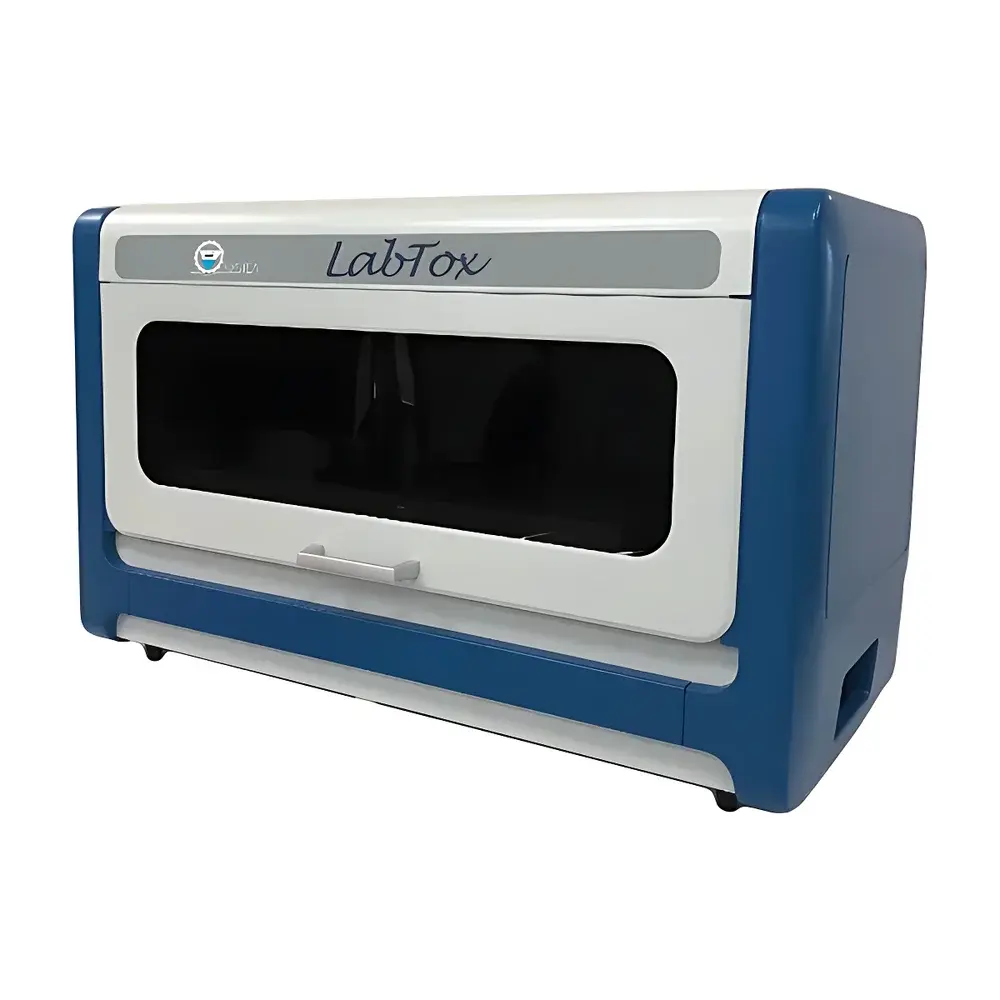
LabTox Automated Biotoxicity Analyzer by SYSTEA
| Brand | SYSTEA |
|---|---|
| Model | LabTox |
| Measurement Principle | Bioluminescent Bacterial Toxicity Assay (using *Aliivibrio fischeri*, *Photobacterium phosphoreum*, or *Vibrio qinghaiensis* Q67) |
| Compliance | ISO 11348-3, GB/T 15441 |
| Throughput | Up to 30 samples/hour |
| Sample Capacity | 80-position carousel |
| Dilution Range | Up to 160-fold automated serial dilution (EC50 mode) |
| Dual-Parallel Testing | Blank + sample replicates (inhibition mode) |
| Integrated Cleaning Station | On-board probe and cuvette washing with programmable rinse cycles |
| Software | Windows-based control & analysis suite with audit trail, user management, and data export (CSV, PDF, Excel) |
Overview
The LabTox Automated Biotoxicity Analyzer is a fully integrated, benchtop instrument engineered for standardized, high-reproducibility assessment of acute aquatic toxicity in water matrices. It operates on the internationally validated bioluminescent inhibition principle: viable luminous bacteria—selectably *Aliivibrio fischeri* (formerly *Vibrio fischeri*), *Photobacterium phosphoreum*, or *Vibrio qinghaiensis* Q67—emit stable light under optimal conditions; toxicants in the sample suppress metabolic activity, resulting in measurable reduction of luminescence intensity proportional to concentration. This quantitative response enables precise determination of EC50 (effective concentration causing 50% inhibition) and percentage inhibition relative to control. Designed for routine compliance testing and environmental risk screening, the LabTox implements the core experimental logic defined in ISO 11348-3 (Water quality — Determination of the inhibitory effect of water samples on the light emission of *Vibrio fischeri* — Part 3: Method using freeze-dried bacteria) and GB/T 15441–1995 (Water quality — Determination of acute toxicity using luminescent bacteria), ensuring methodological traceability for regulatory reporting and inter-laboratory comparability.
Key Features
- Fully automated workflow—from sample loading to final report generation—minimizing manual intervention and operator variability.
- 80-position sample carousel enables unattended overnight operation, supporting extended monitoring campaigns or batch processing of large sample sets.
- High-throughput capability: up to 30 samples per hour, achieved through synchronized pipetting, incubation, luminescence measurement, and data processing.
- Two operational modes: EC50 mode with up to 160-fold programmable serial dilution (via integrated peristaltic pump and multi-channel dilutor) for highly toxic effluents; Inhibition mode with simultaneous dual-channel measurement of blank and sample in parallel, enhancing statistical robustness and detection sensitivity.
- On-board cleaning station performs sequential washes of optical probes and reaction cuvettes using deionized water and ethanol (or other validated solvents), preventing carryover and cross-contamination between samples.
- Intuitive touchscreen interface with real-time progress visualization, live luminescence kinetics plots, and step-by-step status feedback during assay execution.
Sample Compatibility & Compliance
The LabTox accepts liquid samples across diverse water types—including raw and treated surface water, potable water, groundwater, municipal wastewater, industrial discharges (e.g., pharmaceutical, chemical, pulp & paper effluents), and marine/estuarine waters—without requiring pre-filtration in most cases. Turbid or particulate-rich samples may be centrifuged or filtered (0.45 µm) per ISO 11348-3 guidelines. All assay protocols adhere strictly to the procedural requirements of ISO 11348-3 and GB/T 15441, including bacterial reconstitution time, exposure duration (15–30 min), temperature control (15 ± 1 °C), and photometric calibration. The system supports GLP-compliant operation via configurable user roles, electronic signatures, and full audit trail logging of all critical events (sample ID assignment, dilution steps, measurement timestamps, result calculations).
Software & Data Management
The LabTox Control Suite is a Windows-based application compliant with FDA 21 CFR Part 11 requirements when configured with appropriate IT infrastructure (e.g., domain authentication, encrypted database). It provides comprehensive data handling: automatic calculation of EC50 values using logistic regression (4-parameter Hill equation), inhibition percentages with standard deviation, and confidence intervals. Raw luminescence counts, kinetic curves, dilution series tables, and QC metrics (e.g., control response stability, coefficient of variation <15%) are stored in a relational database. Reports export in multiple formats (PDF, CSV, XLSX) with embedded metadata (operator ID, instrument serial number, method version, calibration date). Audit logs record every user action, parameter change, and result modification—enabling full traceability for internal QA reviews or external regulatory audits.
Applications
- Regulatory compliance monitoring for wastewater discharge permits (e.g., EU Water Framework Directive, US EPA NPDES).
- Early-warning systems in drinking water treatment plants for accidental chemical intrusion.
- Toxicity identification evaluation (TIE) phase I screening in source water characterization.
- Ecotoxicological assessment of industrial process streams and landfill leachates.
- Validation of advanced oxidation or membrane filtration efficiency via pre-/post-treatment toxicity profiling.
- Research applications in environmental toxicology labs studying mixture effects, bioavailability, or chronic-low-dose interactions.
FAQ
Which bacterial strains are supported, and how is strain selection managed?
The LabTox accommodates *Aliivibrio fischeri*, *Photobacterium phosphoreum*, and *Vibrio qinghaiensis* Q67. Strain-specific assay parameters (reconstitution volume, incubation time, reference toxicity thresholds) are preloaded in method templates and selectable via software interface.
Can the system validate its own performance between runs?
Yes—built-in QC routines include daily verification using certified reference toxicants (e.g., 3,5-dichlorophenol), automatic calculation of Z-score against historical control means, and alerting if CV exceeds 12% across triplicate controls.
Is method validation documentation provided?
SYSTEA supplies a complete validation package including IQ/OQ protocols, linearity and precision studies per ISO 5725, and comparative data against manual microplate assays demonstrating equivalence (p > 0.05, paired t-test).







